
Song and memory

This weekend was glorious: finally, full sunshine, open windows letting in soft spring air, children biking and running until they were exhausted, and dinner at a restaurant so nearby that Matt and I could walk there through the dusky spring evening.

Saturday I spent five hours in the car scanning unfamiliar radio stations.  I’ve written before about the power that songs have in triggering memory for me; for hours, it was like spinning an old-fashioned rolodex and seeing what was written on the card that it fell open to.  In many cases the words to songs rose up out of some deep reservoir of memory: the words seemed to be carved indelibly on some scroll hidden deep in my consciousness.  I had no idea I knew the words to a song, often, until I was singing along to it.

I’ve realized that my years at camp are full of musical memories.  I wrote about how Like a Prayer will always remind me of being 16 years old and dancing down the dusty dirt aisles of the camp theater, the sheer joy of movement overtaking me.  That song will always, every single time I hear it, remind me of a special, influential friendship and of the fact that I used to love to dance.  One camp tradition that I loved was that each Sunday one unit would perform a song that they’d practiced all week.  These were themed and though I can’t be sure I’m remembering right, I think there were also poems and quotations read aloud.  One year my bunkmates and I sang Landslide, and yesterday, The Logical Song by Supertramp came on and I remembered that that was one too.  Then the Go-Gos came on, and I remembered my Assistant Counselor year, when my 11 peers and I got up during one camp assembly and sang Our Lips Are Sealed.
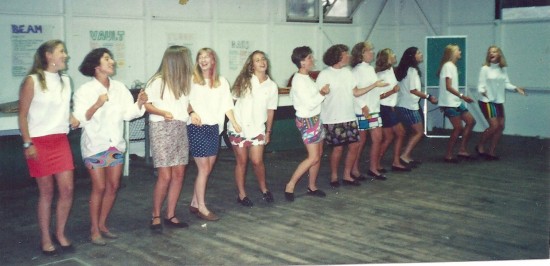
I just cannot wait for Grace to experience camp, and I hope that the place is as important to her as it was to me, magical and grounding at the same time.

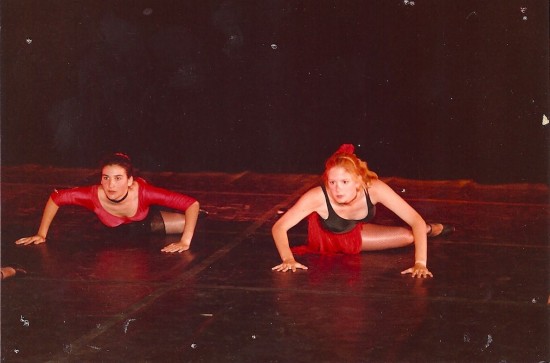
The Soup Dragons came on, singing I’m Free, and I thought about another time when dancing was important to me.  Senior year at Exeter I participated in the dance concert instead of doing a sport.  My dear friend C, a rare real, substantive friend in those years, and I did it together.  We choreographed several pieces, one of which was to I’m Free. In the annals of embarassing photographs, here’s one from another piece (for I’m Free we wore cut-offs and tie-dyed shirts, and I do not have a picture of it).
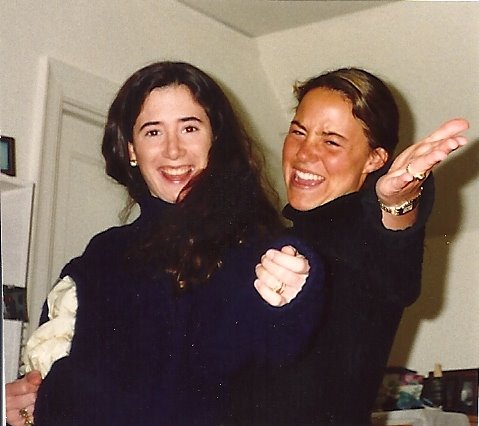
And then a couple of songs sent me back to college, specifically to my little quad in the sky.  The Freshman, by Verve Pipe, Lightning Crashes, by Live, and Whenever I Call You Friend, by Kenny Loggins, each carried specific and visceral memories.  Whenever I Call You Friend, in particular, reminds me of when I had a broken leg and my wonderful roommates took it upon themselves to dance and sing to entertain me.  In the photograph below they are serenading me, and I remember leaning over to grab my camera, and taking the picture, remember how I was laughing so hard that I could barely hold the camera straight.
And then REM’s Night Swimming brought me back to a spring evening, not altogether unlike this one in Boston, when I walked from my freshman dorm to meet a boy for a first date.  The air was thick with the smell of magnolias, the sky perfect, hydrangea blue; we were in the weeks when Princeton is at its most beguiling.  I walked through the junior and senior dorms, gothic facades on either side of me, feeling vaguely intimidated to even be in these spaces that were still foreign to me.  As I approached the room where I was going, the lead-paned windows were all open and REM’s Night Swimming wafted out into the early evening.  I felt anticipation and nerves, was somehow aware, deep in my consciousness, that I was about to step into a relationship that would be one of the most important of my early adulthood and most formative of my life.  I’ve never heard that song since that night without thinking of that walk, and that sense of promise, the tangible presence of the future right in front of me.

And then, as I neared home, poetically, Southern Cross came on.  I’ve always loved CSN(Y), and this song is one of my favorites.  I thought instantly of the summer of 1998, when Matt and I spent 6 weeks in Africa.  We had known each other only a month or two when we planned the trip; I think my parents probably thought I was coming home in a bag.  We climbed Kilimanjaro and on night before the summit ascent it was crystal clear and gorgeous (not so the night we summitted – white-out blizzard conditions).  We could see both the Southern Cross and the Big Dipper in the sky which, our guide told us in his lilting, accented voice, was very rare.  Only possible right near the Equator.  We both looked up, spellbound at the enormous sky above us, at how far we were from everything we knew.  And yet, at that moment, I’m certain we both felt at home.  “For the first time you understand … why you came this way.”  And we did.

What songs trigger important memories for you?

Trust, the middle path, and taking the next step

It is a high honor to feature an essay by Marianne Elliot of Zen and the Art of Peacekeeping today.  Marianne’s blog has long been one of my first stops on my daily internet perambulations.  She writes powerfully and beautifully about her life.  She is a human rights advocate, writer, and yoga teacher.  She created the 30 Days of Yoga course.  I’m also fascinated by what she shares of her own writing journey and practice, and I cannot wait to read her upcoming memoir, Zen Under Fire: Learning to Sit Still in Afghanistan.

When I thought about whose thinking and words I wanted to share on the topic of trust, Marianne came quickly to mind.  I’m in the second quadrant of this year, the year of TRUST, and my nascent, wobbly attempts to trust continue to be tested.  Oh, so much testing.  There are so many tremors in the ground I’m standing on.  But it’s people like Marianne who help me recommit to trusting.  I mean that.

Marianne, thank you, thank you, thank you.  For that handful of you who don’t already read Marianne’s blog, I heartily urge you to go there now and enjoy!!!


Trust, the middle path and taking the next step

Lindsey invited me to write here about trust, which is an interesting subject for me at the moment because if there has been a theme running through my life in the past few weeks it has been this: that we all experience fear and self-doubt.

Maybe that seem so obvious to you as to be redundant. Of course we all have fears and doubts. That’s what marks us as human. Right?

And yet, some days I wonder whether the most insidious effect of our own self-doubt is the way it makes us feel we are alone in our fear and feelings of inadequacy.

We believe there is actually something wrong with us, and suspect we may be the only ones who feel this way. Everyone else is out there getting on with life. We see them publishing blog posts without any fear of exposing themselves as a fool or a fraud. We watch them walk into a crowded room smiling and circulate with confidence. We hear them sooth their children with wisdom, sure of the right thing to do or say.

Yet as I talk with more and more people I hear that our inner critics say very similar things.

I talk to yoga teachers struggling with a sense of fraudulence because their own yoga practice is imperfect and inconsistent. I listen to writers whose inner critic urges them to throw their work into the fire before anyone finds out just what terrible writers they really are. And – over and over again – I hear my friends share their fears that they are failing as mothers.

So if there is something wrong with me then it appears to be ‘wrong’ with everyone else as well.

So if we are all in this together, then how are we to we deal with these mean voices? Should we make peace with our inner critic? Or go to battle and hope to vanquish it?

Let’s say I decide to go to war with the inner critic. Fight my monsters, slay my demons.

On second thoughts, let’s say I don’t. Honestly? I get tired just writing those words. I really don’t want to slay anything. Not even my self-doubt monsters.

So let’s say I address my inner critic with some kindness. She is, after all, a part of me. And most of the time she seems to be driven by fear, and by a desire – however misplaced – to protect me.

I have been known to have a gentle word with my inner critic, to tell her that I know she’s just worried that I’ll make a fool of myself and get hurt. On a good day, I’ve been able to reassure her that I’m actually going to be fine even if my writing isn’t perfect. Even if people do talk about me behind my back. I tell her that I’m safer than she realizes, and braver than she knows. And then I go ahead and do what I was planning to do anyway.

But those inner voices can be really mean. And really persistent. So I wonder whether there isn’t a risk that I end up engaged over and over again in the same conversations. And on a bad day, she’s more compelling that my wise self. Or at least she’s louder.

So I’ve been experimenting with a third way. The way of trust.

This is the path of neither befriending nor conquering my inner critic. It is the path of connecting to something bigger than me something that doesn’t exactly silence the inner critic, but renders her irrelevant. It’s a path that shifts the whole focus of the story from me to that of which I am part: the beautiful, mysterious whole of which we are all part and in which we each have our unique role to play.

It’s a path I’m urged to follow by my teacher and shero, Seane Corne who says:

“There is so much work to be done right now and the question is not ‘Who am I to do this work?’ but ‘Who am I not to do this work?’ How dare I let my self-doubts and fears get in the way of the work that needs to be done.”

Seane’s words take me by the heart every time I hear, read or say them. They feel confronting, as though I’m being called out on a bad habit. Could listening to my inner critic become a way to avoid playing my small part in humanity’s journey towards a kinder, healthier, happier and safer planet for us all?

I think it could. And although I’m certainly not going to start beating myself up for having those fears and doubts, I am exploring what it feels like to respond to them by connecting into something greater than myself.

For some of us that ‘higher power’ will be God, or the divine. For others it will be our collective – rather than individual – self, our ‘true nature’ or our essence, which is part of the essence of all things. For many, it might be as simple as connecting through our feet to the great earth below us and through our breath to the life energy that surrounds us wherever we are.

Yoga is the practice that helps me do all those things. It slowly wears away the illusion, cultivated so carefully by our culture in the West, that I am separate from anyone or anything else. It reconnects me to my essential self, to all other beings, to the earth and to the great pulsing life force that is within and all around me.

I love how Christina Baldwin talks about this:

“We are up to something as a species that is profoundly important right now. We need to attend to this. My life is part of a decision that’s going on in the human race. I know the kinds of values and contributions I want to make in that decision. And that’s where I have to stand. So, when I get dragged down, I just say to myself ‘What are you born to be doing at this time?’ And then I get regrounded and that voice just shuts off because I’m not in the same room with it.”

This is the path I am walking in the face of my inevitable fears and self-doubts. I can find the courage to do things that I seem inadequate for because I know that the work is bigger than me and because I know that I’m not doing it alone.

This is what trust looks like to me right now: I am not the whole story. I am only a very small part of the story. And I need only do the work that I was born to be doing right now – with integrity, with compassion, with courage.

Karen Maezen Miller once said: Faith is taking the next step.

Today I trust that it is enough for me to simply keep taking the next step.

Monday morning

A few things that were on my mind this weekend …

1. Carol Edgarian’s Three Stages of Amazement may be my favorite novel I’ve read in years.  It is a beautiful, pitch-perfect story about adulthood and marriage and in exploring the complexities and challenges of both it shows that trying hard and wanting  something badly doesn’t keep people from messing up.  Edgarian’s characters stagger under the weight of their commitment and responsibility and yearn for the freedom and desire of earlier days but ultimately they tiptoe into a tentative but redemptive  embrace of their flawed, rich lives.

2. Laura Munson, whose book This is Not the Story You Think It Is: A Season of Unlikely Happiness touched many people, is reading in Cambridge on Wednesday April 13th at 7pm.  I’m so looking forward to meeting Laura and hope many others will be there.

3. My friend Hilary Levey Friedman told me about a piece of art she has ordered for her new house.  First we laughed about how there is very little wall space for art, given how many books we both have.  I remembered the Anna Quindlen quote that she “would be most content if my children grew up to be the kind of people who think interior decorating consists mostly of building bookshelves.”  Then Hilary told me about a wreath she is having made out of book pages.  I adore, worship, and covet this idea and can’t wait to see it.

4. Finally, I have a professional page on Facebook.  I’d be honored if you would click over and check it out.  Asking this makes me more nervous than almost anything else.  Thank you to the lovely Social Butterfly Solutions for her help!

You are arriving

As someone for whom journeys, the great sky, the ashes after a fire, and leaving and arriving are all tropes with great meaning, I adore this poem.

The Journey

Above the mountains
the Geese turn into
the light again
Painting their
black silhouettes
on an open sky.
Sometimes everything
has to be
inscribed across
the heavens
so you can find
the one line
already written
inside you.
Sometimes it takes
a great sky
to find that
small, bright
and indescribable
wedge of freedom
in your own heart.
Sometimes with
the bones of the black
sticks left when the fire
has gone out
someone has written
something new
in the ashes
of your life.
You are not leaving
You are arriving.

-David Whyte

Wild horses

I’ve written before about my beloved teacher James Valhouli, the first person who really made me believe I had something to say.  Sitting at my desk here, I look right at a photograph of Mr. Valhouli.  He was without a doubt the most important teacher I’ve ever had, and I still think about him every single day.  I’ve also written about Andre Dubus, a writer who meant a great deal to Mr. Valhouli and whose eulogy at my teacher’s funeral left an indelible impression on me.

So it was with enormous anticipation that I went this week to hear Andre Dubus III read from his new memoir, Townie.  I’ve heard terrific things about the work, most materially from my writing group friend, idol, and general can-always-be-trusted-in-matters-of-books friend, Katherine.  Andre Dubus III blew me away.  He is charismatic, funny, and brilliant, peppering his Haverhill accent and salt-of-the-earth personality with from-memory quotations from the likes of Richard Russo and Flannery O’Connor.  I cannot wait to read his story.  When he signed my copy, I shared my vivid memory of his father.  It turns out Andre was at the funeral himself, and Mr. Valhouli appears in Townie; this single slender detail was enough to fill me with both kinship and nostalgia.

I headed home steeped in these memories, thinking of how Exeter’s importance to me grows in parallel to my distance from the years I spent there.  As I get older I appreciate more and more the enormous impact the place had on me.  It’s the place in the world where I was most baldly lonely, and it has also been the most influential in setting the course of my adult live.  The awakening that took place inside me around Mr. Valhouli’s Harkness table, in his classroom with Cavafy’s Ithaka hanging on the wall, was the essential one.

What’s fascinating to me is that this intellectual birth occurred in a place where I had so few important relationships.  In fact, it’s become a bit of a tomb in my memory, a mausoleum of the mind, a place whose defining characteristic is the fact that I was lonely there.  But the fact is this isn’t right.  I fell in love with a boy for the first time at Exeter (well, I thought so at the time. time offers perspective.  regardless, it was my first “real” relationship.).  There are very, very few people in my life I’ve ever felt this way about.  He then broke my heart.  It’s not a coincidence that my senior year, hurting and sad and wondering if I’d ever recover from my stunned sense of betrayal, I threw myself into my English class with the great teacher called Mr. Valhouli.  The universe took care of me, filling every single empty and broken space in me with language and literature, with conversation over hot tea in Mr. Valhouli’s family’s home, with his small, cramped writing in the margins of my papers, with his lively black eyes, somehow fiercely animated and profoundly compassionate at the same time when he looked at me.

And as I drove home, the Rolling Stones’ Wild Horses came on the radio.  Exeter was already pulsing through my veins and a memory overtook me so vividly it took my breath away.  I focus so much in my memory on the life of the mind that has come to define my two years at Exeter that I rarely remember the awakening of the heart that took place there too.  I was going home to London for Christmas vacation, desperately anxious to say goodbye to my first boyfriend for what felt like the eternity of two weeks.  We sat in the dining hall, watching the minutes tick towards the time my bus left for Logan, and I felt tears well up in my chest.  I begged him to write me a note telling me he loved me, so that I could carry it with me while we were apart.  He was unenthusiastic about this idea, which, though it now seems understandable, upset me at the time.

As we bickered about this, he doodled on a corner of his notebook.  He was an artist who loved to draw and cartoon, and this was characteristic.  I didn’t even look at what he was drawing.  Hours later, on the airplane headed to London, I found a folded piece of notebook paper in my bag.  I don’t know when he slipped it there.  In his handwriting that I’d recognize even now, he’d written, wild horses couldn’t drag me away.

I remember feeling touched though a bit dismayed that he could not say Those Big Words.  Thinking back on that gesture, however, it seems like one of the most romantic I’ve ever received.  Dubus said something in his comments about how memoirists ought to play with the facts of their life, about how memoir is not autobiography.  And I agree.  When I think back on the arc of my life, Exeter was about Mr. Valhouli, about Andre Dubus, about the power of both language and pedagogy, about the impact someone who really believes in you can have on your entire life.  But tonight I’m also remembering the parts of the story that I haven’t told much, to others or to myself, those details about the pencil on looseleaf paper and the wild horses.