
This Life is in Your Hands

It is impossible to read Melissa Coleman’s beautiful memoir, This Life is in Your Hands, without thinking of Eden.  In fact, knowing as we do from the beginning the tragedy on which the narrative hinges, the story is specifically haunted by thoughts of Paradise Lost.  Coleman addresses these echoes head on in an episode about halfway through the book when she hears visitors to her family’s farm talking:

“It’s paradise here,” I once overheard a woman say to her friend.
“The very nature of paradise,” the friend replied, “is that it will be lost.”

And it is, indeed lost, in spectacular fashion.  This memoir is about how hard we can strive for something we believe in and still fall short.  It is about realizing that even dedication and hard work can’t protect us from pain.  It is about how people grow and change and how small silences in a relationship can grow deafeningly loud.  It is, ultimately, about the redemptive power of memory and about how, no matter what, the seasons turn ceaselessly forward.

Before paradise is lost, though, Coleman gorgeous draws it.  She describes in lush terms her early childhood on the homestead that her pioneering, strong-willed father establishes with her sensitive, singing mother’s help.  Young, innocent, and full of wonder, Eliot and Sue set up their lives on a piece of wild land that they purchase from their “back-to-nature” idols Scott and Helen Nearing.  From the very beginning, it is clear that they live close to the land and near to the edge: Eliot rushes to complete the bare-bones house they live in in time for their first baby, Melissa, to arrive.

Coleman’s father is the beating heart of the book.  He is a man of superhuman energy and single-minded drive.  In his pursuit of his dream of a more organic, natural way of life he becomes a kind of celebrity, eventually attracting a legion of fans who are drawn to his clear charisma.  Before long the Coleman farm is a place that young hippies go to on pilgrimage; once there, they strip off their clothes and pick carrots in the nude, swimming at dusk at the ocean and dancing with fireflies after the sun goes down.  It is, for several seasons, an idyllic place.

Coleman beautifully conjures the alternation between the fertile, sun-drenched, almost-frantic summers full of visitors and a raw, sexual energy and the cold, long winters, hibernating under feet of snow.  The family of three, and then four, traverses this progression together, a small unit closely knit by their alternative lifestyle that demanded intimacy both physical, in their small house, and emotional, in their commitment to a baldly difficult way of life.  Eventually the relationship between Coleman’s parents begins to fray, though, dissolved over time by a number of small factors that, “…like raindrops on stone, can eventually change the course of a river.  These small forces, too, can change the path of a life.”

The early years are about the hard work and deep satisfactions that come from a life drawn from the very earth most of us merely walk on without another thought.  Coleman describes the endless litany of chores, from hauling manure to digging ditches to painstaking bread-making and it is hard to not feel exhausted.  Yet the closeness of Eliot and Sue and their abiding faith that theirs is a true heaven on earth radiates from every page.  Even in her most glorious descriptions of her family’s life at its pinnacle of happiness, Coleman gently presages what is to come.  She says of her mother, “she wanted this moment to last forever, but deep down knew its impermanence was what made it so beautiful.”

It might be because we know her fate, but Heidi, Coleman’s younger sister, seems half wood-sprite, only half-human.  Her character floats through the story as though trailing clouds from the spirit world.  She senses weather before it arrives and hears the voices of an imaginary, spirit friend, Telonferdie, in the rustling of the leaves on trees.  In one beautiful scene Coleman illustrates a classic evening on the farm and her sister’s otherwordly spirit,

The glass bell of night settled over the farm … I read in the light as Heidi dangled her feet on the doorstep, looking out for Papa to return from the campground to tuck us in, the cool spring air breathing through the door … I knew the cricking came from the inflated sacs on the throats of the frogs, but it was hard to undersatnd how the slimy shapes we caught at the pond with our bare hands could make such a piercing sound.  Their concert filled the night with a noise so distinct it had a three-dimensional presence, solid with longing.  The noise shapes came right up to Heidi’s feet, praying to her like their goddess.

Then the dark cloud of terrible news descends, Heidi drowns in the pond on the farm, and the family unravels quickly.  The speed with which their paradise dissolves makes clear that there were deep cracks in eden already, but clearly the trauma of Heidi’s death sets a new narrative in motion.  Coleman renders her mother’s decline with compassion and kindness, though its impact on the girl she was was painful and profound.  We see Coleman trying to keep everything okay, worry about her mother weaving a scary thread through every single day.  In one scene, as Coleman’s mother drives both of her daughters (Coleman and baby Clara), her inability to cope crescendoes to near disaster.  Coleman, sits in the backseat, overcome with fear for herself, her sister, and her mother: “Don’t lose your grip, Mama, I whispered out the window.  Hold on, hold on, or we will crash.”

Before long Coleman longs for her father, realizing “his certainty was the one thing I could trust.”  She is relieved when she and Clara go to live with him.  Coleman, in an epilogue, tells of how both she and her mother fought losing battles against their own private guilt about Heidi’s death.  As an adult, Coleman realized that her understanding of Heidi’s death, in which she played a pivotal role, was wrong.  She has thus been released from her guilt.  And over time, her mother, too, has made peace with the tragedy in her young mothering years.  Coleman describes her, living contentedly with her second husband, in my hometown, quilting, “trying perhaps – like me – to unite the pieces of the past into a pattern that makes sense of things.”

It is a remarkable peace, actually, that suffuses the end of This Life is in Your Hands.  I read the last few pages with tears streaming down my cheeks, feeling incredibly empathetic towards all the characters, flawed and well-meaning humans who are  desperate to believe in a benevolent universe.  Coleman has accepted her history, with all of its stunning pain and unique beauty, but has refused to accept the destiny that might have come out of its central tragedy.  This, I think, is the enduring message of This Life is in Your Hands.  It is a story about self-determination and about the fact that we can, through hard work and committed belief, continue to shape the contours of our own lives.  We must not give up, surrender to what might be the easy road, whether that’s in how we till the land or how we define ourselves.

The lines of our hands, and of our lives, are not predetermined and final, but can change as we do.  We are, in fact, already creating what we will become.

(Full disclosure: Harper Collins sent me a review copy of This Life is in Your Hands)
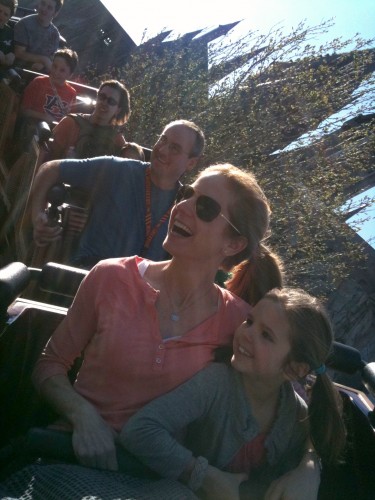
my Gracie girl

This was one of the most special days of my life.  One of our days at Disney, Grace and I snuck away to go to the Wizarding World of Harry Potter.  We were both spellbound.  I have never been somewhere more crowded – honestly.  Harry Potter made walking through the Magic Kingdom seem like an amble on a deserted beach.  But still…. still.  It was absolutely magical.  We walked around Hogsmeade, bought a wand, drank Butter Beer, explored Hogwarts castle, and rode twice on the Flight of the Hippogriffs (above, photo taken from car in front of us).  I don’t like roller coasters and neither do either of my children (coincidence?  perhaps not) but this was a nice, not-scary ride that we went on twice.

In this photo I see sheer joy radiating from Grace.  And from me.  We were both enchanted by the world of Harry Potter brought to life, but I know that part of the happiness was sharing it with each other, and only each other.

I’m extra aware, lately, of how short the time grows in which Grace will always, without question, choose my company.  She wants to be with me all the time.  This past weekend, after a Friday sleepover she was tired and weepy on Saturday evening.    When Matt and I left she clung to me, crying, asking me not to go.  To assuage her, she asked me to list how many nights in a row I’ll be putting her to bed starting on Sunday night.  These moments can be intensely frustrating for me, but I try to remember that soon enough I will miss them.  I’ll be nostalgic for the time – now – when I am a balm for all of her troubles. For the time – now – when a kiss genuinely helps a bruised knee and an extra cuddle truly does chase away bad dreams.

Sunday morning Grace and I sat in her room and played with her American Girl dolls.  From across the room, she said, out of the blue, “Mummy?  Did you know that if you don’t use your imagination you lose it?”  I was startled and then agreed with her, thanking my own mother and instinct and whatever other influences have contributed to my distinctly under-programmed, free range parenting style.

Then we walked down to the stores a few blocks from us, doing errands, and she happily bounced down the street with her hand in mine.  I don’t know how much longer this will last, but I know it’s not that long.  In the afternoon, at the park, she kept calling my name, wanting to be sure I watched her do the monkey bars or launch herself into a full flip above the swings, holding the chains.  Sometimes it feels like Grace needs me witness something for it to be real.  She’s got a wicked, uncanny sense for when my attention wavers, too, and always, always calls me on it.  Often with tears.  This, too, can be daunting: I try to focus on her as much as I can, but sometimes I do falter.   Watching her react, I always feel a wash of emotion, guilt mixed with aggravation.

And then, just as quickly, the reminders come flooding in.  This will pass.  These days are numbered.  It won’t be long til she doesn’t want my attention at all, and I’ll want to go back and relive every single park afternoon when Grace’s voice, calling my name, echoed in the early spring air.

As I write this I hear two things in my head: Grace and Whit’s giggles, from next door, and these lines from Ben Folds:

Life flies by in seconds
You’re not a baby Gracie, you’re my friend
You’ll be a lady soon but until then….

One day you’re gonna want to go
I hope we taught you everything you need to know
Gracie girl

And there will always be a part of me
Nobody else is ever gonna see but you and me
My little girl
My Gracie girl

Seuss and Doty

Sometimes I can be dense.  Sometimes the universe needs to scream at me to get me to hear something.

I wrote a while ago about the Annie Dillard line that I believe says it all: What you see is what you get.

And I practice that, at least most of the time.  Last night, walking with Grace and Whit in the very-early-spring evening, Grace stopped short in front of a dense bush that was still mostly sticks and twigs, no leaves.  She looked, hushed, into it.  I stood next to her and followed her gaze.  She whispered, “Look!” and all three of us witnessed a flock of small, dun-colored sparrows deep inside the bush.  I have no idea how she noticed them, but I’m glad she did.

I guess I had flagged in my paying attention, though, because I was forcefully reminded of the need to do so this week.

This weekend I read Mark Doty’s beautiful short meditation on creativity, art, and life, Still Life With Oysters and Lemon.  The book itself is an exercise in looking closely, an exaltation of the wonders that can result.  It evinces, simply, “A faith that if we look and look we will be surprised and we will be rewarded.”

And then last night I read Whit the book that Grace took out of the library for him (one of her new and more endearing habits).  It is a Dr Seuss book that’s new to both of us, I Can Read With My Eyes Shut.  And Seuss’s voice joins with Doty’s, in a different kind of poetry, “If you keep your eyes open, oh the stuff you will learn!  The most wonderful stuff!  …you’ll miss the best things if you keep your eyes shut.”

Okay, universe.  I’m paying attention.  Eyes wide open here.  What I see is what I get.

this most amazing day

We are on the cusp of spring.  Yet it is going to snow tomorrow.  Work is good.  But it is so busy.  I’m not writing enough.  But I’m finally reading more.  I have some new, sudden question marks hanging around the edges of my awareness.  The weight of my domestic tasks – summer camp health forms, new battery for the car, deposit checks, pack lunches, laundry, write birthday cards – seems to grow and grow.  The childrens’ new Crocs for summer have arrived and they are alarming, heartbreakingly large.  My desk holds a vase of cheerful yellow daffodils, an always-blinking blackberry, and the shell that Whit painted for me for Valentine’s Day.

I went for a run this evening, which was hard, because I am tired, and because my Achilles tendon hurts.  The iron sky spat cold rain/sleet on my face.  I ran down familiar streets, past my parents’ house, along the river I love so well.  And I came home to the smell of Grace and Whit’s dinner, to their animated noise, deep love and endless demands wound together in their pressing, urgent way.

I came upstairs and sat at my desk, looking out the window at the tree I love so much.  All of a sudden its branches are swollen with buds.  The buds are full, reddish, the branches slightly drooped from their new weight of fecundity.  Did this happen overnight?

Moved by a power I cannot name I knelt by the window, my elbows on the windowsill, my hands clasped.  This has happened to me before and I felt the same sensation, of something greater than me filling the room.  It was connected, somehow, to the reminder of the turning seasons outside my window, and it gave me both an overwhelming feeling of comfort and an intense need to express my gratitude.  My head rested against the cold pane of the glass.  I thank you god for this most amazing day ran through my head, over and over again.

Thank you, thank you, thank you.  Thank you for all of the immense blessings that my life holds.  Thank you for my legs which can still run, for the health and energy of my children, for the steadiness of my husband, for the well-being of my parents and sister, for our financial stability, for this house, which is small and humble but also safe and warm.  For my friends and for poetry and for the food in the fridge and for every single thing I have.  My GOD, I have been so ungrateful, so often.  Thank you.

My breath fogged up the glass and I knelt, still, murmuring more thanks.  I’ve felt so cold lately, and I began to shiver, so I stood up.  And I picked up my blackberry and walked downstairs into the warmth of the kitchen, the chaos of the children, the noise of my life.

I thank you god for this most amazing day (ee cummings)

The big transitions and the little ones

This is a time of transition.  I can feel us moving to another phase, another season, in every sense of the word.  I am aware of that deep in my body and my spirit.  I dislike change with every fiber of my being, and I wish I was able to let go more.  I’m really more of a holder-onner.  Still, I continue to remind myself that this is futile effort, and that my white knuckle grip on every day is only serving to exhaust me.  I wear a reminder over my heart.

We are shedding skins around here.  Spring is slowly creeping around the edges of our hours, and with every day it seems more inevitable, though I think there is snow forecast for this weekend.  It’s still raw and chilly, though, and we all shiver like the brand-new, slender crocuses.  Grace and Whit are re-adjusting, slowly, to the school routine after two weeks off; I’m waking them out of sound sleep in the mornings, yet finding them unwilling to go to sleep at night.  There have been some reminders in my life of how near the precipice is, always, and of how we tread, every single day, on the line between divinity and disaster.

And then I read these beautiful words by Rebecca at Altared Spaces, about the ultimate parenting transition.  I read this post on Tuesday and by halfway through I was literally sobbing – not just the standard tears-rolling-down-my-cheeks that happens every day, but full-on gasping for air, actively crying.  The line that gouged itself into me was this one: “I came here to let her go.”  I couldn’t stop thinking about it.  Isn’t this, ultimately, the story of what we all came here to do, as parents?  Aren’t we letting to every single day?

Even knowing that, I’m chilled and stunned by the idea that someday – perhaps as soon as 7 or 8 years from now, if she goes to boarding school – I will hug and kiss Grace and watch her walk away.  I remember hugging my mother on the grass lawn in front of a dorm in New Hampshire in September 1990.  That was an particularly draconian farewell: she drove to Logan and got on an airplane to London.  Talk about far away.  I didn’t know until years later that she cried in the car driving away.  I went up to my little teeny closet of a room and sobbed my heart out.  I was scared and lonely and excited, and on the edge of something big.

There are certainly major, notable goodbyes and transitions in parenting, the ones that we all anticipate: kindergarten, high school, college, weddings.  But there are also tiny little goodbyes every single day.  Parenting is a constant farewell.  It’s replete with joyful hellos, too, of course, but it’s undeniable that every day holds an ending.  Every night before I go to bed I carry Whit to the bathroom, his blond head heavy on my shoulder.  Every single night I wonder if this is the last time.  I haven’t read Good Night Moon since I wondered if I ever would again.  The truth of that chokes me up, sits like a stone in the heart of me, a core of loss I simply can’t ignore.  Every day, infinitessimally but inexorably, they move further away from me.

I commented on Rebecca’s blog, letting her know how much her words touched me.  And she emailed me back and said this:

You are so passionate in the way you love your children. Sometimes I think you taste letting them go regularly. You live WIDE awake. At times that overwhelms you.

And I read her words, crying fresh tears, thinking: yes, yes, yes.  The big goodbyes will submerge me in emotion, fear and grief and pride all mixed together, of that I am sure.  But the little ones are in many ways harder for me, since they are so slippery, so difficult to note.  And I do taste them regularly.  I hope she’s right about living wide open; truthfully, I often doubt that.

And now, off to another bedtime.  More pages of Harry Potter, another turn at the Ghostie Dance, the Sweet Dreams Head Rub, and a full-body hug before bed.  Another night when my attention, my kiss, my hug can fix any problem at all.  How many more nights will it be my privilege to do, and be, this?  I don’t know, and that not knowing haunts me.  But tonight, it is.  I try to focus on that.