Did the shadow of what was coming cast its darkness over the light of a moment?

Reading A Double Life reminded me vividly the weeks and months after Grace’s birth, which were the darkest of my life.  As she recounts it in her memoir, Lisa Catherine Harper’s depression seems considered, thoughtful.  I plunged back into my own, remembering how inelegant my complete and utter collapse was, how inchoate the roaring of desperation in my ears.  I had no idea what was happening to me, but I knew firmly that I’d made the biggest and most permanent mistake of my life.

For years I’ve wondered if I could have somehow known what was coming.  As I’ve mentioned, I think the seeds of my depression were sown in my surprise pregnancy, and in how out of control I felt of the endeavor from the absolute beginning (fair question: is there ever a way to feel in control of such a fundamentally uncontrollable enterprise?).  There are two places I go to look for clues, wondering if with the wisdom of perspective I can see the shadow of what was coming casting its darkness over the light of a moment?

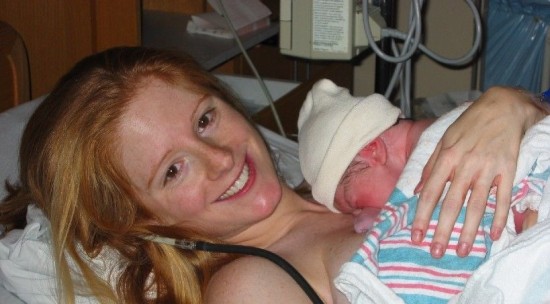
One is in my photographs.  It’s no secret that I take pictures of everything.  These photos do not become a silent, untouched mausoleum on my hard drive.  No, they are a living, breathing record: I return to the photos over and over, revisiting experiences, remembering moments.  I’ve done that a lot with the pictures of the days surrounding Grace’s arrival.  I can see a certain tentativeness in myself, but other than that I don’t think I see any concrete evidence of what hovered ahead of me.  I’ve looked at the pictures of her first weeks on earth an awful lot too, and those make me mostly sad.  I see a shell-shocked woman, overcome with a numbness so complete I don’t remember very much from that time.  I realize how that that numbness was sheer survival instinct – I was so deeply wounded that I think experiencing the raw feelings all at once would have swamped me utterly.  The picture above, moments after I delivered Grace with my own two hands, is the last one where I think I look like myself until many months later.

The other place I can pick up crumbs that show me the path I was on at a given time is my quote book.  In the specific quotes that moved me enough to hand-write them into my books I can decode something of where I was emotionally at a specific time.  In these books I see more clues than I do in the photographs, a deeper, subconscious anticipation of what lay ahead.  One week to the day before Grace’s birth I entered the James Baldwin quote that has come to be so incredibly important to me: “Trust life and it will teach you, in joy and sorrow, all you need to know.”

Two days before her birth, I added these lines from William James: “I am done with great things and great plans, great institutions and great successes.  I am for those tiny, invisible, loving human forces that work from individual to individual, creeping through the crannies of the world like so many rootlets…”  It’s as though I knew I was moving to a world whose focus was small acts, deep individual love, and a power beyond sight.

And then, three days after Grace was born, the day after we brought her home from the hospital (incidentally, those photographs terrify me – my eyes are both blank and blazing, full of what I recognize now as abject terror), I wrote this: “One word frees us of all the weight and pain in life … and that word is love.” (Sophocles).

It took me many, many long months to learn what I can see now so brightly in these specific quotations and in their chronology.  I’m grateful that I now understand how the path unfolded, though I remain bruised by the experience of walking it.  In some strange way being able to revisit the woman I was then, through words and photographs, allows me to extend compassion to her, to attempt to heal in some out-of-time way the wounds I still carry from those days.

Do you have places – written, photographic, filmed, or otherwise – that you can return to, looking for a record of who you were at a specific moment in your life?  Places where you can see threads of your life glinting through, even when you weren’t aware of them at the time?

There are many ways to hide from your life

I’ve been thinking an awful lot about achievement, and the Race to Nowhere, and the ways we hide from our lives.  Specifically, I’ve been thinking about how complicated it gets when the ways you hide from your life are applauded by the world.  For me this has mostly been true: whether it’s running or studying with a fierce concentration or following the tide of popular sentiment down a path that might have been the wrong one.

This is a kind of hiding in plain sight, right?  None of your behaviors speak of anything being wrong.  In fact, they are celebrated.  For me, the pinnacle of this was at Exeter.  I’ve been very frank that my two years at Exeter were difficult for me.  I think late adolescence is an emotional and awkward time for most people, and some extenuating circumstances made mine especially challenging.  My parents were across an ocean (and in this pre-cell day, we spoke once a week on the payphone in the basement of my dorm).  My heart was broken at the very beginning of senior year when the first relationship of my life exploded in front of me (and in a hurtful, and public, way, no less).

What did I do?  I ran and I studied.  That is it.  I ran for an hour every single day, mostly in the woods out behind the gymnasium (across the bridge that appears in A Separate Peace), but when it was really freezing I’d run laps around the track suspended above the cage.    My senior year GPA was 10.8 (out of Exeter’s characteristically-unusual GPA scale of 11).  I read and I wrote and I studied and I went to bed every single night well before 10.  I didn’t have many close friends.  I didn’t have another boyfriend.  I didn’t ever break any rules, didn’t experiment with drinking or smoking, as so many boarding school denizens do.

It was a fraught time.  I was a liminal creature (Peggy Orenstein ascended even further in my pantheon of favorites when she used this, one of my favorite words, in Cinderella Ate My Daughter).  I was moving from girlhood to adulthood, and I was doing it mostly all by myself.  In this dark time, one I remember as still and ever-moving at the same time, I had one firm guide: James Valhouli, my English teacher, the first person to believe I had something of value to say.

But all of my coping mechanisms, things that I understand now were ways of avoiding actually engaging with my life, looked like success from the outside.  I was profoundly unhappy, but I don’t think anyone who didn’t know me well could tell.  I don’t know what the conclusion of this is, necessarily, but I do know that it points to a truth I’ve often referred to here: outsides and insides are not always congruent, and we ought to be slower to judge others based on the external indicators they display.  It also reminds me that there are many, many ways to hide from our lives, to numb ourselves to the things that hurt, and we would be well-served to approach all others with compassion.  They, too, are likely grappling with demons, even if we cannot see the struggle.

A Double Life

I suspected I was going to enjoy A Double Life: Discovering Motherhood by Lisa Catherine Harper.  I didn’t, however, imagine that I’d devour it almost in one sitting.  I adored Harper’s book: it is full of careful, scientific details that were new to me, it is written in eloquent, beautiful prose, and more than once it made me gasp with identification.  The terrain of Harper’s memoir – pregnancy, birth, the first months of motherhood – is familiar, but the honest and funny voice in which she tells it, and the nuanced observations with which it is filled, are unique.

The first half of A Double Life is concerned with conception and pregnancy.  Ella, Harper’s daughter, is conceived on 9/11, and Harper describes how that fall there “seemed to be darkness everywhere.” There are fascinating details about the development of a baby from zygote to blastoscyst to fetus, the physiology of pregnancy, and about Harper’s own family history.

The book began to really gather power for me when Harper talks about the first time she felt her baby move inside her.  She hints at what is to come when she says,

But something infinitely more primal and more immediate had happened on the couch, and its aftermath was not unlike the seconds after a small earthquake, when everything you know about the world is cast into doubt, when your own terra firma crumbles beneath you and you are certain only of uncertainty.

A Double Life reaches the crescendo of its impact as it addresses the profound, irrevocable change that motherhood represents.  As Harper describes it – and I agree with this characterization – it is a complete and utter dissolution and then rebuilding of identity.  This begins with a harrowing description of labor, as close to the real experience as I’ve ever read.  I felt like I was back in the room where I had my daughter, during my third hour of transition, begging my midwife to put a bullet in my head and just cut my daughter out (that really happened), when I read this:

In the middle of that pain, at pain’s deep center, it was dark.  In that dark there were no others and there was no language.  It was silent and it was deafening, it was still and it was cyclonic.

Still and deafening, still and cyclonic: I’ve never read labor more viscerally evoked.  At the end of her long and arduous labor, Harper delivers her daughter, Ella.  When they return home she and Ella sink into that otherworld known as the fourth trimester, where the standard demarcations of day and night crumble and life as it has been known fades away entirely.  Harper loves these days, even while acknowledging their stultifying exhaustion.  “The intense passions that I had sought most of my young life seemed shallow in comparison to the deep tides of contentment that pulled at me now,” she writes, and for a period of time she and Ella exist in a world where all they need is each other.  It is a calm and joyful time, a “steady stream of wonder.”

After about nine months, however, Harper’s sense of herself as a mother in the world begins to feel more complicated. At one point, noticing that Ella’s eyes follow her around the room, she “began to understand ‘mother,’ its permanence fixed to me like a shadow” and we intuit that Harper is growing aware of the permanence and immutability of the role.

In the last few chapters of A Double Life Harper grapples with her most complex and ambivalent feelings about motherhood and in so doing begins to face essential questions of personhood.  The nearness – twinned-ness, in fact – of life and death, a theme that surfaces during her pregnancy, recurs in these final chapters.  For Harper, giving birth – giving life – occasioned a reckoning with death.  This awareness also shapes her experience of her young daughter’s life: “Motherhood made me familiar with this mortal creep of time.”  This is of course intensely familiar to me.  In fact it made me consider that my own preoccupation with being present and aware and my profound sadness about time’s passage likely have their roots in my being a mother.  I don’t think these are new wounds for me, but they are certainly rawer now that I watch my own children grow.

It was a sort of miracle to be able to hold these two moments – of life, of death – in mind at once; to be acutely conscious of both the present and of the presence and nearness of loss; to hold in my arms the evidence of life and death, for that is what my daughter was: an inspired, poetic fact.  She gave me an accidental genius, and if it filled me with night terrors, it also filled me with song.

At the end of A Double Life, Harper seems to move into a period of heightened sensitivity, into a porousness that I recognize intimately.  She describes a moment in church as “A pause in my life and something strange possessed me … Something had visited me.  It came, imparted, and was gone. .. I was not so changed so much as infused.”  This reminded me of a moment in my early 20s in the crypt at Assissi, a memory I return to again and again because it was a harbinger of what was to come later in my life.  I’ve had other moments – few, but indelible – like this in my life, too. They remind of the presence of something greater, a design vaster than I can understand, and, as Harper says, infuse me with the current of humanity itself.

In her memoir’s second to last chapter, Harper confronts the twisted world of the mommy wars, and suggests that the essential problem is not, essentially, whether a woman works outside of the home but the fact that the world at large has utterly devalued the work of motherhood and the experience of life inside the home.  She realizes that conversation at her baby group sometimes feels like “a storm of all that nothing,” but simultaneously finds herself deeply interested in the details of domestic life.  Ultimately Harper comes to a conclusion that I identify with strongly:

I felt I belonged in neither world: much of my energy was invested in raising Ella so I couldn’t fully claim my professional identity, but neither could I identify with what seemed to me to be the petty concerns of motherhood.  I loved my daughter and I loved my home.  I did not love the stay-at-home culture of mothering.

I guess this shouldn’t surprise me, given that Lisa and I connected when she read my essay in the Princeton Alumni Weekly called “A Foot in Two Worlds.”  Harper vows to “move between my worlds of teaching, writing, and mothering, and I tried hard to see how each inflected the other,” which reminded of Anne Tyler’s comment that “since I’ve had children I’ve grown richer and deeper.  They may have slowed down my writing for a while, but when I did write, I had more of a self to speak from.”  Perhaps instead of interpreting my life as fractured, and bemoaning the losses in that, I ought to celebrate the ways in which I am a kaleidoscope (one of those recurring tropes in my writing).  Each of the various slices of who I am, of which I inhabit in every single day, can, and should, inform – indeed, enrich – the other.

A Double Life doesn’t reach a single firm conclusion on the work/home tension.  Instead, Harper proposes that mothers ought to feel more united than opposed, and that we should drop the false bifurcation of “working” and “staying at home” identities.  Harper asserts that “what bound us together was the fact that we found our children interesting, that we were inspired by them, that we had allowed our lives to be changed by them.”  I may have initially fought this change with everything I had, but I’ve certainly allowed it now.  The new reality of who I am as a mother – not that new anymore, in fact – floods every cell of my being on a regular basis, bathing me in wonder and gratitude as much as in impatience and sharp sadness at the speed with which it all passes.

The very last scene of A Double Life takes place, tellingly, as Harper sits working at her desk.  Her daughter crawls up to her and commands her attention; there, sitting at her desk, her baby at her feet, we see the disparate strands of identification and person come together in a single compelling image.  Harper reminds us of where she begins her memoir, with researched, scientific awe at conception and pregnancy, and then touches on the various highs and lows we have experienced with her over 232 pages.  And, with the moving honesty and elegant prose that fills A Double Life, Harper concludes:

Out of nothing she had become something, and I had become something more.  If the crushing love that I felt for her made me newly and forever fearful of mortality, and if, on some days, it made me tired and irritable and beside myself with despair and fury, there was something else, too, something with wings rising now like hope, or gratitude, or grace.

Love within a family

There’s no vocabulary for love within a family

Love that’s lived in, but not looked at
Love within the light of which all else is seen,
The love within which all other love finds speech,
This love is silent.

-T.S. Eliot

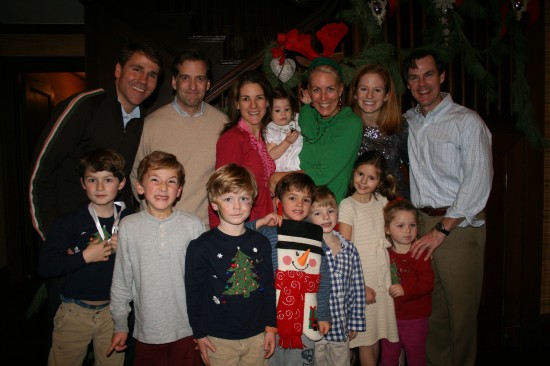
I’m in New Hampshire (on the Lost island, I joke, for the complete lack of cell service for miles and miles around) with my extended family.  Eight children, six adults, skiing, white wine, casseroles, sledding, and lots and lots of laughter.  These women are my anchor and my wings; their lives throb alongside mine with a reassuring regularity and their families are interwoven with mine.  They are the other two legs of the stool and for that I will be eternally grateful.

Back tomorrow.

Full

I am thrilled to share writing from Christine from Coffees & Commutes here today. I absolutely adore Christine’s blog and every single time I read it I find myself nodding with identification.  More often than not I find myself crying.  Christine has written candidly about her struggle with depression and about her ongoing efforts to sink into the life she has with her two sons and husband.  She is currently exploring meditation and her writing about the impact that it is having on her is honest and compelling.  I’m looking forward to spending more time with Christine, but in the meantime her blog is one of my must-reads and I suggest you put it on your list too.  Please enjoy this beautiful post called FULL, and then visit Coffees & Commutes to read more of Christine’s lyrical, powerful writing.

FULL

Of love for my children and the countless ways they bless my life.

Of joy for a happy marriage and the partnership that I share with my husband.

Of satisfaction with my professional life and a career that continues to be meaningful and challenging.

Of friends to connect with and share laughs and tears.

Of pleasure for the creativity that flourishes in my life through words, and pictures and pretty paper crafts.

Of desire and curiosity to read and explore and enrich my soul with the wealth of words written by others..  ,,

Of wonder and excitement over my burgeoning desire and trust to freely ask the big questions.

Of urgency to focus on my physical and emotional health; to keep me strong and moving forward.

Of need for more time, energy and acceptance so that all of these things don’t overflow and drown me.

Thank you Lindsey, for welcoming my words. It’s truly a pleasure and an honor to share this space with you.