
Ambivalence and regret roll into my heart like thunder

I had a professional conversation yesterday morning that triggered a landslide of self-doubt. I realized anew, sitting in a conference room as snow drifted down outside, how little I feel I have accomplished in the 10 years since I graduated from business school. I have very clearly chosen a path of a foot in both worlds (“career” and “home,” both in quotations because I think these definitions are simplistic) and as a result I have a home in neither. In being unwilling to give up active participation in either world, did I just end up doing a poor job at both?

What does it mean to have a foot in both worlds? I think it can be wonderful and it can be tormented, depending on the person and the situation. I’m just not sure which it is for me. I’ve always straddled the gulf of the mommy wars, always worked part-time, always spent part of my week in office buildings and part in the sandbox. I have adamantly insisted on keeping a “foot in the door” professionally because I was sure I’d want to “ramp back up” someday. All of these phrases seem foreign on my tongue now, like a language I used to speak but have lost.

I made an active decision to scale back my professional aspirations and involvement in order to have more flexibility to be home with Grace and Whit. And yet I have such an ache about having missed the babyhood of my children. It’s easy to blame that on the fact that I was at work some of the time, but when I’m really honest I don’t think that is the reason at all. I think it’s about my wiring, my frantic restlessness, the way I struggle to be fully engaged in one thing at a time. Still, I wonder if I had chosen to be home full-time I would feel better about my childrens’ infancies, if I would feel I had caught more of the swollen moments of feeling that are what it’s all about.

And yet I also feel frustrated by what feels like wasted years, spent only partially engaged in jobs which, in retrospect, did not mean very much to me. In order to keep the flexibility I prize so highly (to allow, among other things, time for writing) I have had to take jobs that are often peripheral and not core to a company’s function. This has eroded both my sense of real contribution and my feeling part of a cohesive team. What was the point of having missed hours with my faintly baby-powdered scented babies, for something that feels so insubstantial and inconsequential now?

Of course, the dirty truth is that I didn’t really want to be there every single second. I hate admitting that, because now I wish so devoutly that I had every single one of those seconds back. But, still. I know I needed the perspective of time away. I guess I just wish that I felt better about what I had accomplished in the hours I was away. I wish I didn’t feel like a fraud who is hiding the fact that she doesn’t know anything real.

There are two things that people tell me all the time about the way I have navigated the complicated territory of work/home. One is that I am lucky to have flexible, part-time work. This infuriates me because while I am deeply, firmly aware of my tremendous good fortune, I think calling my professional situation lucky trivializes the amount of work and forethought that went into it. And then, of course, my gerbil brain goes off on the wheel of: oh my God, I spent all of that time planning … this??? Anyway. The second is how well I’ve figured out how to have both. And when people tell me that, I always smile and nod and express my satisfaction with my situation. But I haven’t figured anything out, and those comments always make ambivalence and regret roll into my heart like thunder. They remind me of all of the anxieties and misgivings I have about the trade-offs and choices I have made.

Aidan at Ivy League Insecurities wrote a couple of weeks ago about how she frets that she has wasted her education. I relate to this, though my reasons are slightly different. I worry that I am letting down my parents, for their enormous financial and emotional investment in my education. I worry that I am failing the special teachers who took a particular interest in me, made me believe I was not stupid, helped open my mind. And I don’t feel that I am letting those people down because of my specific choices but because of who I am: that I am not more curious, ambitious, intelligent.

Days like today I feel that I’m the epitome of that trite and critical saying, “a mile wide and an inch deep.” I feel as though I’ve skimmed the surface of many worlds but not had the courage to really pick one and immerse myself in it. On other days I think that, as I wrote at Kelly’s blog, Cleavage, I am simply more kaleidoscope than laser. On those days, when I am feeling kinder towards myself, I think a life splintered into myriad pieces just fits me. I think that I could never commit to one place because I never found one that felt like home. I don’t know. I just know that today ten years of frantic effort has left me with a handful of dust and a heart full of questions.
Lift

Today, Lift arrived. I pulled it out of its Amazon cardboard eagerly, turning the slender volume over in my hands. As soon as I had wrestled my children to bed (Whit, despite having been up last night throwing up, despite complaining of being exhausted all day, still went to sleep with the calm and peace of a motorized robot without an off switch). And then I opened the book. And I read it, falling into Kelly’s world for 45 minutes, emerging blinking as though I’d come out of a soothing room with a friend into a bright and cacophonous city street. Lift is a lovely letter to her daughters, Claire and Georgia, a book whose slightness belies the weight of its message.

Kelly’s voice is the same as in The Middle Place: both humorous and serious, somehow light while talking about the heaviest of subjects. She writes clearly, without extravagance or fanfare but with memorable imagery (hair that looked burnt on the ends, razory screams). The book is, ultimately, a meditation on that topic closest to my heart: the way that every moment of life, and motherhood in particular, is shot through with the awareness of the transience of time. Early on she cites a favorite Rilke quote that captures this gorgeously:

“the knowledge of the impermanence of that haunts our days is their very fragrance.”

Sigh. Yes. Kelly uses three stories to talk about the way that risk and loss are woven inextricably through the very fabric of parenthood. She talks about the scare of her second daughter’s infant meningitis, the death in a car accident of her favorite cousin’s teenage son, and her best friend’s decision, at 40, to pursue single motherhood. These narratives, while different, are all animated by the human longing to commit deeply to parenthood in spite of the fact that danger hovers around every corner. They all circle around the same central, unavoidable truth: even knowing how much pain we will cause ourselves, we feel powerfully compelled to take this risk. We can’t help ourselves.

The book’s title and central metaphor is taken from a story Kelly tells about hang gliding. Talking to a friend’s husband about his passion for hang gliding, she asks “what keeps you up?” The friend goes on to explain that the glider is kept aloft by going from “thermal to thermal,” which entails going straight into the turbulence. Kelly expresses confusion, and her assumption that a tiny human being hanging in the sky would want to avoid turbulence. No, says her friend, “Turbulence is the only way to get altitude, to get lift. Without turbulence, the sky is just a big blue hole. Without turbulence you sink.”

And we do, don’t we? We dive into the turbulence. We hurl ourselves into the heart of life, into being parents, despite all of the logical and rational reasons we know we ought to take care. Kelly’s stories illustrate the risks of this. But the rewards, of course, are commensurately (or more) enormous. It’s glitteringly clear that Kelly’s daughters are the most important people in her life. “Mothering you is the first thing of consequence that I have ever done,” she says, and then, later, tells them simply, “You are sacred to me.” Her fierce devotion to her girls, despite her self-confessed weaknesses and propensity to “detonate,” comes through in every line of this book.

My favorite passage in the book is towards the end, as Kelly talks about her dear friend Meg’s decision to pursue pregnancy and motherhood by herself. She muses: “I want her to have this thing I have that’s so ordinary and tedious and aggravating, and then, so divine.” Kelly’s slim letter to her daughters, 82 pages, manages to touch on the grand themes of life: forgiveness, acceptance, risk, faith, passionate adoration. She very humanly describes her own mistakes and with humor she paints a familiar picture of a woman recommitting, over and over again, to being a better, more present, more patient mother. Hers is a profoundly human voice, in awe of the task of mothering even as she acknowledges its immense challenges. Lift‘s words, which speak of both my heart’s tenderest fears and of its profoundest truths, will continue to echo with me for a long time.

The bright freight of memory

I was reading a newly-discovered blog yesterday called Catching Days.  Cynthia Newberry Martin was writing about Devotion, a book I also adored.  She cites specifically Dani Shapiro’s passage on memory, which was one of my favorites as well.  I was grateful for this prompt to return to the elegant pages of the memoir, and I thought about memory all day.

There are two passages that strike me from Devotion‘s section 54.  The first, Cynthia also quotes:

Why do we remember the particular things we do?  Great pain certainly carves its own neurological paths.  But why random, ordinary moments?

I have written before about how some of the memories I recall most vividly are of “random, ordinary” moments, whose eventual power I would never have known as I was living them.  I am fascinated by this particular alchemy: why is it that we recall what we do?  Certainly my mind has power to shape our memory in ways beyond my conscious awareness: this is at work, I think, in the way my brain seems to airbrush over certain incredibly difficult times, smoothing the specific contours of grief and pain into a uniform, though unmistakably sad memory.  The years at Exeter, for example, are for me a blur of snow, cold, running, and my tiny dorm room.  Very few specific memories endure.  The same is true of the months after Grace’s birth, as I grappled with my post-partum depression.

This makes me think of the oft-quoted line from Ann Beattie’s gorgeous short story, Snow: “people forget years and remember moments.”  As curious to me as why certain moments become eternal, sturdy parts of our memory is how rarely we can know as we live our lives which specific experiences will be elevated to this pantheon.  Which moments endure?  Why?  What message is our spirit sending to us in the patchwork of our lives that it preserves with glowing, brilliant detail?

I randomly remembered an essay I’d written during freshman year on To The Lighthouse (why this memory?  why today?) which addressed something similar.  I opened it up tonight and, amidst an odd encounter with my 18 year old self, found this line:

“Mrs. Ramsay illustrates what most human lives are like – a long thread of day-to-day banality and an occasional, vivid gemstone of insight or memory.  It is these memories, these moments, that make life interesting and valid; we live from one of these special times and experiences to another; while the stuff of life may be the mundane, it is the rare moments for which we truly live.”

How is it that we can’t recognize the gemstones as we live them?  Certainly there are hours, days, months of our lives that feel more alive than others.  Some periods of my life feel like going hand over hand through a swarm of gray days, clinging to the few moments of emotion or meaning that rise through the fog.  Other periods are like standing under a waterfall of feeling, unable to take it all in, pounded with emotion and sentiment, so awake and receptive I feel either pain or a gradual, defensive numbness.  Still, we can’t know which will be the memories that really endure, that lodge in our minds and stay with us for the duration.

The second passage about memory from Devotion comes at the end of section 54:

I had experienced my own memory as a living thing, a palpable presence in my body.  I had felt my past unfurl inside me as if it had a mind of its own.

I was actually thinking about something like this before I reread the section and found these lines; again, Dani puts into exquisite words the bumbling and humble thoughts of my heart.  I was thinking about some of the most cherished memories, the ones whose remembered details stud them like the jewels that cover a Faberge egg, who glitter most brightly in my mind.  Some of these take on an odd power, functioning almost like a lens through which I see my life.  Retrospectively, yes: the memory of that time in my life is refracted through that specific, salient moment.

But also, perhaps more oddly, this works prospectively.  There are certain moments who seem to have, in retrospect, informed the shape of the rest of my life.  I can’t know if this happened in real time or in retrospect.  I remember sitting at the foot of my bed, holding 5-day-old Grace, dripping tears onto her newborn head and answering earnestly the question of “what are you looking forward to?” with “when she goes to college.”   This has taken on such power as a defining moment of that time in my life, and of my motherhood in general.  But did that happen then, or only as I remember it and the (admittedly blurry) months around it?  I don’t know.  I have the phrase “freight of memory” in my mind, but in truth this is more like memory pushing something formative in front of it, rather than pulling it behind it.

In this way our past unfurls inside of us, cohabiting our present.  The past and the present echo inside of us, both creating the music of now and anticipating that of tomorrow.  We cannot understand the mystery of memory; my goal is merely to accept the messages it offers.  To honor the things my soul seems to hold dear, as represented by which memories bob up out of the morass to be the ones I recall with blinding brightness.  To remain open to the ordinary moments, as I can never know which will become those to which I return again and again, rubbing them like a touchstone in my pocket.  It strikes me that this trick of our mind is, perhaps, just another way of acknowledging the grandeur and beauty of the most mundane moments in our lives.

A sibling weekend

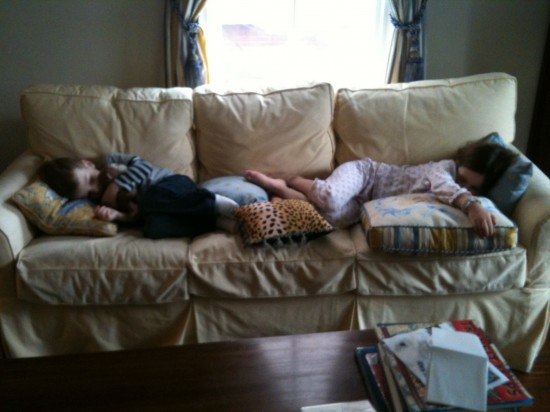
Saturday morning. For some reason, despite 12 solid hours of sleep, these guys were wiped out. They eased into their day on the living room couch.

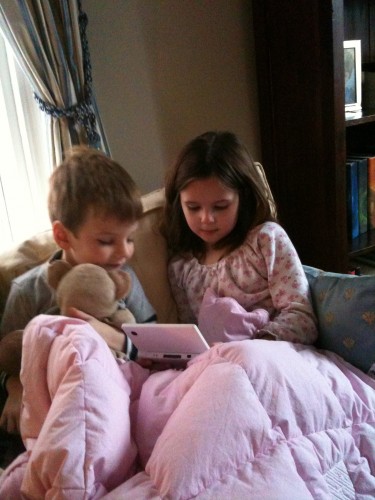
Finally they worked up enough energy to sit up. Whit watched Grace playing on her DSI. He was enraptured. She was sufficiently softened up by his avid worship that she even let him play a few games. Trust me, this is definitely not the norm. Methinks Whit is figuring out how to manipulate his sister just like he plays the rest of us. It’s only taken him this long with her because she’s just a little sharper than the rest of the family.
Later in the day, Grace and Whit were playing in her room and I did not know what they were doing. I heard Whit exclaim, “let’s do the shoulder opener, Grace!” and I had to see. I opened the door to see them in a partner yoga pose of surprising complexity. Scattered all over the floor was a deck of cards for kids with hand-drawn yoga poses on one side and an activity to save the earth on the other (Grace’s “big sister” gift on Whit’s birthday). I was blown away at how long they had been entertaining themselves doing this. Then Grace held up a card that showed one person in a handstand, leaning against the other person, standing in tadasana. “Let’s do this one, Whitty! You do the handstand,” she suggested, surprising me not at all with her selection of who would play which part in the pose. I decided this was a good point to stop and pointed out that hand stands were best attempted with parental supervision.

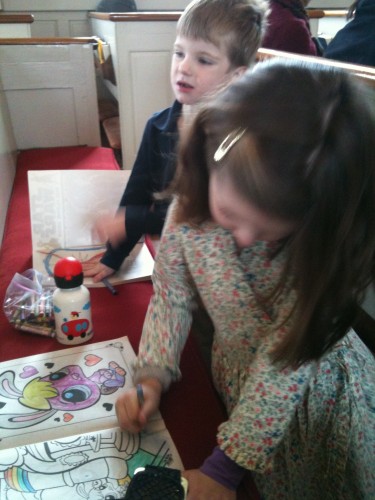
On Sunday morning, Grace and Whit accompanied me to church (after we took Matt to the airport). What’s more holy than taking pictures with my iPhone before the service starts? They colored and ate their booty (pirate for him, veggie for her) and then they actually sat and listened for a bit. Whit looked carefully through the hymnal and the book of common prayer and was disappointed by the lack of illustrations. They enthusiastically participated in the peace, shaking hands and repeating loudly, “Peace be with you!” to our neighbors. Later on as the rector said the prayers over the bread and the wine, Grace, who was reading the BCP with me, said “The Lord be with you,” in unison with the rest of the congregation. Whit said (not in a whisper), “No, Grace, peace be with you.” This child, hilarious as he is, is becoming a liability in my short-lived church career.

They both joined me for communion, and Grace for some reason reversed her firm stance on No (red) Wine to take a sip from the chalice. She spluttered dramatically as we walked back to our pew, eliciting several giggles from other people in the church.

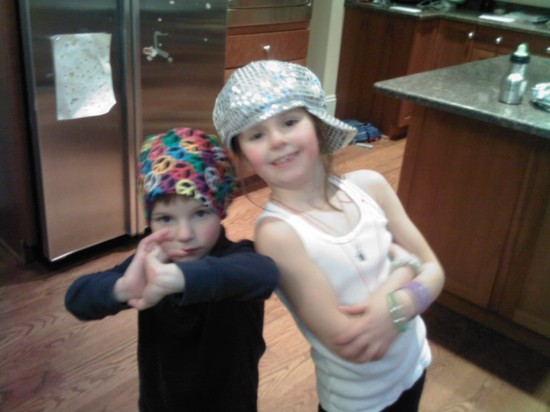
Grace went to a birthday party in the afternoon and Whit curled up with Star Wars and I curled up with bills to pay and thank you notes to write. Relaxation and fun all around! The party Grace went to was hip-hop themed, so she came home with this hat and a bunch of new moves which she promptly taught Whit.
They even went to sleep in good moods with each other. This has to be a record, and just as I think “my baby slept through the night!” is just asking for five nights of screaming child, I am likely jinxing it now. But it was lovely.

Watching Grace and Whit in a patch of sunshine, behaving benevolently towards each other made me think about my decision to have a second child. It’s no secret that my introduction to motherhood was difficult. The honest truth is I felt no impulse whatsoever to have another baby. Zero. In fact, truthfully, I felt dread and fear. But I also knew, intensely, that I wanted Grace to have a sibling. I feel guilty about this memory, because I worry it might make Whit doubt how fervently he is loved. Despite all of my anxiety, from the moment he arrived he brought laughter and joy in his wake, and he gave me the blissful newborn experience I so desperately wanted to have. And I haven’t for a single moment, ever, wished he was not here. I really do believe that a sibling is a gift. I have one, my older-and-wiser younger sister, and I can’t imagine my life – or myself! – without her. Seeing Grace and Whit this weekend made me think of the interwoven lifetimes that lie ahead for each them, the particular terroir they are growing in, and the tremendously good friend I hope they will always be to each other.

And I tried to pause over the weekend, to watch them, thinking: we won’t come back here.

The receiving end of judgment and assumptions

Two posts yesterday twined together into a solid cord that ran through my thoughts for much of the day. Gale at Ten Dollar Thoughts wrote about the relationship between insecurity and judgment, and about her own (very human) propensity for both. The Kitchen Witch shared a guest post by Naptime Writing which, though ultimately focused on a different (and moving) message, started making a point about the perils of snap judgments, both by and of ourselves.

I’ve written often about the distinction between how people appear and how they truly are, and about the frustrating futility of ever truly understanding the heart of another. I’m awestruck by the mystery of other humans, even those I love most passionately. This inscrutability makes me both feel both wonder and agony, makes me gasp in amazement even as I scratch my fingernails against the person’s facade, trying to get in.

One passage from last fall’s post reminds me in particular of what Gale wrote yesterday:

It amazes me to hear this. I, who feels and is many, many things, but pretty much never either hard or self-assured. I, who mostly feels shy and awkward in social settings but is sometimes told she is a bitch. I, whose personality is defined in large part by a deep seam of insecurity that sometimes manifests as judgment. I was going to ask how it is that vulnerability can come across as such a formidable wall, but I realized that question is dumb: of course in 35 years we build up calluses over our sore spots, build barricades over the holes that have tripped us up over and over again.

I did not dwell yesterday on the ways that I jump to conclusions about others when I ought not, though I do do that much more than I should. Instead, what I mulled is why it is that I seem to have consistently, throughout my life, been someone that others form swift and not-always-lovely opinions of. I sometimes feel as though I’m nothing more than a blank screen that others project onto. Project their issues, their assumptions, their biases. This is, it occurs to me, the curious flipside of one of my true strengths (which is really a weakness, of course): being what others want me to be. I am hyper sensitive to what other people want from me, always keenly aware of what other people are feeling, thinking, reacting to. It’s as though this skill has permeated my personality such that I’ve blanked my actual self out in order to better give people what they want.

I’ve taken endless grief for being such a pleaser and for caring so much what others think. And, to be sure, much of this beating up has come at my own hand. But when I peel back that criticism, and think really deeply about why I am that way, I wonder if in fact it’s just that I prefer to present to others what it is I sense they want because I’m afraid that if I was just me they would not like what they see. This seems so stunningly obvious when I write it that I’m ashamed to say it’s taken me years to realize it.

Somehow the ability to sense what others want from/of me combines with my own deep insecurity about myself to make me an effective screen on which people can play out their instant judgments about who I am. There are so many ways I’ve been misunderstood and misconstrued it’s impossible to list them here. Sometimes this can be really powerful and toxic, to the point where I lose sight of what I know to be true about me. I wonder if this is why I take pictures of my shadow so much: am I trying to prove that I’m still there?  Or is it because my shadow, in its abstraction, is a symbol of being without detail, a mere form for others to color in the details as they see them