Present Tense with Dani Shapiro

I think anyone who’s been reading this blog knows how profoundly touched I was by Devotion, Dani Shapiro’s memoir that came out this winter. I was very privileged to meet Dani at a couple of her readings this winter; she is everything in person that you’d imagine from her graceful, honest memoir, and more. Devotion has stayed with me months after I finished it, its lines presenting themselves fully-formed in my head, its lessons growing ever more compelling and wise, its elegant language prompting me always to try to write more carefully, more lucidly. Dani also has two fantastic blogs, both of which I now eagerly follow.

One reason I identified so strongly with Dani from the start is because she is clearly interested in the central issue that preoccupies me now: presence. In both her memoir her blogs she wrestles with questions of how to be more engaged in her life, less distracted, better able to live within the shadow of time’s relentless passage. These are all questions I struggle mightily with, daily, and I have already learned so much from Dani’s writing about them.

You can imagine how elated I was when Dani agreed to participate in Present Tense! There aren’t really superlatives strong enough to describe how my I admire Dani, so I’ll just say she’s both a role model and an unwitting teacher. Thank you.

1. When have you felt most present? Are there specific memories that stand out for you?

When I think of when I’ve been most present, I think of silence. Of moments of quiet–when I have been with the people I most love, my son, my husband–not necessarily doing anything, but rather, being. I often feel very present, for instance, when tucking my son in for the night, sitting on the edge of his bed in the darkness. Or with my husband, when we have time together to just be, rather than the constant racing that takes up too much of our lives.
Travel, too, pushes me very much into the present. There’s no greater reminder to “be here, now” then the realization of how fleeting the moment is. My family and I take a trip each year to Positano, Italy (my husband and I direct a writers’ conference there) and when I wake up in our darkened room that first morning, then open the shuttered doors that lead to the patio and the view of the sea, the fleetingness of our time there, the way it marks the years passing each March, the place unchanged, us all a year older… there is something so beautiful, so bittersweet about that awareness that I feel pierced by it.

2. Do you have rituals or patterns that you use to remind you to Be Here Now?

Without a doubt, my yoga and mediation practices are my two greatest reminders. They are also, for me, inextricably linked. I don’t know how to meditate without first spending an hour practicing the physical, asana part of yoga. I wish I were able to just plunk myself down and meditate — but I find that I need the preparation of yoga, my body spent, wrung out, before I have any hopes of sitting for any length of time. Of course this means that I need, like, ninety minutes to do it all — which I don’t have every day. But the days I unroll my mat are far better days than those when I don’t get around to it.
3. Do you have specific places or people that you associate with being particularly present? Who? Where? Any idea why?
I completely relate to what you’re saying here, and I’m also still working out why that is — why some people seem to command my full attention more than others. I am most alive, and most myself, and most present, when I’m engaged in genuine conversation. Intimate, real dialogue. Cocktail party chatter, social banter — these make me flee somewhere deep inside myself, I guess because I feel both bored and uncomfortable. I’d much rather talk about something real — and when I do, my attention does not feel split, and I am fully present.
4. Has having children changed how you think about the effort to be present?

Yes, yes, yes! Since the birth of my son, Jacob (he’s now eleven) I have such a strong feeling of wanting to get it “right” — aware of my failings, wanting to do better, be better. Wanting not to miss a single moment, which is, of course, impossible — but desperate not to look back some day and realize that I was racing from one thing to the next and missing the magnificence of his childhood, and of early motherhood. I heard another mother recently say that she realized that the time in the car — you know, that time when you’re often racing just to get from one thing to the next, late, irritated, attention fragmented — that time actually is the thing. The time in the car. Thinking of the time in the car as sacred has really helped me. I look forward to it now. It’s often where we get our best talking done.
5. And just cause I’m curious, what books and songs do you love?

Oh, where to begin! Books — well, I keep Virginia Woolf’s A Writer’s Diary on my desk at all times, which should tell you something about how I feel about Woolf, generally. I read a lot of my friends and peers — Martha McPhee has a wonderful new novel called Dear Money coming out pretty soon. Jennifer GIlmore just brought out Something Red, which is also terrific, and Jennifer Egan’s A Visit from the Goon Squad is a tour du force. I go back often to Annie Dillard’s work. And for spiritual writing, I read anything by Sylvia Boorstein or Jack Kornfield, again and again. Each re-reading bears new fruit.
********
There is so much in these answers I relate to, Dani. The time in the car, that is the thing. That is motherhood. That is our life. That resonates so powerfully with me, and I too am so often rushing through it. I remember months ago my son went through a phase where he demanded that I buckle him into his carseat, despite very clearly being able to do it himself. For some reason I had the patience, in that phase, to step back and say: pretty soon he’ll never want me to do this again. Let me enjoy the intimacy of those rote movements, of that buckle, buckle, snap. And that – seeing this mundane reality of every day life as, as you say, sacred – helped me hugely.
Your description of accessing a meditative state only through physical exertion is also keenly familiar. I remember this from when I first stumbled into a yoga practice more than 10 years ago. Somehow the exhaustion of the body paves the way for quiet in the brain; I don’t understand the alchemy, but I recognize it as you talk about it.
Similarly, I totally know what you mean about feeling very present as you sit and tuck him into bed. I know that feeling well; sometimes there’s an awareness of the meaning of the moment as I do that, specifically around bedtime, and I feel cracklingly alive, aware of the seconds as they pass, full with my stroking his hair back from his forehead and kissing his cheeks, smelling his just-tubbed smell. Also, when I read with Grace before bed. It is so routine, so regular, but also I know that in the blink of an eye it will be over. And that’s the essence of all of this: how to live in the moment even as we realize it is already dying to us. This is almost unbearably painful, for me at least, when I stop and think about it. Awakening to that has been the task of the last few years for me, the path that I am clearly walking.
Dani, thank you again for holding a light on this path for me and for so many others. Your example, your honest inquiry and willingness to “live inside the questions” makes me feel less alone and less afraid. Thank you.

YES!

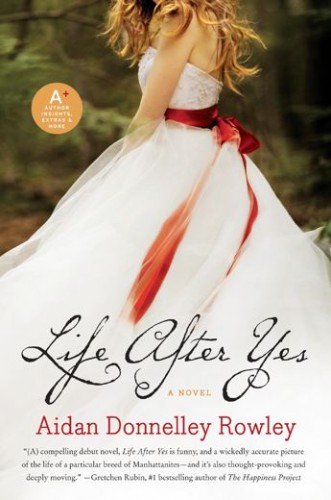
The time has come … (I keep hearing, in my head, “the walrus said, to talk of many things…”) But the time has come. It’s here. Life After Yes debuts today and I whole-heartedly encourage you to order it. It’s been such a pleasure and an honor to live this process a little bit, vicariously, through Aidan. I read snippets of the book as she revised it, listening to Coldplay, at Starbucks. I saw the cover before it was final. And, finally, last week I got to hold it in my hands. And read it. And revel in it.
Life After Yes is, first and foremost, an absolute pleasure to read. I gulped it down in two sittings. Aidan’s characters are human and likeable, despite their real and visible flaws. The dialog is real, the descriptions of New York vivid, the particular moment in life recognizable to all who’ve been through it.

But Life After Yes also dares to ask some big questions. The book is, in my view, about two main things: about the ways that loss echoes through our lives, crippling and humbling us in ways we cannot anticipate, and about the various crutches and devices we use to keep ourselves from embracing life, from saying, wholeheartedly, YES.

The book’s protagonist, Quinn, lives in the shadow of her father’s unexpected death on 9/11. This is particularly poignant because any reader of Aidan’s blog knows that she lost her father very recently. It gives me shivers to think that Aidan wrote this novel before her father was sick, as though her subconscious was prodding her to work through this particular life passage in advance of needing its wisdom. Quinn’s fiance, Sage, also struggles with a deep loss. The way that Quinn and Sage and others around them (in particular, each of their mothers) reckon with the ramifications of these deaths forms the beating heart of the book.

Quinn’s story is also about the myriad ways that we hide from true and honest engagement in our lives. Aidan explores thoughtfully all the various tools that people use to numb themselves, to avoid really looking at the core of who they are and what they have chosen. There is alcohol, there is empty flirtation and sex, there is betrayal, there is plain old denial. We watch Quinn realize the futility of all of these crutches, and ultimately we see the beauty and joy that is possible when we overcome the human instinct to hide from ourselves. Part of this process for Quinn is also about letting go of her need to follow the yellow brick road, the path of great adulation and achievement. I relate to this keenly, and particularly loved the passage where Quinn begins to trust her inner compass:

Something clicks. I’ve spent my whole life stockpiling reasons – for why I should go to law school, or become a litigator, or become a wife. Maybe some things don’t need justification to be right. Maybe instinct is the best measure.

There are other themes in Life After Yes. Quinn’s maturation into herself is integral to the plot, and we watch her dreams of how her life would be confront the reality of how it actually is with results that are sometimes bitter, sometimes beautiful. Life After Yes is also a love letter to New York, and Aidan’s abiding love of the city she grew up in and still calls home radiates from every page. The law firm where Quinn works illustrates the alternative universe some professions inhabit, where a very different morality passes for normal and where people are so good at their facades that they can lose sight of their actual selves.

I loved Life After Yes. This book is fun to read and also full of provocative questions and lingering meaning. I can’t imagine a more compelling combination. I am proud of my friend and very honored to have been able to read this book. I heartily encourage you to do so as well. You can buy it here.

Lust for truth

It’s my distinct honor today to post an anonymous post here on A Design So Vast. This was written by a friend and I am deeply touched that she trusted me with her story and asked me to share it with all of you. This is part of Five for Ten in that it is about courage, and also represents my post about lust – I share this not only because I respect and admire the writer, but because of my abiding lust for truth.

So, without further ado, the gorgeous and haunting story. In my view this is truth, raw and real, humanity on the page.

Is Anonymity Courageous?

Panic. The kind of panic that grips my lungs, making deep breaths very near impossible. The kind of fear that whips all my innards up in a tizzy. The kind of audible, tympanic panic that simultaneously reverberates throughout, making it near impossible to hear anything other than the beating of the truth.

These emotions ricocheted through my body when I realized I would link up with Momalon’s FiveForTen.

Audacity and verve line the path of she who willingly speaks that which makes her uneasy…no matter how true. It takes courage to step out of the seclusion of my silence, to share my stories, making them equally more truthful and less powerful, less binding, less.

How do you know the intent behind someone’s words? In life, all we really have is our own interpretations. We filter sentiments, ideas, comments and insults through our own personal screen.

So it is no surprise that I filter my father through my own experience. I have, shall we say, a unique non-existence with my father. He no longer holds a place in my life (well, no physical place in my life). I ended our relationship more than 15 years ago because I tired of his bullshit. I said goodbye. Goodbye to the negativity, goodbye to the pain and so long to the selfishness. So goodbye I said. I had to protect the buoyant part of my soul from his damning, suffocating shit. Because he danced with his demons, I, too, tangoed with them. I allowed his comments and critiques to derail my confidence. As a result, it nose-dived, leaving me questioning, empty and unworthy. I believed I was dumb, ugly and awkward.

Some (maybe many) judged my decision—some quietly, some openly. But the most boisterous critic was my own psyche—sending up smoke signals of remorse and betrayal. “What kind of person removes her father from her own life?”

Me.

Why I loved him:
Smart
Did what he said he was going to do
Took me to sports events
He loved me

I don’t have many memories from my life. Most of what I “remember” is from other’s shared recollections. I wish I had more of my own little house of moments I could pull from. But I don’t. And unfortunately, because I found myself constantly defending my decision to extradite my father to myself, I needed to rationalize his horrible-ness to validate my choice. Therefore, the hate list flows very quickly from my pen:

He, with one sentence, forced me to question my innocent safety in his presence. He told me that I learned of sexual politics at the age of three, from him. He also asked me if I thought he molested me when I was young. Oh, the twisted web we weave—whether he did or not, I’ve always questioned and wondered. I wonder when he may have touched me, fulfilling some sick pleasure, puncturing my soul, while driven by his own, twisted past. Others in family wonder if he was molested as a child. Through the years, I’ve concluded that indeed, he was. And that his cruel fate crafted my own.

He never paid child support after he and my mom divorced.
His rank, stale aura stank of beer and sweat. The smell in his bedroom in the morning made me gag.
He leered at my developing body, forcing me to take cover.
Instead of celebrating my successes, he chose jealousy as his response.
He disrespected my wishes, hopes and dreams.
My children and husband do not know him because he is unstable and likes guns.
He could kill me. He could kill my children. I doubt he’d kill my husband because, well, because he’s a man.

My mother thinks he hated women. In retrospect, I think she’s right. Everything was A. OK. when I was a sweet little girl. But when I threw boobs, hips and body hair into the mix, all bets were off. Maybe the physical signals of my development alerted alarms in his sick mind…alarms that indicated my power and ability—and highlighted his inadequacies.

Family members so feared my father’s unstable condition that they thwarted his descent with an emotional barricade, littered with power plays and emotional negotiations.
In a recent conversation with my mom, she remembered that call from a family member, the one when they alerted her to keep her ex-husband away from me. She acted swiftly. She took precautions to attempt to protect me, my brother and herself. She talked with her place of employment, and my brother’s school, warning that my father may come do something horrible. She had to do this because my father is intelligent, sick and an expert marksman. My mother, with fear white-knuckle gripping her heart, knew that if he so chose, he could kill us all.

So, this is why hate trumps any traces of love I had for this man, my father. Ironically, he brought me into the world—and my greatest fear is that he will take me out.

My threatened safety submerges into the depths of my subconscious and then resurfaces, gasping and sputtering as if I were trying to drown it. I think I forget so I can live peacefully, not always looking over my shoulder. But when the force of my fear returns, my reflex is to quiet my voice and retreat.

This story might be the equivalent of a red flag for my bullish father; if I felt it safe to share this story and credit myself for my enormous successes despite the damning emotional baggage, I would. Although I do not link my name with my story, and although I share through a shroud of anonymity, my spirit and courage mobilize. Through many achy years, riddled with depression and self-doubt, I’ve emerged. I now proudly define myself and do not allow (ok, try vehemently not to allow) past events to define. I give validity and energy to those areas which I want to thrive. I share my story openly with friends and family.

I’ve finally arrived at a place of peace…and almost one of forgiveness. I’ve got time…and courage.

A Memory Framed in Magnolias

Memory. Where to start? I’ve written so much about it. About the mysterious alchemy whereby small moments, inconsequential as we lived them, become significant, weighty memories, full of recollected details. About the way that certain songs can transport me back, instantly and vividly, to the past. About the occasional awareness of the memory of a moment even as I live it, the experience of present and future recollection colliding, the sparks of that collapse flickering in my mind. Also, about the way that I am losing my memory, my mind, the ability to juggle twenty things simultaneously that used to come so easily to me.

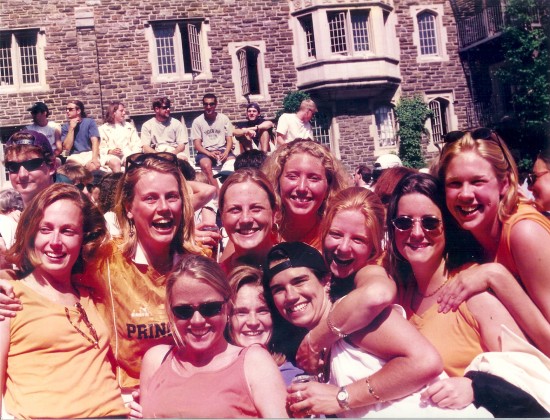
Today, I’m thinking about a specific memory, one that is framed in magnolia petals, flat beer, and laughter. My college senior spring. These weeks shimmer in my memory, so full are they of feeling, laughter, sadness, and promise. They are saturated with the impending farewell we all lived with: every single day was a step closer to leaving the campus we’d grown to love so much. We turned in our theses, the reunions fences and tents went up, and we marched inexorably towards our forced exodus from that sheltered and sunny place we’d spent four years.

Of course there was much of college that was not sunny or happy. There were difficult times, experiences that hurt me, and heartbreak. But when I think of April and May 1996, I’m hard-pressed to remember anything but the joy. It was, perhaps, my first taste of that special kind of joy, the kind that is haunted by the promise of loss, that has become so central to my experience now. This now-familiar happiness was thick with feeling, the reminder that an end was coming a viscous swirl through the fluid of every day.

What were those days like? I sit at my desk now and I can close my eyes and be back there, my mind a kaleidoscope of details recalled with startling lucidity. I turned in my thesis two weeks early, and I forgot to include my middle name on the cover and frontispiece. The entire campus seemed to burst into bloom at once, the magnolias riotous in their celebration of spring. The soundtrack included The Tide is High, Killing Me Softly, and Glory Days. Mission Impossible had just come out in the theaters, we all went to see it, and then spent many nights trying to dance to the main instrumental song from the soundtrack (very difficult). There was a heat wave and we set up baby pools on the back lawn of our eating club, sitting in them and running through sprinklers in the oppressive humidity.

At our eating club’s annual alumni dinner, some male alumni stood up and toasted the days before the club was coed. That was nice. Not. My friend wrote a thesis called I Love the Freedom of It about water imagery in Virginia Woolf’s novels, and we mocked her incessantly for that title. We studied for the final comprehensive exams in our respective majors and then sat for long hours in those beautiful lecture halls, writing in putty-colored exam booklets. As I sat in a wooden chair bolted to the floor, wracking my brain to identify a piece of prose on the exam, I looked at the shafts of sunlight coming in through the windows, watched the dust dance in the light, and felt aware of the centuries of life that this room had held.

Reunions arrived, ringing the bell that our time was truly almost up. On Thursday night we started at Forbes, at the Old Guard reunion, because they had good alcohol. We then made our way through all of the tents, visiting them all before the crowds arrived on Friday. Saturday’s P-Rade was hot and beautiful, and we stood for hours outside of Cuyler Hall, cheering ourselves hoarse. In our matching orange Gap t-shirts we drank warm cans of beer from ripped-open cases stashed on the lawn behind us. When it was our turn to fall into line, we marched across Poe Field field together, arms flung around each others’ shoulders, tears rolling down our faces as President Shapiro welcomed us to the alumni body. That night, wearing blue shorts, a cream J Crew wool cable-knit sweater, and flip-flops I bumped into a long-lost face and unexpectedly rekindled a relationship that had been dormant for two years and that I had presumed dead.

We spent a week driving all over the tri-state area for graduation parties. One night, Quincy and I decided impulsively, around midnight, to leave the party where we were. We drove through the night from the Hamptons to her parents’ house on the Jersey shore, singing Bob Marley the whole way. The next day, we made possibly the most labor-intensive recipe I’ve ever made, artichoke soup. Hand-scraping every single leaf of ten artichokes.  Another night, Kathryn‘s mother hosted us, hungover, and we ate vegetables and chugged water, all swearing we would never drink again (right).

Our rooms slowly disappeared into brown moving boxes. Our parents arrived for several nights of celebratory group dinners. We ran from a restaurant in town to the Senior Arch Sing, and because we were late we wound up sitting on the bottom step of Blair Arch, belting out “Eye of the Tiger” with our class as though our lives depended on it. My instinctive use of “we” to describe this time reminds me of The Virgin Suicides, and underlines how critically important my friends from this time of my life were and are. We really were a we then, and while that we has receded to secondary status, it is still a group identity that I draw strength and solace from.

We knew we were coming to the end of something, but also knew we were about begin something. Our real lives. “We prepared our hearts for something drenching and big,” writes Lorrie Moore in Who Will Run the Frog Hospital, and those words always reminded of these weeks of my life. We were liminal creatures, still in college but peering at the great wide open that lay just beyond the threshold that we were barrelling towards. We drank and danced and laughed and loved and left. I am so grateful that my memory has kept such a detailed, fully-dimensioned account of those once-in-a-lifetime weeks.

The Geography of Love

I read Glenda Burgess’s exquisite memoir, The Geography of Love a couple of weeks ago, reading it voraciously in two sittings, unable to put the beautiful volume down.  Glenda makes me believe in soul mates.

Given my own fixation with maps and geography, with all the tools that we use, concrete and ineffable, to guide our way through life, I was predisposed to love this book. I did not, however, expect the completeness with which I’d tumble into Glenda’s world, that I’d be so completely seduced by her voice. She knocked me over twice in her first chapter alone, first with “And while the question of God himself frames the universe, the great mysteries exist in the human heart unsolved,” which echoes my growing awareness that beyond the questions there are more questions. And her description of her life before meeting her husband is a far more eloquent and lyrical summary of exactly what it is I write about so clumsily, all the time:

Eventually, I constructed a layered exoskeleton, a coral reef instead of a life. The structure was there, but the essence was missing.

It is a rare book that sends me to the dictionary almost once a chapter. An even rarer one that does so in an elegant, unforced way. This book did both. Glenda’s prose is never showy or flamboyant. It is simply elegant, intelligent, and full of metaphors that seem to spring from a deep intuition.

The Geography of Love is, most of all, a love story. Glenda describes falling in love with Ken, and taking a chance on a life together despite some red flags in his history that might send a more cautious woman running (twice widowed, he was a suspect in his second wife’s murder). Her narrative is interspersed with reflections on faith, meaning, and the soul. There are many sentences that made my breath catch in my throat, sentences that glitter like gems, that put into the perfect words, in the perfect order, things deep in my heart. For example: “How do you know a heart? The life only tells the journey.”

The story that Glenda tells of her life with Ken and their two children is evocative and personal. The bulk of the book traces Ken’s illness with cancer, his deteriorating health and their movement as a family towards his death. Glenda seems certain that Ken is her destiny, that her path was always meant to lead to him (“In every way, he was my true home, my center of gravity.”) At the same time, she evinces raw reverence in the face of life’s great mystery, circles around the essential unknown at the heart of the human experience. In her very first chapter, those five pages that are as beautiful as any prose I’ve read in a long time, she talks about “quintessence: the essence of a thing in its purest and most concentrated form … Quintessence, like faith, remains unproven: a deductive belief.” Certainty and the unknown, tangled inextricably together.

Interleaved into this story of an ordinary life and an uncommonly strong love are Glenda’s reflections on the great currents of feeling and belief that I think run through all of us. She accomplishes what is surely the highest aspiration of memoir: taking a deeply personal story and telling it in a way that examines and explicates universal emotions and experiences.

The scene of Ken’s death, which happens at home and in Glenda’s presence, is among the most powerful I’ve ever read. She writes of watching – feeling – his soul leave his body. She is suffused with grace as she sits with the body of the man who has become the geography of her life, of her love. Her courage and humanity in sharing this scene, this most private of moments, awes me. The book ends with Glenda moving towards the “formal feeling” that Emily Dickinson said came after great pain. Even in her grief, she continues to respect the forces beyond our control and understanding that shape our lives, and her gratitude for what she shared with Ken clearly overwhelms the pain of her loss.

This is a gorgeous, lucid, moving book. It is sad but also profoundly hopeful. For me, the most enduring of Glenda’s messages is that in abandoning ourselves to – even embracing – all that we cannot know, we may find peace and comfort. The Geography of Love is the story of two human beings, whole and flawed and full of love, and of the path they walked together. It hints at the path that lies ahead for the one who survives, and, even, at the path ahead for the one that dies.

Life distills in the elements of chaos and chance. Vagary, arcane and capricious, hints at destiny and confounds God, adumbrates the fragile human landscape.