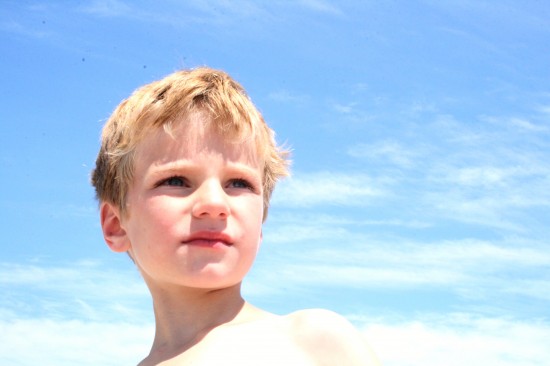
Blond hair, blue eyes, cornflower blue sky. He swam by himself to the raft in the blue ocean for the first time this weekend. Whit, my first son, my last baby.

Blond hair, blue eyes, cornflower blue sky. He swam by himself to the raft in the blue ocean for the first time this weekend. Whit, my first son, my last baby.
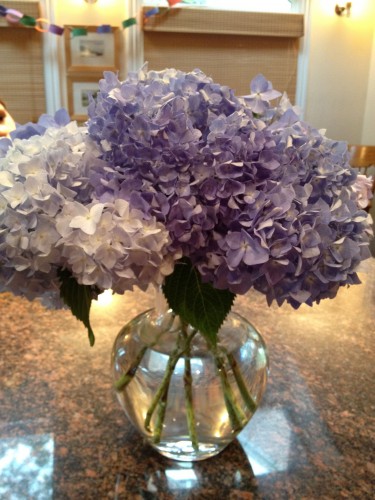
A snapshot of my version of “it all”: hydrangeas (one of our wedding flowers) grown by my husband, in our small front garden, on the kitchen island. In the back you can see a construction paper garland that Grace recently made for father’s day.
Like everyone else in the blogosphere and real-world-o-sphere, I have been participating in many conversations about Anne-Marie Slaughter’s cover story in the Atlantic, Why Women Still Can’t Have it All. While I certainly don’t have a clearly-articulated response to Slaughter’s comprehensive and thoughtful examination of working motherhood today, I do have a profound emotional response. By the third page of the article my eyes were full of tears, the words having touched some reserve of emotion in me as inarticulate as it is endlessly deep.
Most days I feel pretty good about my choices regarding work and family. Sure, I wonder sometimes what would have happened had I not “leaned back,” as per Sheryl Sandberg, before I was even pregnant. And yes, I do wonder what it would be like not to work, mostly whether I’d be a more relaxed and less distracted parent to my children. But on the whole I feel pretty good about the decisions I’ve made and about the trade-offs I make every day (I hate the word and notion of balance when it comes to this topic). My emotional reaction – quiet, but intense – when I read articles like Slaughter’s, however, suggests that something deeply buried in me still grieves, hurts, and wonders. About and over what, I am not entirely sure.
Mostly what Slaughter’s article has me thinking about, though, is what “it all” really means. My friend Kathryn, who is one of those can’t-live-without-her-friends that are for me a big component of feeling like I have anything like “it all,” emailed me to say she was at home because her nanny was out, sitting on her bed with her laptop working while her children lay on either side of her watching TV. Is this “it all,” she mused?
For me, the answer to that is yes.
I am certain this is a deeply personal equation, and one that changes every day. For me there are some elements of “it all” that are non-negotiable. Downtime with my children most days. A happy relationship with my husband. Work that I find challenging with colleagues I respect and learn from. Not missing any – or almost any – school events, plays, concerts, assemblies. My handful of dear friends, those native speakers whose companionship I cherish. Time, several days a week, to think and write about this divine and devastating life. Time to read. Eight hours of sleep most nights. Time, several days a week, to run by myself. The calculus of how each day’s hours are allocated is ever-shifting; I think having “it all” is something we ascertain over the arc of weeks and months, not in a single day.
The point of Slaughter’s piece with which I agree with most vociferously is that flexibility is absolutely essential to making this particularly rich, and demanding, phase of life work. There’s no question that that is true for me. I’m certain that my ability to be present for events both big and small in the lives of my children while working full-time has a lot to do with my job’s flexibility. Of course I’ve made compromises though, and I have written before about how my life over the past years has simultaneously narrowed and widened. What I’m not totally clear on is where the line is between a mature acknowledgement of the need for compromises and a defeatist acceptance of “not having it all.”
There is lots I don’t have. Lots. Tons of children. A book published. A fancy house. A perfect figure. Extravagant vacations. Sound sleep every night. A marathon under my belt. A high profile CEO job. A real yoga practice. Unbitten fingernails. A yard for my children to run in. A king size bed. A red-headed child. A basic orientation towards calm.
But I think I would say that in the ways I care about, I do have it all.
What is your definition of “it all”?
Update: I’m happy that Catherine, of comment #19, won Priscilla’s book in my giveaway. Congratulations, Catherine – I can’t wait to hear how you like it!
I’m thrilled to be participating in a blog party for Priscilla Warner‘s birthday. I read Priscilla’s book, Learning to Breathe, last year, and was immensely moved by it. I later read her first book, The Faith Club, in anticipation of our family trip to Jerusalem, and learned a lot of valuable information about the three religions that intersect so richly – and with such sparks – in the winding streets we walked in December.
Leaning to Breathe was one of those books that I think about every day. It was nothing less than a light for me, a beacon showing me the path, an invisible hand on my shoulder reassuring me that I am not alone in my sometimes-frantic, often-agitated search for a something I know is that even though I can’t quite name it yet.
Some of the greatest things in life don’t have to be so dramatic … It’s in the quiet moments that our lives are shaped. In homes, in cribs, in bedrooms, in the little things. That’s where it all happens.
This is my favorite passage from Learning to Breathe, and is one of the book’s many such intimate epiphanies. I’ve had the good fortune to get to know Priscilla through email since I read her book, and she’s every bit as delightful, warm, human, and inspirational as I had imagined. Furthermore, she has both the same name and same home town as my beloved grandmother, a small coincidence that nevertheless made me feel even closer to her. I’m thrilled to add my voice to the chorus that is chanting:
Happy birthday, Priscilla!
As part of this celebration, I’m thrilled to give away a copy of Priscilla’s book. If you relate to any of what I write here, I can assure you you will be touched by Priscilla’s story of learning to breathe, both literally and metaphorically. Please leave a comment and that will enter you into the giveaway. I can’t emphasize how meaningful Priscilla’s book is; I think everybody should read it.
In addition to this giveaway, Priscilla is hosting a wonderful birthday giveaway on her blog. She is giving away one of her buddha bracelets, a tibetan singing bowl, her favorite candle, nirvana Belgian chocolate, and a CD by Bellruth Naparstek, her guided imagery guru. Please click over to Priscilla’s blog to participate. Some other writers who join me in celebrating Priscilla are there as well. It is my honor to share in this wave of love towards someone who I am proud to call my teacher. Thank you, thank you, thank you, Priscilla, for all that you are, to me to so many.
What I want is a quiet life.
I mean a life that listens: to other people, to my place, to silence. I want to notice even the smallest things, to stay immediate to my surroundings. But daily distraction can be so fragmenting, so addictive, and the kind of attentive patience I seek requires clarity of mind. To find this clearheadedness, I must make a commitment to do so – I have to say no to the constant, frenzied consumption of “needs” (more often wants and excesses), and I have to make room for the quiet, contented yes I actually desire.
It is a generous gift – to choose the way I want to live, in spite of circumstances. I believe that I am daily shaping myself through my decisions, and so I make them earnestly, carefully. But I too easily fall into patterns I believe to be obligatory – habits of convenience I depend upon. I am carried away by the impulse to keep up, though this sentiment inspires only a perpetual state of wanting. I’d rather punctuate my days with actions turning me towards gratefulness, revitalizing my eyes to see the calm goodness already around me.
– Julie Pointer (from Kinfolk, volume three)
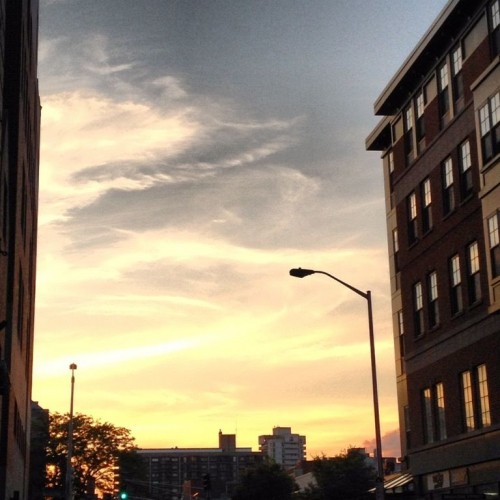
Today is the summer solstice. It is the longest day of the year. The day out of 365 that holds the most light. And from here we turn towards darkness again.
I have always felt a connection to the solstices, surely in part due to my family’s long tradition of celebrating December 21st. But something even deeper than this tradition beats in me. My soul vibrates with the ever-shifting balance of light and dark and recognizes the importance of its brief, teetering pinnacle (and nadir) on the summer and winter solstice. I asked my husband recently which was the happier day for me, the summer solstice or the winter solstice. It was a little quiz. He got it wrong.
The answer is the winter solstice. From there we are turning towards the light, moving in the direction of longer days, out of the dark days that takes the most faith. The summer solstice comes at the very beginning of a season I love so dearly, with its swollen days and evenings of slow-arriving dusk, fireflies and popsicles, sandy toes and children worn out from wonder and the ocean. But I do find June 21st tinged with sadness. It reminds me that we are commencing our revolution towards fall and winter again.
I wish – desperately, wholly, wildly – that I could just sit and enjoy a day of my life. One day. I wish I could sit by a pool, giggling at my children jumping off a diving board, a glass of white wine in my hand and a dear friend at my side. And if you were at that pool, that’s what you would see. That’s what it looks like from outside. But inside there is an essential crack in my spirit that yawns open, more narrowly or more widely depending on the moment. This crack – this wound– is always there.
I promise I’m not a hugely depressing person. I’m not even depressed. I’ve been there, believe me, and this isn’t it. I’m actually a fairly happy person. My husband has even noted that I’m funnier in person than anyone would imagine from my writing here. I guess I try to keep my heartbreak to myself. But the truth is that even on days like today, a day as gorgeous and perfect a summer day as I can imagine, the longest day of the year, there is a kernel of sadness buried deep inside my experience that I can’t ignore.
And there is still so much here I do not understand. These are my favorite lines in Adrienne Rich’s deeply moving poem that I publish every winter solstice. No matter how much I struggle and think and unpack and write, there is still so much that is unclear to me, both within and without, so much that I find perplexing, sad, complicated. Also, yes, there is also so much that I find devastatingly beautiful, radiantly joyful, and deeply satisfying. What I am beginning to see is that it is in these knots of tangled meaning that my life actually exists. I’m slowly realizing that my hope that someday I’ll be sailing smoothly down some clearly-defined path is simply naive.
Last year I said this: “I realize, again, fiercely, is that this is how I want to live: in the right now of my life with a broken heart. I want this, in full knowledge of the pain it carries, far more than I want to keep hiding from my life.” Reading this avowal reminds me that for all the uncertainty, there are things I do absolutely know. On a day like this when I want to simply enjoy, it is easy to forget these commitments I make, to myself, to my family, to those I love. But I won’t. I will pull out my camera, take some pictures of this glorious day, of my alarmingly tall and lanky and funny and sad children, surrender to the knot of sadness that will gather in my heart as the sun sets, and acknowledge this is what it is to be me in this world. It just is.
Parts of this post were originally shared on this day last year. And they are still so true, as I continue my spirals through the same questions, the same concerns, the same sadnesses, the same joys.