Don’t Miss This

I have been a huge Jena Strong fan for a very long time, and I was delighted when I heard that she was releasing a book of poems, Don’t Miss This.  I ordered it immediately.  I tried to read it slowly, savoring Jena’s characteristically gorgeous words which somehow manage to be both as intimate as the body and as universal as the cosmos at the same time.

Don’t Miss This is a memoir told in poems.  The memoir is broken into three parts: She Who Stays, Landmine, and What I’ll Miss, and traces Jena’s cataclysmic realization a couple of summers ago that shatters the life she knows into a million pieces.  Jena’s poems are some of those pieces, their sparkling blindingly brilliant and beautiful.

The concluding stanza of Desert Woman, in the book’s first section, is an achingly lovely assertion that where we came from has value, no matter how scorched it’s earth:

For this is what I know:
one day we will return to visit,
stronger and more humble still,
to honor this desert
of what we passed through,
of what moved through us.

I read these lines and shivered, thinking that they captured what the whole of what Don’t Miss This is: a benediction of what was, before a grenade went off and altered it forever.  Jena writes both from that before and also from now, looking back on it.

Landmine, the book’s central section, begins with land mine/blindside, a poem whose drumbeat cadence speaks of a truth coming finally, irrevocably to light.  Jena writes of her daughters: “you cannot protect them/by staying small/or living in fear” and later poignantly acknowledges that “the coming together/and the falling apart are the same.” This section is full of lines where beginnings and ends are conflated, and we feel Jena’s future pulling her forward like a horse at a gallop, straining against loyalties and the power of what she thought her life would be like.

I spent the day with this absence
unsure if I was coming or going
departing or arriving
losing the poem or remembering the poem
forgetting or remembering

In In the Absence of a Departure we see the way many strands of a life can be tangled in a single explosive moment.  All the poems in Landmine are animated by tremendous emotion and passion, an eruption of a long-buried truth, but they are also limned with the loss that is woven through the fabric of Jena’s new life.  As Landmine concludes, we sense a new peace ringing in Jena’s words.  Silver Moon ends with a simple statement that reminds me of Emily Dickinson’s formal feeling: “My heart, for all its aching/smiles quietly.”

In What I’ll Miss, the third section of the book, Jena’s voice takes on a new rhythm, hypnotic and reverent, as we watch her sink into her new life.  There are still moments of anger and despair, like in The Perfect Storm, but there is also glowing, radiant acceptance of what simply is.  Jena speaks lyrically of what I would describe as midlife’s central task: letting go of what we thought it was going to be so that we can embrace how it is.  When she speaks of holding a life whose contours are unfamiliar, I feel goosebumps of familiarity.

It is simple, really,
a slideshow, a retrospective
that bends and curves in shapes
we never expected to learn
but can come to love

These lines, in There is a Picture, resonate and stayed with me after I finished Don’t Miss This.  Jena’s gorgeous memoir, whose words fairly glimmer with truth, pain, and wonder is nothing so much as her writing her way to loving her life.  Her life as it is, even though it looks nothing like it did a few years ago and certainly not at all how she thought it would.  This life, this radiance, this heartbreak.  Don’t Miss This traces the flare of lightning in the sky of a life.  Jena’s poems show how that lightning reverberates and changes the very texture of the darkness it split open, and they celebrate and honor the new shape left in the wake of the storm.
Curator of moments

Happy Birthday, Hadley
(Photographs of the girls dominate my pictures; there are no recent ones of us.  That’s okay – they’re the best part of us anyway, aren’t they?)

I am sending you all my love, halfway across the country and up a mountain, and looking forward to seeing you in a few weeks.

We met 16 years ago this fall, which seems amazing to me. You were – and are – so impeccably elegant that it took me a long time to believe that there was, as you kept telling me, tumult and anxiety beneath the surface. I’ll never forget the New Year’s, years ago, when another friend met you and told me, days later, that her original impression that you were intimidating had quickly given way to realization of your warmth, generosity, and sense of humor.

You are the calm one who talks me off of the various ledges that I perch on weekly if not daily. Where I am a tornado, you are tranquil, where I am rough you are refined, where I am struggling you are serene. More than once you’ve pulled me through a very dark spot with the tenacity of your friendship (I’ll never forget the Fed-Exed box of pacifiers when Grace was one week old).

I am honored to be able to know the you beneath the gloss, but I also admire tremendously both the way you put yourself together and your view that each day is an opportunity to craft something beautiful. You bring beauty wherever you go, creating lovely spaces, moments, experiences. You are a thoughtful and generous hostess; you have rice milk in the fridge and diapers in the right size in the bathroom. You think of everything. Your aesthetic sense is an inspiration. Every facet of your life always strikes me as almost achingly lovely: your stationery, your Christmas cards, your handwriting, your clothing, the art on your walls, the fruit in your fruit bowls, the food on your table. Patterns, colors, songs all seem more vivid and beautiful in your hands, and you handle all of these things with ineffable, instinctive ease.

Every time I see you I leave dedicated to working harder at cultivating beauty in my life.  You make me realize the immense value of paying attention to the smallest detail, make me see how beauty can truly soothe our souls.  Every time I’m with you – which is never enough – I come away feeling like I’ve experienced something special.  You have personally curated some of the most sparkling memories of my life.

I love watching your generosity towards and intimacy with Grace, your goddaughter, and hope to share even a fraction of that with your son, Jack, my godson.  Thank you for teaching me the words to Frost’s The Master Speed, what agave tastes like, the importance of arnica, how entertaining the New York Post is in the morning, and a million other lessons both too big and too small to list.  I look forward to learning a million more.

Happy, happy birthday, my dear, beloved friend.

Parts of this are reposted from 2010, but it’s all still true, and it’s still HLKS’s birthday today, so I wanted to re-share it.

The story I can’t stop telling

I have a new piece on the Huffington Post, The Story I Can’t Stop Telling.  It’s a story which will be very familiar to anyone who’s read anything I write here.

And I really can’t stop telling it.  While swimming this afternoon, Whit hopped in one end of the pool while I happened to be walking by.  I watched him set out to swim the whole length, which he did, inelegantly but without stopping.  I hadn’t told him I was watching, so I didn’t think he knew.  But when he got to the other end, he hauled himself up by his still-narrow shoulders, water sluicing off his white back.  I smiled at the back of his head and then was startled when he turned to look at – or maybe for – me.  I gave him a thumbs up and a big smile and his grin in return was incandescent.  He still wants to know I’m watching him.

I know these days are numbered, and the drumbeat sound of their passage deafens me.  The sweetness overwhelms me and makes me cry.  And all I know how to do is to pay close attention, to watch and listen and love deeply, and then to write it all down.

To write down the story I can’t stop telling.

The distances between stars

Besides realizing that two glasses of wine can make you drunk, I have had this realization: that you can look at something, close your eyes and see it again and still know nothing – like staring at the sky to figure out the distances between stars.

– Ann Beattie

To fully live that golden hour


Last weekend was one of those golden, empty-of-all-plans weekends.  We spent it at my parents’ house on the coast, one of our very favorite places.  On Saturday morning my parents left for two separate out-of-town commitments, and the four of us looked ahead at two empty days with delight.  We simply hung out.  There was golf, tennis, hamburgers on the grill and dinner for four at the table on the back porch.  There was reading on the couches, a game of Clue, many games of Mancala. There was some shouting and a lot of hugging.  In short, it was our regular family life.

One thing that’s critically important to me is that my children know how precious it is to be alone, the four of us.  I want them to know how much I prize that time.  My attachment to these empty family hours grows ever fiercer and my experience of them shimmers with more and more beauty.  I am sure this is correlated to my keen sense of how limited they are, days with no plans and only each other for company.  These are the days I know they will remember as their childhood with a capital C, the days I’ll turn over in my pocket years and years from now like touchstones smoothed from repeated touching: them sprawled out on top of their beds asleep in the heat, the smell of sunscreen on Whit’s head when I kissed it, the clatter of Mancala pebbles as they played, talking quietly to each other.

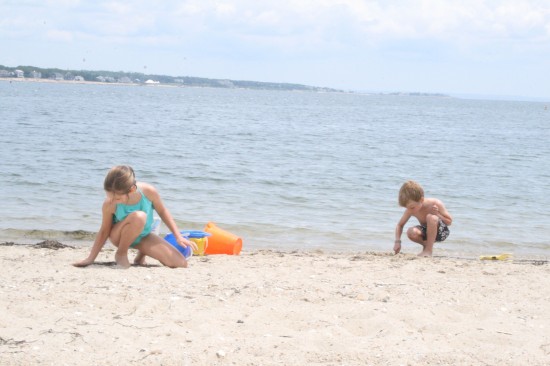
My favorite part of the weekend, though, was Saturday afternoon at the beach.  I love the coast; for many reasons I have explored before, there’s something about this border between two worlds, this place that the moon demonstrates its power over the tides, this land of shells and myriad blues that feels like home.  On Saturday I stood where the ocean meets the land and watched my three family members’ heads, dark and sleek as otters, bobbing towards the wooden raft off the shore.  They clambered up and waved to me, arms above their heads, exaggerated as though they were miles away.

Then I watched Grace jump off the raft into the ocean.  She came up, broke the surface, and even from the shore I could see her grin.  It was 5 weeks to the day since she broke her collarbone.  I felt a wash of simultaneous wonder and gratitude, and saw the ghostly, broken bones on the x-ray in my head.   My eyes filled with tears as I thought about how healing happens, inexorably, undeniably, mostly invisibly.

And I stood there, shallow waves lapping at my feet, watching my children hurl themselves over and over again from the raft into the ocean, hearing their laughter, trying to simply be there.  I fought to keep my observer self inside my body, instead of letting her slip out and hover apart, watching, chronicling.  No: I squished my toes into the sand, felt the sun on my arms, squinted to watch Grace and Whit having a cannonball contest.  Trying to fully live that golden hour, even as I knew it was running through my fingers as I watched it.