Light

I have been thinking, for days now, of how to describe our magical adventure, our family trip to Jerusalem, a week full of delights and overwhelm and memories none of the four of us will ever forget.  We experienced things, individually and collectively, that moved us all deeply.

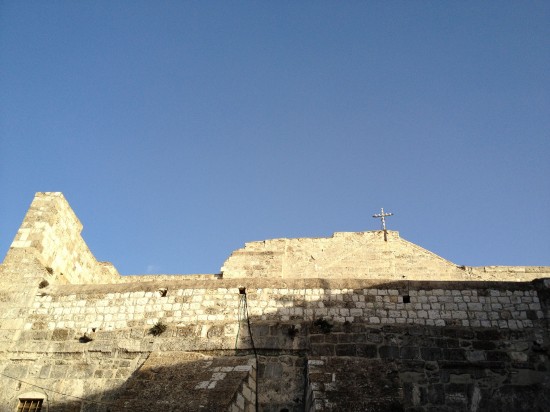
This is the photograph I keep returning to.  Not any of the more glorious ones, of famous sites, of gold domes and flags waving in the cornflower blue sky and 12th century churches, of childrens’ smiles.  It took me a while, but gradually I realized that this photograph asserted itself for a reason: it fits perfectly with my reflections on 2011 and hopes for 2012.

For me, Jerusalem was about faith.  It is a place where the extraordinary power of religion – to render both egregious harm and outrageous beauty – is undeniable, unavoidable, written indelibly on every cobblestone, every mosaic tile, every crying face.  We saw the silver star on the floor marking where Jesus was born and the rock where he was crucified.  We saw people weeping at the Western Wall and the stunning gold dome where Mohammed ascended for the first time.  I stood outside the Church of the Holy Sepulchre, listening simultaneously to a ghostly choir singing from somewhere inside (above us?) and to the haunting Muslim call to prayer, the two sounds floating on the same incense-scented air, colliding and, improbably, weaving together into nothing less than the sound of faith.

Faith is something I’ve written about a lot.  It’s something I think about in the middle of the dark night, something I lunge for, awkwardly, clapping my hands together, trying to grasp it even as it floats away, something I look for above me, in the clouds, in the patterns of bare branches against winter’s sky.  It is impossible not to be moved by the tangible faith all over Jerusalem, in the relics but most of all in the way faith itself is animate in the hundreds of thousands of pilgrims moving through the streets.

Above all, there was one moment.  On Christmas Eve, we made our way to Bethlehem (for the second day in a row: on the 23rd we’d gone, seen Jesus’ birthplace, walked around the Church of the Nativity).  We walked across the intense checkpoint between Israel and the West Bank, and after a slow taxi ride made the final half mile ascent into Manger Square on foot.  The sun was setting, and the streets were packed with a crowd whose mood seemed to skitter between ebullient and emotional.  I had a child holding each  of my hands.  And then I looked up.  And I saw the end-of-day light on the wall of the Church of the Nativity.  And my heart thudded and my eyes filled with tears.

That was my moment of faith in Jerusalem.  Not the big scenes, the places where pilgrims threw themselves to the floor and wept, the places where I imagined I might feel the presence of a sense sublime … of something far more deeply interfused.  No.  Instead, it was the setting sun on a wall that had been there for many, many years.  A wall that has mutely witnessed tragedies and glories, that has been watered by the tears of the faithful and been subtly shaped by the over-centuries erosion of their handprints.  It was the light.

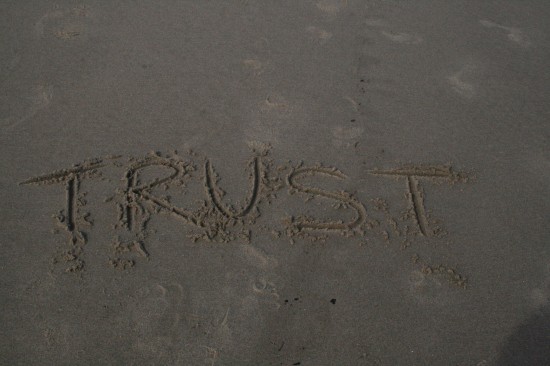
Last year I chose a word of the year for the first time.  Trust served me well.  The truth is, I’m not sure – for me at least – there’s a whole lot of difference between trust and faith.  At least there isn’t in how I think of them.  I spent a lot of time thinking about trust last year, and while I still struggle with the effort to let go and to believe that everything is unfolding exactly as it should, I feel enriched and calmed by having focused on the word for 12 months.  I wasn’t going to pick a word for 2012, though.  Nothing really came to me.  But then in Jerusalem I kept thinking of this same word, and this picture, out of so, so many, kept pushing itself into my consciousness.  So here it is.  For 2012.

Light.

Light as in less-heavy: I want to laugh more, to remind people – maybe even all of you, and certainly myself – that there are many aspects of my personality that are not stiflingly serious.

Light as in light on trees, on stone walls, on the faces of my children.  Light from inside and light from outside.  The light of sunrise and sunset, whose source I cannot fully understand; this is the light that makes me feel trust, makes me feel faith.  I am already fairly attuned to this light, photographing it all the time and writing about it even more incessantly.

May the light from the Church of the Nativity, which tremendously moved me, stay with me in 2012.  May I never forget that the power in light resides, somehow, in its relationship to darkness.  Shadows exist at the edge where light meets dark, and they are where I have always found the most meaning.  There is no reason to be afraid of the dark.
November: Pain

I spent the month of October in pain.  First an injury, and then an illness, each of which is particularly painful in their individual categories.  Not at all fun.  I realized how little physical pain I’ve had in my life, with gratitude and also guilt – how could I not have appreciate all those many, many days of feeling just plain fine?  I spent more days that I’d like to admit curled up in my bed, trying to work on one laptop and write on another, closing my eyes when I just couldn’t do anything but breathe through the pain.

I thought I had a high pain threshold.  After my two childbirths, I really thought I was strong.  In fact, those epidural-free deliveries were my benchmark (clearly a 10) whenever a doctor asked me to rank my pain on a scale of 1 to 10.  I was somewhere between 7 and 9, on and off, for most of October.  I’m still at 4 or 5, most days, and some much higher.

I don’t know about my pain threshold anymore.  I do know, in a way I never did before, that pain is its own country.  I have tremendous empathy for people who live with substantial pain on an ongoing basis.  Often I looked at Grace, trying to listen to what she was saying, her voice muffled by the ringing of pain in my head, feeling like I was across a moat in a different place altogether from her and my regular world.  A regular world I had never appreciated until it was stolen from me, replaced by this foreign place full of pain.  It is both exhausting and terrifying to ride the day-in, day-out ebb and flow of pain, the peaks of agony and the valleys of oh-maybe-I-am-okay-now almost-normalcy.  Every time I breathed a sigh of relief and thought, yes, finally, I’m on the road to recovery, something would flare up, and I would return to bed, eyes full of tears and heart full of fear.

It is the helplessness of it, as well as the emotional content, that shocked me the most.  I would get pulled under by a riptide of pain, unable to do anything about it.  And the incredible fear, that I had never anticipated.  I am familiar with emotional pain, in all its range, but I did not realize that physical pain carried with it a big emotional burden.  My mind would get on its hamster wheel: will this never improve?  Am I going to live like this for the rest of my life?  I can see how quickly chronic pain leads to immense depression.  I am not depressed, though: right now I am marveling, more than anything, at the power of pain.

My other observation is that pain is absolutely exhausting.  A few weeks ago I wrote about being tired, and about feeling quiet.  Some of that is surely seasonal, and the particular rhythms of my spirit and mood.  But the tiredness stuck around, persistent, thick, heavy, and I began to wonder if it was also partially caused by my pain.  Now I suspect it was (and is).  I am wading through thigh-deep snow these days, slow going, feeling spent, both emotionally and physically, more quickly than usual.

I read Kristin Noelle’s beautiful post last week with tears streaming down my face.  She writes of a harsh few months, of a demanding season, and of the release of finding herself in a soft place. These lines in particular moved me:

What if becoming (painfully, gut-wrenchingly, sometimes) aware of our fear is not always a sign that we’re far off from peace, but actually quite the opposite: a sign that we’re actually close enough to peace to start collapsing into it, to start admitting to ourselves or someone else how hard things have been?

Clearly, the ways that this last month have been difficult for me are more physical than emotional, though, as I said, there was a soul component that I had not expected.  What have this pain, and the pain’s handmaiden, fear, come to teach me?  I ask myself this over and over again, in the day and in the night, wondering, wondering.  Perhaps they are a sign, as Kristin says, that I draw ever nearer and nearer to peace.  I’d like to believe it.

Note: I believe, firmly, that both of my ailments were helped, not impeded (and certainly not caused by) the cleanse I was on.

Holiday reading

I read a lot this last week, aided by two very very very long travel days (for example, on 12/29 we left Jerusalem at 7pm ET and got home at 5pm ET).

The Anti-Romantic Child: A Story of Unexpected Joy – Priscilla Gilman (A gorgeously written story about love between a mother and child.  Well, about love, period.  with lots of quotes from and references to my favorite poet.  I highly recommend!)

The Cat’s Table – Michael Ondaatje (I couldn’t put this down.  It’s lyrical and haunting.  I’m reminded that Ondaatje is my favorite novelist, and that I adore prose by poets.)

Admission – Jean Hantz Korelitz (Fun read, with lots of details about a place I love, Princeton)

The First Secret of Edwin Hoff – AB Bourne (Written by a friend, thriller set in Cambridge/Boston, entertaining)

The Underside of Joy – Sere Prince Halverson (An ARC of novel released 1/12/12 – stay tuned for my review.  This is beautiful!!)

The Help – Kathryn Stockett (I finally read this, which I’ve been resisting for some reason.  Very entertaining)

Amy and Isabelle – Elizabeth Strout (I seem to be reading her books in reverse order.  This is lovely, though I didn’t adore it as passionately as I did Abide With Me)

Shadow Tag – Louise Erdrich (I’m still in the middle of this)

What did you read this holiday?

October: These are the years they will remember

Most mornings, I walk Grace and Whit into their respective school buildings.  Occasionally, if I have to make it to an early meeting or something, I do “live drop off” instead, letting them hop out of the car while I idle at the curb.  For some reason this always brings tears to my eyes.  There’s something about their backpacks bobbing away from me, their independence, their resolve, their enthusiasm for school – all of it mixes up into a cocktail that brings tears to my eyes as surely as onions on the chopping board or Circle Game on the radio.

The other morning was no different.  I drove away, blinking back my tears, and suddenly I thought: these are the years they will remember as their childhood.  We had driven to school all belting out Edge of Glory together, and then we had sat in the car near school singing along until the song ended.  I looked in the rear view mirror to catch them grinning at each other, overwhelmed again with the realization that tiny things can bring sheer joy for them.

I remember when Grace turned four thinking: okay, this really matters now.  That is because my own memories of childhood begin when I am about four.  I actually don’t have that many memories of my childhood, and those I do exist in a slippery kind of way: am I remembering the actual event, or the picture I’ve seen so many times of the event?  I wonder if part of why I write things down so insistently now is to address this very fact, this inability to remember when I so desperately wish I could.

My flashes of memory, as limited as they are, begin in the second apartment we lived in in Paris.  I was four-ish.  So, my assumption was that Grace and Whit would start remembering things from the same general time period.  Certainly, they will remember these days.  The power of the most mundane moments and experiences – something I’ve long believed fiercely in – was probably particularly on my mind after reading The Long Goodbye last week.  For sure, O’Rourke’s memoir had me thinking particularly of the memories of our mothers that endure.

And so I drove into Boston, my eyes still blurry with tears, watching the outrageously beautiful trees that line the Charles, the river that throbs through the heart of my home, wondering what it is that Grace and Whit will remember of these days.  We are “deep in the happy hours,” as Glenda Burgess put it in her stunning memoir The Geography of Love, and one thing I’m certain of is that it will be the small moments that most sturdily abide.  Will they remember the notice things walks, the trips to the tower at Mount Auburn, trapeze school, and chocolate cake for breakfast?  Will they remember the hundreds of nights that I read to them, tucked them in, administered the sweet dreams head rub, did the ghostie dance, turned on their familiar lullabies?  Will they remember Christmas, and Easter, and Thanksgiving, and their birthdays?

I have no idea what specific events and experiences will be the ones that rise up for my children, out of the dust of the years, some surprising, some familiar.  I could easily drive myself insane trying to make sure every single day is stuffed with memories.  But I choose not to do that, because, as I’ve written before, the memories that I come back to, rubbing them over in my mind like a hand worrying a smooth stone in my pocket, are almost all from days and moments that were utterly unremarkable, unmemorable, as I lived them.  I assume this will also be true for Grace and Whit.  So I suppose all I can do is try to be here, paying attention, to the vast expanse of ordinary days we swim in.  And to remember, every single day, what an immense privilege each one is.

September: Trust the tides

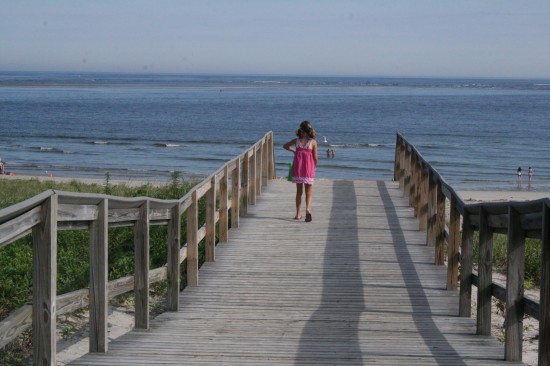
On September 1st I took Grace and Whit on a last summer adventure.  We drove about an hour north to the beach.  The day was magical.  It started out with Grace noticing a rainbow in the cloudy sky – not the standard arc but literally a patch of rainbow among the clouds.  I thought of the Tennessee Williams line I love about a complete overcast, then a blaze of light.  The rainbow is always there, even in a sky mottled with clouds.  You just have to look.

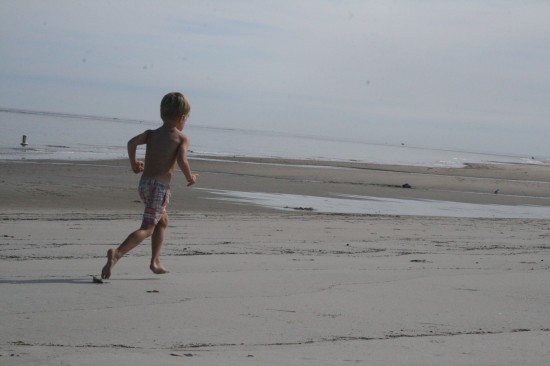
We got to the beach early and it was low tide and beautifully deserted.  Throughout the morning the tide came in, creating and then erasing a series of sand bars as it did so.  We spent the day dancing with the inexorability of the tides.  We stood on sandbars until the water lapped at our feet, wondering at how something that can be so seemingly solid – the sand under us – can suddenly disappear into the ocean.  Whit kept shouting about how the sandbar had been “washed out to sea” and I explained that no, the next time the tide went out it would reappear again.  He looked at me when I said this, baffled, but then he smiled, visibly reassured.

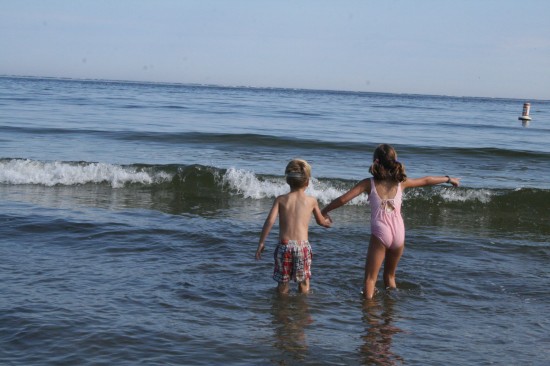
Grace and Whit played in the shallow water as the waves came in, noticed how you could feel the water pulling away at sand under your feet as it receeded.  They jumped in the waves, holding hands.  I watched, fighting tears.

Then they built a castle right at the water’s edge and worked at defending it against the incoming tide.  Grace scooped out a moat in front of the castle and Whit piled new sand on top of it.  They giggled as the waves washed over their castle, slowly wearing it down to flat sand.  No matter how hard they worked, of course, the tide won in the end.  But of course we know, with utter certainty, that the tide will turn and go out again next.  May we trust the tides.