
First impressions, and fertile friend-making periods

Matt and I were talking about first impressions last week.  We met 14 years ago, but the first things we thought of each other – and of other people we’ve met since – remain vivid.  We talked about the major categories of impressions, the things that carry weight when you are first getting to know someone.

“Your friends,” he started, with a smile.  “Well, your friends were, from the very first, awesome.”  I’ve written before about how even if he got rid of me, I’m pretty sure Matt would insist on continuing to go to my college reunions.  He loves those women almost as devoutly as I do (and with good reason).

“Yes, they are.”

“I think you can tell a lot – maybe the most of all – about someone by who their best friends are.”

And I agree with him.  My closest friends are a small group of people for whom I feel fierce loyalty and untrammeled pride.  I feel lucky every single time I think of this handful of people who have, for some mysterious reason, decided to bestow their love on me.  Matt’s and my conversation got me thinking, again, about which friends have stuck with me through life’s unanticipated perambulations, about how some grow nearer even as others ebb away.

There have been three fertile periods of friend-making in my life. The first was my childhood friends, my “family friends,”who really functioned more as siblings than anything else in my early life. These friends flanked me through those first important years, though the relationships were driven as much by our parents’ friendships as by anything individual to us. I am not in daily touch with any of those friend-siblings these days, but they remain close to me in the way of people who have shared formative life experiences. Like, perhaps, people who went through trench warfare together. I also had dear friends from my grade school (one of whom I saw last week and realized that Grace is about to be the age we were when we met – holy holy holy!).

The second was college. High school, fractured as it was between England and New Hampshire, was quite fraught for me. I had some good friends in London but we have dropped out of touch, proving to me that the weight of different cultures and the ocean was too heavy for the fragile bonds we shared. At boarding school I pulled into myself for a variety of reasons, and I remember those two years as some of the loneliest of my life. Yes, I had friends, and people with whom I shared the long cold days; one of my very best friends now I met there though it was really in college that our friendship blossomed into what it is now. But I spent a lot of time alone, too, running endless miles in the snowy woods, black trees silhouetted against gray sky, and writing essays and reading books in my tiny bedroom.

College changed all of that. I arrived at Princeton desperately lonely, full of insecurities and fears (yes, believe it, even more than now). I don’t think I had realized the extent to which those two years in New Hampshire saddened me. I was desperate for a place to call home, a group of friends into whose embrace I could relax. Oh, and how I found it. To this day, Princeton remains the place I was happiest. There was standard college drama, of course: sadness, frustration, embarassment, heartbreak. But oh, my friends. I was and am still surprised that such extraordinary women wanted to be my friends. Some of this was, of course, in reaction to the cold years at Exeter. For sure. But it mostly just my lonely heart gratefully opening to the warmth of Princeton, to the spring sky riotously full of magnolia blossoms, to orange tee shirts and mardi gras beads, to young women singing “oh what a night” at the top of their lungs at a dive Chinese restaurant.

Those four years were healing, and the friends I made there will always be the dearest of my life. Anne Patchett writes about how true friends are “native speakers,” and I find myself recalling how at Princeton we basically invented our own language. We were teased for abbreviating everything, and indeed, we did. Abbrevs, T and a P, TDF, the chalice, DTR … I could go on. Those of you who know what all of those things mean know who you are. And you speak my language.

And many of these college friendships have endured, grown thicker and stronger and more sustaining even as we move further away from Princeton. We have passed through early professional choices, graduate school, weddings, divorces, more weddings, babies. I’m not sure I can say it better than I did, in a letter addressed to these wonderful women, several years ago:

“There will be and are other incredibly special friends, but as a community you all are ground zero: yardstick and safe haven, the people who knew me when I was becoming who I am.”

The third rich period of friendship in my life was around pregnancy, delivery, and the transition into motherhood. This passage is so complex, the particular dilemmas and issues of life with a newborn so detailed and specific, that the people I shared it with have become dear friends. These friendships developed in the context of family and children, and the women I have grown close to in that fecund place full of abundant concerns and anxious questions are deeply special to me.

It strikes me that it is not an accident that our truest and most lasting friendships are forged during times of life transition; we are closest to those who have shared experiences that changed who we are. Whether it was childhood, college, or becoming mothers, this is true for me. There are other examples, individuals who have shared things with me that contributed indelibly to who I am. In this way, a very few other people have become a part of my own self, their voices permanently embedded into my private narrative.

There are a few sustaining threads in my life, people whose story I know will always run next to mine, friendships whose sturdy support I lean on routinely.  And how fortunate I am that these people were impressive enough to my husband when he met them that he decided, too, to stick around.

Do you agree that people’s close friends are a significant indicator of who they are?  Are there phases in your life that have yielded particularly close or lasting friendships?  What did you think the first time you met your spouse?

(parts of this are reposted from September 2009)
Liminal

Grace is such a liminal creature right now, straddling girlhood and tweendom, the baby she was and the young woman she’s becoming at warp speed both visible in her bottomless brown eyes.  I look at her and it takes my breath away, the dizzying identification, the breakneck pace with which almost 10 years have rushed by, the inevitability, somehow, that she and only she would be my daughter.

I read two posts over the weekend that brought me to breathless, gasping tears with their evocation of what lies ahead of me.  Of us, Grace and me.  Launa’s essay, On Heartache, reminded me how very much growing up of my own I have to do before I am able to effectively mother Grace through the next several years.  I know I am not up, yet, to the challenge that Launa elucidates:

Because this is what it means to be a good teacher, and a good mother, to adolescent girls.  It means to hold your own self together, to endure and be strong and be both firm and loving, so that you can be the adult they need you to be.  Even when it stings the most, we mothers and teachers have to be stalwart and certain in the boundlessness of our love and the firmness of our boundaries.

Oh, oh, oh.  I am still so immature myself, as a woman and a mother, and this strength and firmness seems far out of my grasp.  The boundlessness of my love, that part, I’ve got down.  The rest of it, I need to work on, and I am immensely grateful for Launa’s wise and articulate counsel as I move, just behind her, through the myriad stages, each full of an amalgam of heartbreak and wonder that I had never imagined, of mothering a daughter.

And then I read Katrina’s stunning post In Awe, about watching her son in his element, about observing the flowering of the innate skills and passions that she glimpsed in him early on, when he was a two year old toddler.  Katrina’s a mothering role model for me, there’s no question, and each and every piece of her writing moves me to tears as it shifts something heavy and essential inside my chest.  She puts into words the challenges and glories of this road, of the effort to remain steadfast and of the need to believe in what we know to be true of our children better than anyone else I know.

And what is our real job as parents, if not first to nurture the beings entrusted to our care, to have faith in their inchoate processes of growing and becoming, and then to show up, again and again, for as long as we are able, to bear grateful witness to their unfolding destinies?

It is this faith, and this showing up, that is central to my life now.  I watch Grace and Whit as they stretch into the beings they have always been, leaning into what I know of them, even when they behave in ways that I dislike or as they begin to explore where the limits are.  They still look back over their shoulder to make sure I’m watching them, and as much as this can feel like a burden – I have to watch everything – I also know these days are precious, and numbered.  What Launa and Katrina remind me, though, is that even when Grace and Whit roll their eyes and push me away, I need to keep watching, witnessing with forbearance, trusting, loving, even – perhaps most of all – when I doubt that they notice or care.

I’ve written before about my conviction that my children do not belong to me, shared how deeply I’m honored to be the passage they chose to come through on their way to the great wide open of this world.  It’s a privilege beyond expressing to watch them flower, to watch them grow, and while I know that there is more shocking bittersweetness ahead, it’s all worth it.

Some days I can do nothing other than kneel, press my forehead to the cold window, watch the setting sun turn the sky orange and pink, and whisper my gratitude.  My gratitude for these children of mine, for this ordinary and painful and startlingly lovely life, for these friends and sages – today, and often, Launa and Katrina – whose words give me solace, comfort, and inspiration.  Thank you, thank you, thank you.

Cold clear morning

Monday morning dawned clear and cold.  I went out at 6:30 for my first run in six days.  Last week I my first real migraine – an unwelcome return to the country of pain –  and I have new respect for those of you who deal with those regularly.  Then Grace, Whit and I had a wide open morning.  We headed into Boston to visit the new playground, an outing they’ve both been agitating frantically for.

Because it was early, and because it was cold, we were alone at the playground.  And what a playground it is!  The kids ran wild, and then the three of us spent a long, long time on the zipline.  We each rode the zipline to the end, bouncing back after hitting the big black spring.  We laughed, hard, over and over again.  Then the kids rode it together.

Boston was gray and brown in the background.  Grace noted that the world was the color of Still’s (the sparrow who spends the night on our front porch) feathers.  The day before, as we drove home from New Hampshire, we had had a long conversation about state house domes, and we found the gold dome of Boston’s state house among the Beacon Hill roofs.  “It looks the Gold Dome in Jerusalem!” exclaimed Whit, drawing the first-ever parallel, I’m pretty sure, between our state’s state house and the Dome of the Rock.  “There’s not as much mosaic,” he observed, after staring for a few minutes.


And then we walked back to the car, our shadows falling long behind us.  I remembered another empty day, when the three of us did trapeze.  I found myself begging the universe: please let them continue to be enchanted by such small adventures, please give me more cold air full of their peals of laughter, please don’t take these mornings, somehow gorgeously rich precisely because they are so empty, away from me yet.

Right now

Dear Grace and Whit,

I want to remember right now, February of 2012, this season when we see our breath in the air in the morning but still await snow whose coming seems, every day, more and more unlikely.  There is so much I hope you’ll remember.  The red velvet brownies I made served you for breakfast.  Your eyes were wide, incredulous at the fortuitous treat you woke up to.  The chicken noodle soup I made from scratch several weekends in a row, that you devoured.  The golden, maple-syrupy light on the trees outside our house when we got into the car each morning to go to school. The Adele songs you both know by heart, the way we all sing along to them when they’re on the radio.  The day we drove with Allison, your beloved cousin, to see Pops, your great-grandfather.  You swam in the pool at his retirement community and then we all had lunch, with Pops and his friend Helen.  You marveled at the notion of ordering from a menu every single day, and you smiled at each of Pops’ friends that he proudly introduced you to.

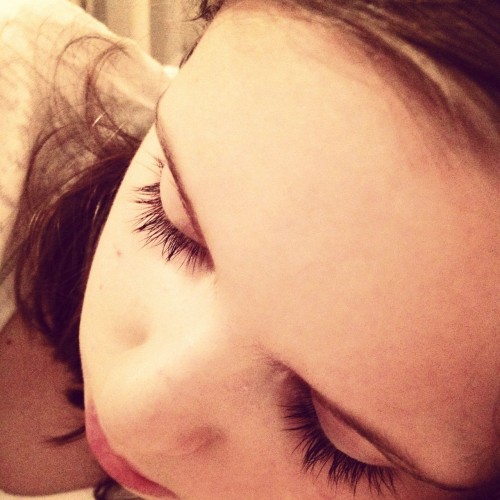
The weekend in New Hampshire, skiing with our dearest friends, the way you gamely rolled out sleeping bags and slept on our floor.  Skiing first thing in the morning, barreling down Turkey Trot, each of you flying over that run’s groomed jumps.  On Saturday morning, being the first people to ski down and then, from the lift, admiring our tracks in the fresh powder.  On Sunday morning, we got a call that you didn’t feel well, Grace, and then you fell asleep lying on my lap in the very crowded, noisy lodge.  I could have watched the shadows of your eyelashes on your sleeping cheeks all day long.  The way the four of us got laughing, uproariously, on the way home.

The crayon hearts we made together, and the Harry Potter sweet shop chocolate frogs too.  The way each of you, without prompting, said to me during this month, “Mummy!  Look at the light of this hour.”  And we did, almost every day, with outright wonder.  Our kitchen, full of homemade Valentine decorations; construction paper hearts all over the walls and pink and red garlands hanging between the cabinets.  Grace’s touch-typing homework, Whit’s introduction to Harry Potter, and red and white heart-shaped ravioli.

There are some things I hope you’ll forget, too.  The morning I snapped at you, raising my voice, outright hollering as we sat at a gas station before school.  “Guys!” I shouted, and you both turned to look at me, silenced and startled.  I am sorry when I lose my temper.  There’s very little that sets me off like your bickering.  I call you the Bickersons and some days, when I have fortitude, patience, I am able to roll my eyes at the arguing.  But some days my fuse is short and I yell.  I’m sorry.

I love you, I love you, I love you.  This love is manifest in the tiniest details of every single day, even when I’m grouchy, even on the grayest days.  The grout between the tiles of life, I once called these small moments, and that’s what they are.  But it’s the grout that holds everything together, isn’t it?

An absence shouts

So much of any year is flammable,
lists of vegetables, partial poems.
Orange swirling flame of days,
so little is a stone.
Where there was something and suddenly isn’t,

an absence shouts, celebrates, leaves a space.

I begin again with the smallest numbers.
Quick dance, shuffle of losses and leaves,
only the things I didn’t do
crackle after the blazing dies.

Naomi Shihab Nye, Burning the Old Year (excerpt)

I read this for the first time on Patti Digh’s wonderful blog, 37 Days.