The holiness in housekeeping

I love empty, unprogrammed weekend days.  Sometimes we have adventures and fly through the air.  Sometimes we simply hang out at playgrounds.  But most often, a wide-open Sunday contains some mix of errands, laundry, walks around the neighborhood, skating, work email, bill-paying, packing of lunches, and cooking for the week ahead.

And you know what I’m realizing, lately?  Very often, the days full of these chores, of life’s most prosaic tasks, are my very favorites.  Grace and I were walking to the drycleaner and bank last Sunday morning, holding hands as we admired the cloudless blue sky when she sighed and said, “Mummy, I love just hanging out with you.”

“I do too,” I said, squeezing her peace sign patterned fleece glove.

We walked on in amiable silence.  Often, on the weekends, we fall into pairs, with Matt and Whit playing hockey or starting a big Lego project and Grace and I being the errand brigade.

“You know, Grace,” I said as we waited for the light.  “I think it’s great if you can really enjoy these little things.”

“Why?  You mean because if we can think something as regular as a chore is fun, then something big like” she hesitated.  “Like … Legoland, well, something big like that is even better?”

I thought about this for a minute as we crossed the street.  What did I really mean?  I guess it’s that the ability to find authentic joy in the grout I keep writing about seems like a very strong predictor of a life filled with contentment and cheer.  When I see my daughter evincing pleasure in such basic, quotidian tasks I feel immense pride and also a flicker of hope that she will have a happy life despite being freighted by having a mother who’s more shadow than sun.

I suspect this is also about my growing conviction that there is a deep holiness in this housekeeping, this elemental life-keeping.  It doesn’t seem like an accident that in recent years some of the basic burdens of keeping a family going – packing lunches, folding laundry – have become things I do, often, with reverence.  I can’t explain what’s changed, but there’s no question that the most ordinary details of my life seem shot through with meaning, charged with a shimmer of the spirit.

And, finally, just as I exhort my children to simply notice things, I’m grateful for any signs of their sinking into their lives, of their learning to lean into the truth of whatever is, at any moment.  Even when it’s boring, even when it means standing in line at the post office or scrubbing dishes.  There is divinity in that drudgery.  I know there is, and it is a source of grand, enormous pride that my daughter may as well.
 

Being conscious of all of life

I loved Mariam Gates’ post last weekend, Brave Heart, about her son’s broken arm.  Mariam’s recounting of her conversation with her son – when he tells her he was not brave because he scared and was cried – is heartfelt, and the reflections she shares about what bravery really means are stirring and thought-provoking.  She writes that she is “not interested in bravery that is synonymous with fearlessness” and while I’ve never thought of it so clearly and compellingly, I find myself nodding.  Yes, yes, yes.  Fearlessness seems like a defense mechanism, doesn’t it?  An over-simplification of this life?  Mariam calls it disconnection, and I think that’s right.  I’ve never been fearless; if anything, I’m often consumed with fears.  Fears run through my veins along with hope and wonder and memory, sometimes making my heart skip a beat, sometimes clouding my vision so I can’t see anything other than that which I dread.

So maybe fear is not fearlessness.  But then what is it? Well, I like Mariam’s definition:

I think bravery is about being conscious of all of life.

Why yes.  Yes, that’s it.  Isn’t she utterly right?  Isn’t true bravery about remaining open to the fear, about letting the fear permeate you, even, and not running away from it?  Of course you could call this a self-interested response, since I think one of the central themes of this blog is being aware of everything, of all of life.  But truthfully I hadn’t thought of it this way before, and when I read Mariam’s post I found myself agreeing absolutely.

Bravery is staring into the sun, even when the brightness of life – and the brightness is precisely because life’s minutes are burning in front of us – is painful.  Bravery is not flinching and not looking away, even when the emotion of a moment overwhelms us.  Bravery is not hiding, in a thousand ways little and big, from our own lives.  Bravery is letting heartbreak gouge your spirit, because you know that that leaves a deeper well for joy.

Bravery is about being conscious of all of life.

Thank you, Mariam, for putting it so beautifully.


Air thick with both wonder and loss

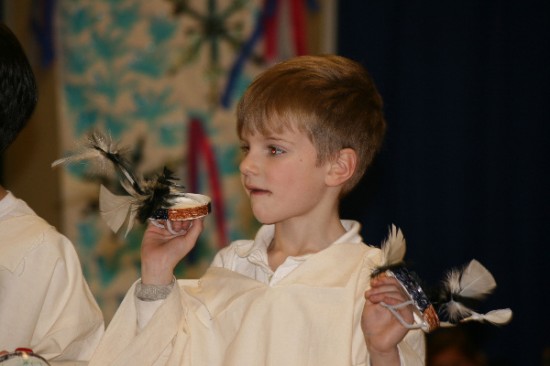
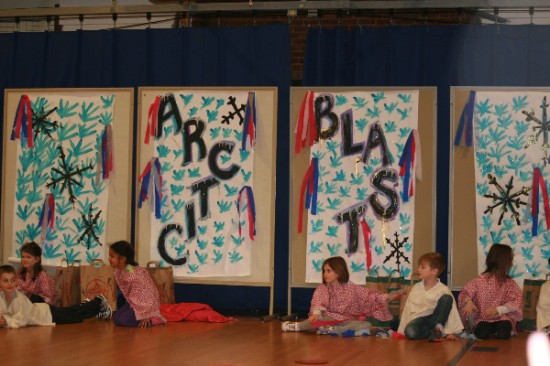
Last Friday the 1st grade performed their annual movement and music assembly, which this year was called the Arctic Blast.  It seems like moments ago that I sat in the audience watching Grace in her 1st grade assembly (Musicians of the Sun), the morning after I threw a surprise birthday dinner for Matt.  We sat in the same gym, our heads telling the story of the night before’s raucous toasts, and while I remember feeling sentimental I was surely not as crushingly overwhelmed with time’s passage was this time.

Probably it’s because Whit is my last baby.  Perhaps part of it is that with each year, each week, each day, I seem to grow more porous, my awareness of life’s beauty and heartbreak.  Maybe it was just the afternoon.  I don’t know, but I sat there on the metal folding chair with tears rolling down my cheeks.  It’s as though the passage of time was in the room with us.

The air was so thick with both wonder and loss that I almost couldn’t breathe.  I marveled at my son.  My son, who just two seconds ago was one of those tiny almost-babies in the pre-K class who sat restlessly on mats on the floor.  My son, who just two days ago was born, his blond hair, his blue eyes, and his boy-ness all shocking me in equal measure.

I am a broken record, these days, I know.  But I cannot stop my astonishment at how swiftly it’s flying, at how vivid the colors of this life are as they blur past my eyes.

You know what else, though?  I don’t want to.

Lonely

I’ve learned via a couple of channels that my post last week about friendship made some others lonely.  This makes me feel terrible, because one thing I am – extremely often – is lonely.  I know the emotion intimately, and I hate knowing that I have contributed to others feeling it.  I am so familiar with loneliness, in fact, that I wrote a post a few years ago called Flavors of Loneliness.  Sometimes the reaction people have to what I write here makes me feel misunderstood, and this is one of those times.

How is it that I can be certain that I am hugely blessed with wonderful friends and, at the same time, often, profoundly lonely?   It’s actually not only not a paradox, it is absolutely at the root of what I consider the most toxic and icy kind of loneliness: loneliness when surrounded by people.  It is true that in the last many years (and even since November 2009, when I wrote Flavors of Loneliness) I’ve become increasingly aware of how wonderful my friends are.  For sure.  I would go further: I am more aware of everything.

But I still feel lonely.  Very.  Often.  I still gaze out at the sumptuous riches of my ordinary life and feel like I’m staring at them through glass, from a cold place where the temperature is turned down too low.  Yet, somehow, maybe because the glass is clear, nobody else can tell how isolated I am.  I suspect that this loneliness has its roots in my cognizance of our essential unknowability, which, while I believe it firmly, I continue to agitate restlessly against.  I want to be known – don’t we all?  I also want to really know those I love best.

I am writing this post sitting in an airport alone on a Saturday evening, after having gotten up at 4:30 to start my day.  I can assure you I feel lonely.  But as I’ve noted this kind of loneliness is precisely because of the fullness of my life; if I didn’t feel so much love and joy (and, sure, pain) in my regular life I wouldn’t ache for it when I was away.  While I dislike this loneliness, it’s nothing compared to that sense of being alone even when surrounded by people, to that creeping, shadowy consciousness of how fundamentally alone I am that follows me through my days.  That loneliness is corrosive, and, unfortunately, for me it’s also a relatively common feeling.

As I’ve mentioned, lately I’ve been particularly noticing the moon.  Specifically, the shadow of the rest of the moon in the night sky, even when only a sliver is bright.  Maybe that’s what this is – the changingly visible but omnipresent remainder of the whole, even when only part is bright.  It’s part of the deal.  Loneliness is an integral part of my life, simply one manifestation of the dark that is both inextricable from the light and crucial to its meaning.

Loss, failure, or unwelcome change

“If grace is so wonderful, why do we have such difficulty recognizing and accepting it? Maybe it’s because grace is not gentle or made-to-order. It often comes disguised as loss, or failure, or unwelcome change.”

– Kathleen Norris