Birthday

Today is my birthday, but really it should be my mother’s day.  On August 16, 1974, she was born as a mother just as surely as I was born as a human.  I was three weeks premature, and I’ve been in a hurry and chronically early ever since.  She was in the middle of cooking for a dinner party when she went into labor, and she’s been the life of the party and everybody’s favorite hostess ever since.

I love you, Mum.  Thank you for being my most important role model in this, the most important role of my life.

The struggle and the beauty

“One day, in retrospect, the years of struggle will strike you as the most beautiful.”
– Sigmund Freud

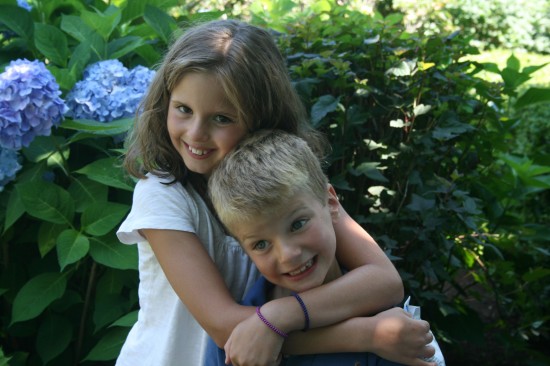
Many thanks to Anthony Lawlor, from whom I found this quote on Twitter. I do believe this to be true, absolutely, though it’s so incredibly difficult to remember in the moments where the struggle seems overwhelming. The struggle which occurs for me on so many levels these days. The struggle to stop my crazy squirrel brain from frantically spinning over and over on the same questions. The struggle to remain patient and present with my lovely children who can be charming, curious, and incredibly aggravating. The struggle not to over-identify with Grace, to maintain the distance and perspective I need to parent her well. The struggle not to crush Whit’s effervescent spirit, whose enthusiastic bubbles sometimes challenge the rules and norms. The struggle to try to keep alive my professional and creative selves, as well as to have enough left over for those who need me.

“These are the day of miracle and wonder”
– Paul Simon

For some reason that lyric was in my head nonstop this weekend. My subconscious was trying to remind me of the richness of the present moment, I suspect, which can be so hard to really see.

It was a weekend with plenty of struggle as well as ample beauty. Somehow the struggle is so quick to occlude the beauty, so much more urgent and immediate, so hard to shake off. Does this make sense? It is here, on the page, and through the lens of my camera that I am more able to see the beauty. It rises more slowly, over time, asserting itself in memory rather than in the vivid moment. The beauty is in the smallest moments, infinity opening, surprising me every time, from the most infinitessimal things, like a world in the back of a wardrobe (there really are only two or three human stories, and we do go on telling them, no?). Why is it, then, that the struggles, also often small, can so quickly and utterly yank me back to the morass of misery and frustration, away from the wonders that are revealed in the flashing moments of beauty?

I wish I could change the dynamic between these two, but the beauty, fragile as it is in the moment, seems sturdier over the long arc of a life. Freud’s quote supports this, the notion that the beauty develops over time, like a print sitting in the solution for a long time, image gradually forming on the slick surface of the photo paper, slowly, haltingly hovering into being. It is, of course, the photograph that is the enduring artifact of the experience.

This was originally posted exactly 2 years ago, and it’s still all true.  Today I am dropping Grace off at sleep away camp, at the camp I went to for 10 years, with the daughter of my best friend from camp.  I miss her already, and she’s not even gone yet.  It will surely be a day full of both struggle and beauty.

Transition

My childhood was punctuated by a series of transitions as regular as a drumbeat.  They were not easy, thought they were an integral part of the rich and complex terroir in which I grew up.  I learned, early on, about the deep bittersweetness of goodbyes.  My family’s moves, back and forth across the ocean with a metronomic every-four-years cadence, engraved into me a deep fear of change.  Transitions, farewells, and endings all cause me deep discomfort and often tears.  This truth is an essential part of who I am (and I know I’m not alone in this).

A couple of weeks ago in a yoga class, I realized something new about myself and transitions.  As I moved through a sun salutation, the poses as familiar as a long-known language, my breath carrying me like a stream, it occurred to me:

The transition between poses is as important as the stillness within them.

I’ve been practicing yoga, with varying degrees of regularity and commitment, for over 13 years.  And for every one of the thousands of practices those years have held I’ve thought that what I was learning was a lesson about stillness, about holding, about enduring, about breath.

And of course I was learning that.  I’ve learned so much about those things – mostly, about abiding, with myself and others – both in class and in my life.  But suddenly that day I saw, with a flash of insight that almost embarrassed me because it was so obvious, that the moving between those poses that I held was equally as important.  I’ve always liked the vinyasa part of yoga, probably because the being still is so hard for me.  But if I’m honest, “liking it” has manifested mostly as moving quickly through the poses, and I realize that is not the point of the vinyasa.  Instead I need to pay equally close attention as I move my body, my breath, and my mind, up and down and around and through.

I need to honor the transitions just as I do the holding.

I’m sure it’s not an accident that this realization comes right as I feel I stand on the threshold of another transition with my children.  They are so incredibly lovely right now, so full of the golden life that is, to me, childhood incarnate.  And yet I see the end of these days like the storm clouds we watched on the horizon as we drove to Storyland (I hope not for the last time).  I know something else wonderful exists on the other side of that horizon, I promise I do – my own childhood of goodbyes taught me that – but I still dread the change.

And yet.  And so.  The lessons keep coming.  Breathing, breathing, into another transition.


To fully live that golden hour


Last weekend was one of those golden, empty-of-all-plans weekends.  We spent it at my parents’ house on the coast, one of our very favorite places.  On Saturday morning my parents left for two separate out-of-town commitments, and the four of us looked ahead at two empty days with delight.  We simply hung out.  There was golf, tennis, hamburgers on the grill and dinner for four at the table on the back porch.  There was reading on the couches, a game of Clue, many games of Mancala. There was some shouting and a lot of hugging.  In short, it was our regular family life.

One thing that’s critically important to me is that my children know how precious it is to be alone, the four of us.  I want them to know how much I prize that time.  My attachment to these empty family hours grows ever fiercer and my experience of them shimmers with more and more beauty.  I am sure this is correlated to my keen sense of how limited they are, days with no plans and only each other for company.  These are the days I know they will remember as their childhood with a capital C, the days I’ll turn over in my pocket years and years from now like touchstones smoothed from repeated touching: them sprawled out on top of their beds asleep in the heat, the smell of sunscreen on Whit’s head when I kissed it, the clatter of Mancala pebbles as they played, talking quietly to each other.

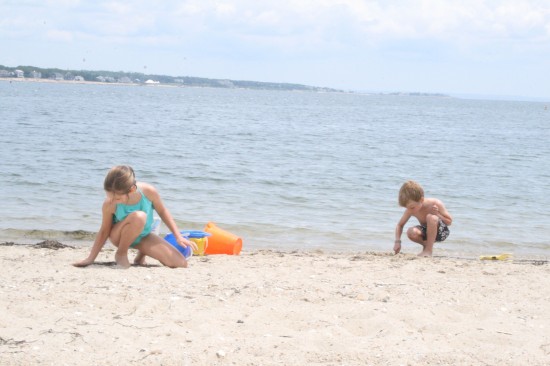
My favorite part of the weekend, though, was Saturday afternoon at the beach.  I love the coast; for many reasons I have explored before, there’s something about this border between two worlds, this place that the moon demonstrates its power over the tides, this land of shells and myriad blues that feels like home.  On Saturday I stood where the ocean meets the land and watched my three family members’ heads, dark and sleek as otters, bobbing towards the wooden raft off the shore.  They clambered up and waved to me, arms above their heads, exaggerated as though they were miles away.

Then I watched Grace jump off the raft into the ocean.  She came up, broke the surface, and even from the shore I could see her grin.  It was 5 weeks to the day since she broke her collarbone.  I felt a wash of simultaneous wonder and gratitude, and saw the ghostly, broken bones on the x-ray in my head.   My eyes filled with tears as I thought about how healing happens, inexorably, undeniably, mostly invisibly.

And I stood there, shallow waves lapping at my feet, watching my children hurl themselves over and over again from the raft into the ocean, hearing their laughter, trying to simply be there.  I fought to keep my observer self inside my body, instead of letting her slip out and hover apart, watching, chronicling.  No: I squished my toes into the sand, felt the sun on my arms, squinted to watch Grace and Whit having a cannonball contest.  Trying to fully live that golden hour, even as I knew it was running through my fingers as I watched it.

Having it all

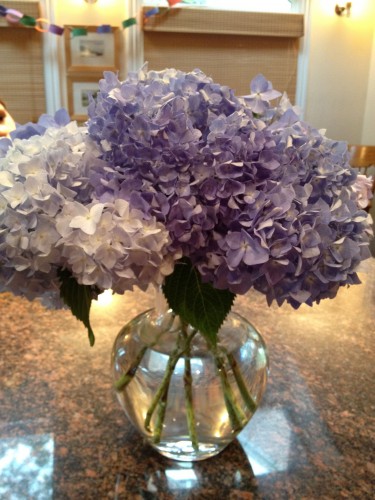
A snapshot of my version of “it all”: hydrangeas (one of our wedding flowers) grown by my husband, in our small front garden, on the kitchen island.  In the back you can see a construction paper garland that Grace recently made for father’s day.

Like everyone else in the blogosphere and real-world-o-sphere, I have been participating in many conversations about Anne-Marie Slaughter’s cover story in the Atlantic, Why Women Still Can’t Have it All.   While I certainly don’t have a clearly-articulated response to Slaughter’s comprehensive and thoughtful examination of working motherhood today, I do have a profound emotional response.  By the third page of the article my eyes were full of tears, the words having touched some reserve of emotion in me as inarticulate as it is endlessly deep.

Most days I feel pretty good about my choices regarding work and family.  Sure, I wonder sometimes what would have happened had I not “leaned back,” as per Sheryl Sandberg, before I was even pregnant.  And yes, I do wonder what it would be like not to work, mostly whether I’d be a more relaxed and less distracted parent to my children.  But on the whole I feel pretty good about the decisions I’ve made and about the trade-offs I make every day (I hate the word and notion of balance when it comes to this topic).  My emotional reaction – quiet, but intense – when I read articles like Slaughter’s, however, suggests that something deeply buried in me still grieves, hurts, and wonders.  About and over what, I am not entirely sure.

Mostly what Slaughter’s article has me thinking about, though, is what “it all” really means.  My friend Kathryn, who is one of those can’t-live-without-her-friends that are for me a big component of feeling like I have anything like “it all,” emailed me to say she was at home because her nanny was out, sitting on her bed with her laptop working while her children lay on either side of her watching TV.  Is this “it all,” she mused?

For me, the answer to that is yes.

I am certain this is a deeply personal equation, and one that changes every day.  For me there are some elements of “it all” that are non-negotiable.  Downtime with my children most days.  A happy relationship with my husband.  Work that I find challenging with colleagues I respect and learn from.  Not missing any – or almost any – school events, plays, concerts, assemblies.  My handful of dear friends, those native speakers whose companionship I cherish.  Time, several days a week, to think and write about this divine and devastating life.  Time to read.  Eight hours of sleep most nights.  Time, several days a week, to run by myself.  The calculus of how each day’s hours are allocated is ever-shifting; I think having “it all” is something we ascertain over the arc of weeks and months, not in a single day.

The point of Slaughter’s piece with which I agree with most vociferously is that flexibility is absolutely essential to making this particularly rich, and demanding, phase of life work.  There’s no question that that is true for me.  I’m certain that my ability to be present for events both big and small in the lives of my children while working full-time has a lot to do with my job’s flexibility.  Of course I’ve made compromises though, and I have written before about how my life over the past years has simultaneously narrowed and widened.  What I’m not totally clear on is where the line is between a mature acknowledgement of the need for compromises and a defeatist acceptance of “not having it all.”

There is lots I don’t have.  Lots.  Tons of children.  A book published.  A fancy house.  A perfect figure.  Extravagant vacations.  Sound sleep every night.  A marathon under my belt.  A high profile CEO job.  A real yoga practice.  Unbitten fingernails.  A yard for my children to run in.  A king size bed.  A red-headed child.  A basic orientation towards calm.

But I think I would say that in the ways I care about, I do have it all.

What is your definition of “it all”?