Off the grid

I’m off the grid this weekend.

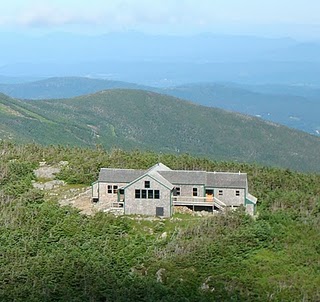
So, so off the grid.  At a cabin in the White Mountains (that’s the actual cabin, above).  This is the fourth annual trip: we hike up, spend the night, and hike down on Sunday.  We are now a group 40+ strong, half children.  This is another stool adventure, and I am looking forward to spending some time with two of my very dearest friends.  I’m also hoping it won’t rain, and my wipers can take a rest.

When they speak of grace

In the church, I force myself to look up into Mary’s eyes, to study the twisted agony of her mouth.  I kiss my baby’s sleeping head, bend down to press my nose to the fragrant scalp of my own son, squeeze the hand of Sam’s older daughter.  I am so sorry to see the limp curve of His only child, although I don’t actually believe in God.  But standing before this stricken Madonna, surrounded by what I love most in the world, I wonder: Was an entire religion generated from a mother’s most fervent wish that her child not be dead?  The twinning of loss and love seems suddenly to explain everything:  To devote ourselves properly to one another, we must brave love’s terrifying undertow, which is grief.  I am awed, suddenly, by our courage to love each other as recklessly as we do.  Awkward and confused, rational and godless – I am all of these things.  And yet this moment must be what people mean when they speak of grace.

-Catherine Newman

wipers

For the last several months, it seems like every time I get in the car for a long drive it starts to pour.  Last Friday I drove through the most intense rain I’ve ever driven through.  It was actually pretty scary: when I got out of the car I realized my hands hurt from gripping the wheel, which I hadn’t even noticed I had been doing.  My jaw hurt from being tensed.  There was also thunder and lightning.  Which I normally  love, but when making my way down the highway surrounded by trucks barreling above the speed limit, not so much.

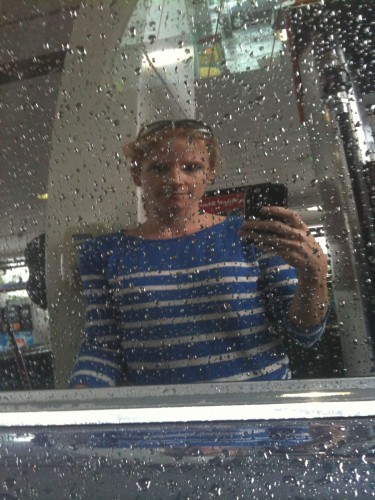
The wipers were going as fast as they could go, and still it was not nearly enough.  I noticed that just the fact that my wipers were on high made my body tense slightly and my anxiety tick up.  I felt a tightness in my chest, there was a slight aggravation in my voice and a quickness to my breathing, all almost imperceptible but not to me anymore now that I can’t help but notice everything.  It stresses me to not have any reserve.  If it’s not enough, these wipers on high, there is nothing else I can do.  Well, other than pull over.  This reminds me of my behavior when physically challenged, of the way I get nervous anticipating that I might not be able to do something (but well before I am actually at my limit).

And the other than pull over part is, I think, essential to the stress.  When the wipers really can’t do the job, even on their fastest setting, I have to figure out another way.  It is the universe telling me – through rain, literal or metaphorical – that the current coping system is no longer working to deal with the weather.  And realizing that I’m running out of rope, or that my road is coming to a bend, or choose your own metaphor … well, all of these things scare me.  A lot.

My wipers are going really hard right now in my life.  I’m definitely at the fastest speed and I’m not sure it’s enough.  There is a lot sluicing down on my windshield: worries about both my parents and my children, anxieties personal and professional, fears of many flavors.  The concerns are sloshing around, occluding my vision, and no matter how hard my wipers go I can’t see the road ahead clearly.

Recently I heard a doctor say that a situation had to stabilize before he could even remotely figure out what was going on.  The underlying issue would not “announce itself,” he maintained, until the rest of the surrounding flux settled down.  This made sense to me and immediately my mind began to spin it into a metaphor.

Maybe it’s time to pull over.  I just don’t know what that looks like, and furthermore I’m not certain I can, given the forward propulsion to some of the things that are raining down in front of me.  Of course Doctorow’s famous words come to mind: “You never see further than your headlights, but you can make the whole trip that way.”  I try not to think that I can’t even see a fraction as far as my headlights.  I can only inch forward, hoping that reckoning will keep me safe on the path.

Oh.

And it recurs: there is nothing to do but to trust.  And to let go.  Even as my wipers frantically flip back and forth, and as I walk with anxiety in my chest for the mere fact of their speed.  Even so.

Setting the terms

The beginning of wisdom is the definition of terms. – Socrates

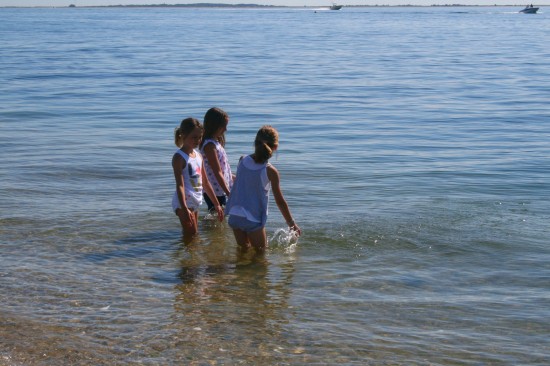
We were visiting friends at the beach this past week, and at one point I was with Grace in the ocean. Despite the heat of the day, the water was cold, and we were standing right at the edge of the waves’ breaking, tip-toeing in slowly. Suddenly a really big wave came and Grace was standing in just the wrong place. She was tumbled over and thrashed around in the whitewater. When she came up, spluttering, her hair and her bathing suit were both full of small rocks. She was breathless, surprised, somewhere between gigglingly startled and authentically afraid.

This was just one more time when the ocean provided me with a metaphor. I know I’m neither alone nor original in finding meaning in the waves, the water, the tide, the undertow. But it is to these images and sounds, to the salty bite of the ocean air, the snapping of halyards against masts, the caw-caw-cawing of seagulls soaring above that my mind most often returns. I am the child of sailors, who grew up mostly on the coast, and this runs through my veins as surely as does my affection for scientific inquiry and my East Greenwich Eldredge blood, so perhaps this instinct is innate.

For some reason I feel a connection between the image of my daughter, tossed in a wave breaking on shore, and that quote by Socrates. I’ve been in my own version of whitewater lately: feeling confused, a bit lost, unsteady. And I wonder if part of that is because I haven’t even begun to define my terms, the terms by which I want to live my life, by which I want to exist in the world. I am fairly sure that awareness of such a need is progress for me. I suspect that for years I just assumed some general universal terms applied to me. Terms that were, importantly, set by someone else.

No more.

I’m going to set my own terms now.

I am not sure how, or when, because right now I’m still a bit upside down in the whitewater, unable to see for sea spray in my eyes, and waiting for the water to drain out of my ears so that I can hear clearly. But at least I know I need to. I know the terms I want to live my life by start with compassion and empathy and kindness, and that they include a deep need to honor the reality, savage and beautiful as it is, of my life.

Maybe that’s what writing is for me. Just as my lifetime love of cornflower blue was, all along, guiding me to my son’s eyes, maybe my words, in the convoluted, slow-to-be-revealed wisdom that I must trust is there somewhere, are taking me to the place where I will know how it is I want to engage with the world. How is it I want to live my life.

A repost from exactly a year ago, because I am still, or again, or always, in this place.  Also, for my oldest friend Ethan, whose birthday it is today, and whose choice to live life on his terms is something I’ve always deeply admired.
(picture is from this year)

The summer of letting go

Letting go continues to be a theme in my life.  I think about what I wrote in December and it’s all still so true:

This letting go is releasing my white knuckle grip on the way I wanted my life to be.

It is EM Forester’s familiar words: “We must be willing to let go of the life we had planned, so as to have the life that is waiting for us.”

It is also acknowledging that certain things are lost and other things will never be.

It is accepting, with a deep internal settling, the passage of time against which I rail so often and so furiously.

It is the sentence of Jack Kornfield’s, to which I return again and again with an instinct as rhythmic and powerful as the tide, its truth ineffably sad and profoundly uplifting at the same time:

To live is to die to how we wanted it to be.

But this summer there’s a new note in the chorus.   Whit is letting go, too.  Giving me no choice but to do so, and to watch him ascend, move away, stretch the raveling red string that ties his heart to mine.  First, there’s the lost tooth.  Oh, my aching heart.
This past weekend we visited friends on Martha’s Vineyard.  We spent most of Saturday at the beach.  At the end of the long dock there was a twisting slide that dropped off into the ocean.
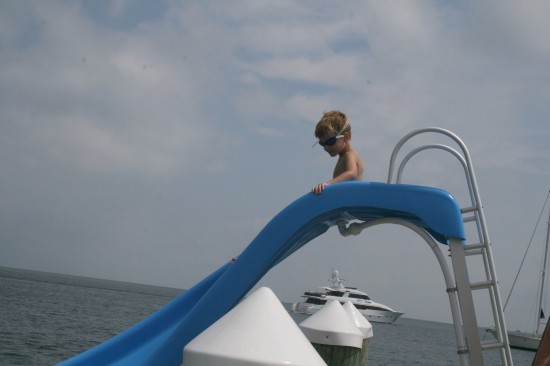
It’s hard to convey how tiny he looked sitting at the top of this slide from the beach.  I walked down and stood by him as he deliberated, deciding whether to let himself go.  And, finally, without any announcement, he did.
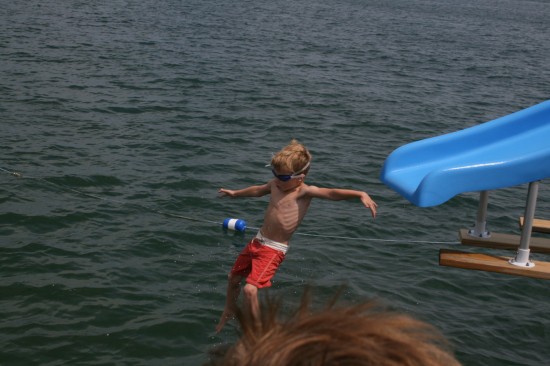
(and yes, I swear I feed him)

The week before we went to the Vineyard, I’d enrolled Whit in a neighborhood camp around the corner.  He knew exactly zero people there.  And on the first day, I signed him in, watched him make a name tag, and then stood with him at the corner of the playground.  “Are you ready for me to go?”  I asked him.

He looked up at me, indicating I should crouch down so that he could whisper something to me.  “Yes.  See you later.  I love you.”

And then away I went.  With a few glances over my shoulder, to witness this.
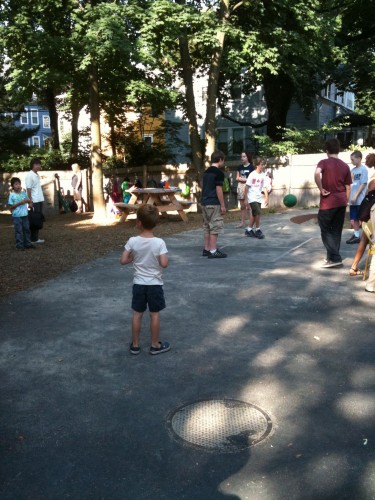
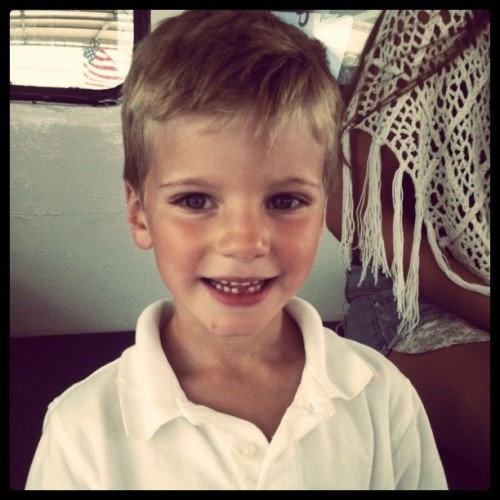
He is tall and lean and looks like a full-blown boy, his hair is bleaching quickly to summer blond, his smile is now crooked, and he’s reading early readers about rockets and bugs.  It’s all blurring in front of my eyes because it’s moving so damn fast.  Like an invocation, I chant silently to myself: let go, let go, let go.

But still he still sleeps with his Beloved wrapped in his arms.  Still.