
Holiness

We live in all we seek.  The hidden shows up in too-plain sight.  It lives captive on the face of the obvious – the people, events, and things of the day – to which we as sophisticated children have long since become oblivious.  What a hideout: Holiness lies spread and borne over the surface of time and stuff like color.

I went back to my dogeared copy of Annie Dillard’s For the Time Being this week, I’m not sure why.  As I leafed through the familiar pages, these words jumped out at me.  During these days when we wake in darkness and we eat dinner in darkness, when the light is so full of both endings and beginnings, the sun bright yet weak, I am trying to see the holiness spread all over this life of mine.

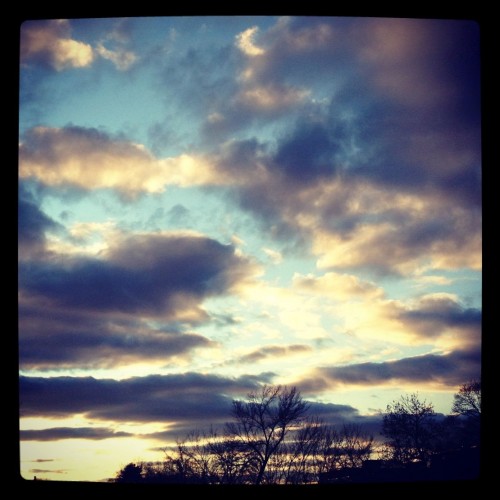
Some days it jumps out and snaps foil in my eyes, waking me up. How can I miss the beauty in this sky, that was spread out above me on a recent walk with Grace?  If that’s not divinity, tangible in this human world of ours, I don’t know what is.
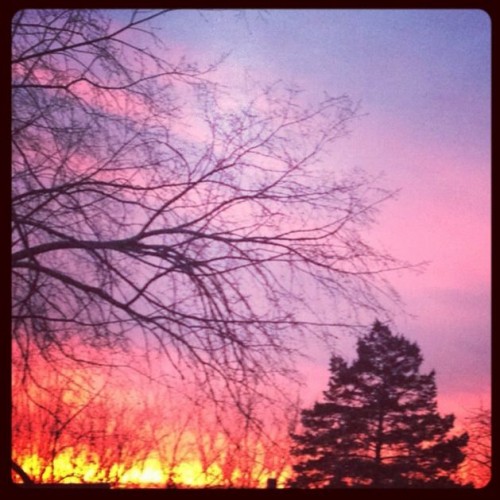
Or this sunset, seen from my desk.  The sky went deep pink, and I took pictures, and then returned to my computer.  And suddenly, for some reason I can’t recall (maybe I heard car doors slamming and the screeches of my children) I looked back out.  And the sky had caught fire.  If I hadn’t looked over, I would have entirely missed it, as the entire show lasted no more than 5 minutes.  It is impossible not to drop to my knees in reverence, not to feel the presence of something that exists beyond logic – over the horizon – in that sky.  And so I do.
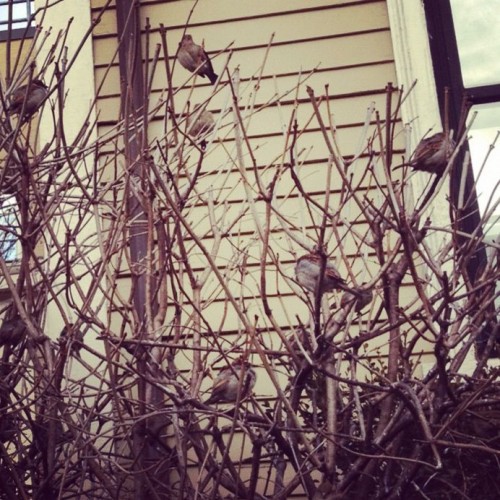
Other days I have to be slightly more aware.  When I parked the car the other day, on my way to an interview on a cold early morning, I could not believe how loud the song of sparrows was.  I looked closely and saw that the bush right by the road, barren and brown, was absolutely full to bursting with sparrows.  I tried to take a picture but of course it didn’t quite capture what I saw.  In the midst of all these dead branches, this fallow world, there is song.

Loving with one’s insides

And I shall not weep from despair but simply because I shall be happy in my tears, I shall steep my soul in my emotion.  I love the sticky leaves in spring, the blue sky – that’s all it is.  It’s not a matter of intellect or logic, it’s loving with one’s insides, with one’s guts.

– Fyodor Dostoyevsky, The Brothers Karamazov

Invisible to mortal sight

I’ve mentioned my father before, the physicist–poet whose influence looms large over me (as does my mother’s).  Well, in a single gesture this week, Dad reminded me yet again of the craggy peaks of his intellect; he read my post about light and responded with an email in which he shared a passage from Paradise Lost.  A passage about light.  A passage I haven’t read in years, a passage that brought to mind long, drawn-out conversations about ancient poetry under magnolia trees at Princeton, a passage that reminded me that Dad has read and re-read Paradise Lost, the whole thing, on his own, more than once.  The guy who has a PhD in Engineering.

You get my point.

Anyway.  I wanted to acknowledge my super-cool Dad, for this generous gesture that tells you a lot about the terroir in which I grew up.  But I also wanted to share a few of Milton’s truly incandescent lines (a word Dad used in his email, one that is one of my very favorite words, reminding me yet again of the continued power of light in my life).  The lines I love best from the (longer) passage that Dad sent me are these:

So much the rather though, celestial Light,
Shine inward, and the mind through all her powers
Irradiate; there plant eyes, all mist from thence
Purge and disperse, that I may see and tell
Of things invisible to mortal sight.

Of course celestial Light, and angels, and the power of faith, religion, and belief are all front of mind right now.  But these lines also remind me of some I recently re-encountered, when Grace read them for the first time.  She actually told me, that night, as I was tucking her in, that she’d read something she really liked.  And she’d thumbed her paperback carefully, found the page, and read me this sentence.  And I blinked back tears.

It is only with the heart that one can see rightly; What is essential is invisible to the eye.
– Antoine de Saint-Exupéry, The Little Prince

I’ve never been afraid to draw parallels between disparate sources (Dr. Seuss and Mark Doty, anyone?), but this one doesn’t actually feel that disparate.  And what these two passages remind me of is that light, as a concept, as a trope, as a way of understanding the world, functions both externally and internally.  As I continue to strive for lightness – humor and laughter – and to sink into the gorgeousness of the shadows and light and dark at play in the sky, I want to also remember the immense importance of that internal light.

I want to honor the spirit’s seeing, which happens by the beam of that internal light.

Towards the solstice

Toward the Solstice, 1977

The thirtieth of November.
Snow is starting to fall.
A peculiar silence is spreading
Over the fields, the maple grove.
It is the thirtieth of May,
Rain pours on ancient bushes, runs
Down the youngest blade of grass.
I am trying to hold in one steady glance
All the parts of my life.
A spring torrent races
On this old slanting roof,
The slanted field below
Thickens with winter’s first whiteness.
Thistles dried to sticks in last year’s wind
Stand nakedly in the green,
Stand sullenly in the slowly whitening,
Field.
My brain glows
More violently, more avidly
The quieter, the thicker
The quilt of crystals settles,
The louder, more relentlessly
The torrent beats itself out
On the old boards and shingles.
It is the thirtieth of May,
The thirtieth of November,
A beginning or an end.
We are moving towards the solstice
And there is so much here
I still do not understand.
If I could make sense of how
My life is tangled
With dead weeds, thistles,
Enormous burdocks, burdens
Slowly shifting under
This first fall of snow,
Beaten by this early, racking rain
Calling all new life to declare itself strong
Or die,
If I could know
In what language to address
The spirits that claim a place
Beneath these low and simple ceilings,
Tenants that neither speak nor stir
Yet dwell in mute insistence
Till I can feel utterly ghosted in this house.
If history is a spider-thread
Spun over and over though brushed away
It seems I might some twilight
Or dawn in the hushed country light
Discern its greyness stretching
From molding or doorframe, out
Into the empty dooryard
And following it climb
The path into the pinewoods,
Tracing from tree to tree
In the falling light, in the slowly
Lucidifying day
Its constant, purposive trail,
Till I reach whatever cellar hole
Filling with snowflakes or lichen,
Whatever fallen shack
Or unremembered clearing
I am meant to have found
And there, under the first or last
Star, trusting to instinct
The words would come to mind
I have failed or forgotten to say
Year after year, winter
After summer, the right rune
To ease the hold of the past
Upon the rest of my life
And ease my hold on the past.
If some rite of separation
Is still unaccomplished,
Between myself and the long-gone
Tenants of this house,
Between myself and my childhood,
Between the childhood of my children,
It is I who have neglected
To perform the needed acts,
Set water in corners, light and eucalyptus
In front of mirrors,
Or merely pause and listen
To my own pulse vibrating
Lightly as falling snow,
Relentless as the rainstorm,
And hear what it has been saying.
It seems I am still waiting
For them to make some clear demand
Some articulate sound or gesture,
For release to come from anywhere
But from inside myself.
A decade of cutting away
Dead flesh, cauterizing
Old scars ripped open over and over
And still it is not enough.
A decade of performing
The loving humdrum acts
Of attention to this house
Transplanting lilac suckers,
Washing panes, scrubbing
Wood-smoke from splitting paint,
Sweeping stairs, brushing the thread
Of the spider aside,
And so much yet undone,
A woman’s work, the solstice nearing,
And my hand still suspended
As if above a letter
I long and dread to close.

(Adrienne Rich)

My sixth annual sharing of this poem on the winter solstice (2006, 2007, 2008, 2009, 2010)

And so we go on, turning back to the light.

The weight of the questions

I measure my own strength
against the weight of the questions i carry
and find the questions heavier than ever this year,
although my heart is wider.

– Alison Luterman

I’ve been reading poetry lately – Once, by Meghan O’Rourke, The Largest Possible Life, by Alison Luterman, and enoughwater, by Maya Stein.  It’s all ringing in my head, but these lines more than any.