Every Mother Counts

IMG_7349

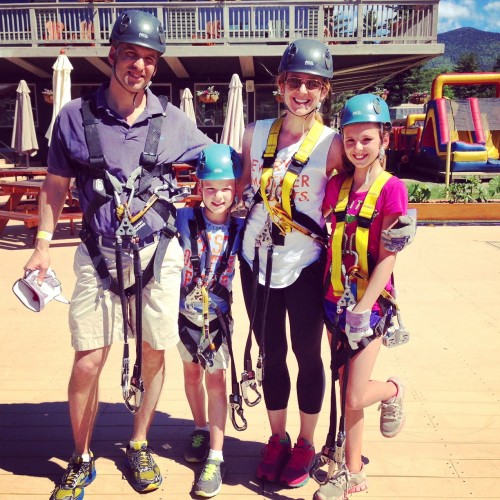
I love what Christy Turlington is doing with Every Mother Counts.  I was thrilled to cheer her on in the Boston Marathon a week ago, and I wear my own EMC shirt with pride (see above, June 2014).  It’s a totally random coincidence, but I’ve also been particularly aware of Christy ever since she and I both had first-born daughters named Grace within a year of each other.

I’ve written about Grace’s birth some, though mostly I’ve written about the deep postpartum depression that swamped me after she arrived. The process of Grace’s birth, in particular its immediate aftermath, makes me care deeply about Every Mother Counts.  Because had I been a mother in a third world country, I would probably have died after delivering Grace.  After a long and intense labor (posterior baby, anyone?  my midwife, who had been delivering babies for decades, told me after that it was one of the most difficult labors she’d experienced) I hemorrhaged.  They gave me pitocin.  I was fine (albeit unhapppy to have the drugs I’d tried so desperately to avoid coursing through my system).

It wouldn’t have been that easy had I been delivering somewhere else.  I am grateful that western medical care was there to intervene when I needed it.  I don’t spend a lot of time thinking about that moment (I mostly think about the 43 hours that led up to it!) but whenever I hear anything about Every Mother Counts, that simple act of putting an IV into my arm comes immediately to mind.  It’s not rocket science, and it was simple that morning. But it saved my life, and I’m aware that that intervention is unavailable to hundreds of women, whose birth outcomes would have been entirely different from mine.

The statistics are appalling.  303,000 women die every year from complications in pregnancy or birth.  These deaths are tragic, and they have a ripple effect too: they leave an average of 4 orphans.  In the United States the picture is better, but not as good as it could be: we rank 60th worldwide in terms of maternal health, and 2 women die per day in childbirth or pregnancy.  Every Mother Counts has a tremendously compelling call to action: 99% of these deaths are preventable.

I adore what Every Mother Counts stands for, and I also love the way that running has become a focus of what they do.  The movie Every Mile, Every Mother (which I was fortunate enough to see in New York a couple of years ago) really highlights this connection, as did cheering Christy on in the Boston Marathon.  The metaphors abound: motherhood is a marathon, of course, and by putting one foot in front of the other we can achieve our goals both large and small.  It’s a mental game as much as a physical one, and it’s about commitment.

It’s impossible me to think about Every Mother Counts without reflecting on my own birth experiences.  I imagine most women who’ve given birth recall those life-altering hours regularly.  I know I do. I was stubborn in my pursuit of an unmedicated delivery; I recognize that, and know that I could easily have wound up with a different kind of experience. People ask me regularly (still!) why I chose to go that route, and I don’t have a good answer other than to say I had a deep, instinctive desire to do it that way.  And I’m glad I did: Grace and Whit’s births are without question the two most empowering experiences of my life. They shaped who I am and I’ll never forget anything about those passages, when I touched another world, felt something holy both holy and primal.  And I’m hugely aware that it was the medical support I received after Grace’s birth that allowed the story to have a happy ending.  The care was so simple, and I think it saved my life. Every mother should have access this.

I’m not affiliated with Every Mother Counts and nobody asked me to write this post.  I was inspired to do because of my particular interest in and passion for the cause. 
the thing is

The Thing Is

to love life, to love it even
when you have no stomach for it
and everything you’ve held dear
crumbles like burnt paper in your hands,
your throat filled with the silt of it.
When grief sits with you, its tropical heat
thickening the air, heavy as water
more fit for gills than lungs;
when grief weights you like your own flesh
only more of it, an obesity of grief,
you think, How can a body withstand this?
Then you hold life like a face
between your palms, a plain face,
no charming smile, no violet eyes,
and you say, yes, I will take you
I will love you, again.

– Ellen Bass

I found this beautiful poem on Light and Pine, a blog I read religiously.

Ease doesn’t look like I expected it to

IMG_0780

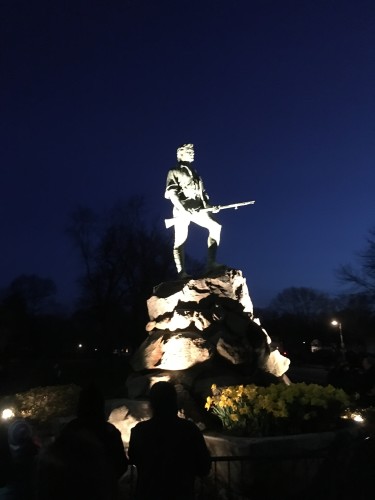
Lexington Battle Green, 5:15am on Patriot’s Day

I should have expected the slap-down from the universe.  I really should have.

In March 2009 I wrote about fragility.  “At any moment Grace and Whit could meet with danger, either through an accident or through development of illness. When thinking about this post last night, I thought initially: I have chosen not to live in fear of these risks.”  As usual, I write my posts a few days in advance.  The day it went live, Whit ended up in the ER with his second allergic reaction to tree nuts.  It was scary.

In May 2012, I wrote about the 10 things I wanted Grace to know when she turned 10.  One of them was “Don’t lose your physical fearlessness.   Please continue using your body in the world: run, jump, climb, throw.”  Days later, she broke her collarbone.

Over the weekend, I wrote about ease, and the ways in which my life right now is the opposite of ease and, perhaps, the embodiment of it.  The post went up on Monday morning.  Monday itself was an exceedingly bumpy day in our family’s life.  I thought almost all day of my friend Launa‘s image of a family of four as a shopping cart.  When one wheel’s wonky, you just can’t drive smoothly or straight.  Monday we had four wheels out of joint.  Which meant, of course, we went nowhere fast and with great aggravation.

It was, on the surface, a great day.  We got up at 4:40 to go to the reenactment of the first skirmish of the Revolutionary War in Lexington.  I’ve never seen it before, and it was both fascinating and unexpectedly powerful.  But that early wakeup put everybody on edge for the rest of the day.

We watched the marathon some, I worked a lot of the day, the kids both finished homework they had not gotten to over the weekend.  Nothing specifically went wrong.  But everyone was crabby – myself included, most certainly – and there was a lot of short-tempered snapping.  Dinner was filled with tense silence and crossed arms.

I didn’t feel ease.  I felt frustration and a generalized feeling of anger and exhaustion.  How could one early morning derail us all like this? Why are we all living so close to the edge right now (all the time)?  Why does everything feel so hard?

As it often has, reading saved us.  After some dish-clanging and raised-voice dinner cleanup, we all retired upstairs.  Grace and Whit showered.  I did some email.  Before long, I was in my favorite place, sitting in bed with a child on each side of me.  We were all breathing, we were all reading, we were all together.  The dissent and aggravation and tears of the day dissolved in the face of those irrefutable truths.

This is what I’m learning, finally:

This is what ease is.

This is what grace is.  They’re not the same thing, but they are, at least in my head, related. They are also some of the many, many manifestations of the way life is not necessarily what we expect it to be.

Ease is not never being aggravated.  It’s coming back to center more quickly.  I think of the round-bottomed glasses my parents have on their boat, which wobble but don’t actually tip over.  It’s breathing through the discomfort.  It’s trusting that the light will return, even when it’s dark.  It doesn’t look anything like I thought it would, ease, but it’s still here, in every step, in every breath, in every moment.

Is this the opposite of ease?

IMG_0758

It’s Saturday morning, 6:24.  I’ve been up since 5:00.  Woke up and just could not go back to sleep.  Matt got home very late from a trip and so he’s sleeping.  Whit just got up and despite my entreaties that he go back to bed, he’s sitting at his desk, down the hall from mine, working on homework.  Grace will probably sleep until we wake her up (see: teenager).

We had the most wonderful dinner with my parents, aunt and uncle, and beloved favorite cousin and her fiance last night.  Grace and Whit adore my aunt and uncle, who came to the Galapagos with us, and my cousin and her fiance.  It was a lovely, lovely evening and I left feeling replete with love and family.  Family was running through my veins, you could say.

We were all up late.  I expected that we’d sleep in this morning.  Instead, I found myself lying in bed at 5am, wide awake, my head racing through various topics big and small.  It occurred to me that this – this behavior, this place of being, this racing mind early in the morning – might be the opposite of ease. It’s ironic that I chose ease as my word of the year when 2016, so far, doesn’t feel like it’s full of ease.  Maybe it’s not ironic at all, of course. Maybe it’s precisely right.  Maybe some deep part of me knew that this would be a year of transition and in-between-ness, and that I needed to remember the value of ease as I journeyed through it.

When I think of ease, the words that come to mind are relaxed, calm, comfortable.  The only one of those I feel right now is calm. In the midst of right now’s shifting sands, in all the uncertainty that occludes every day, in the fog of the not-knowing that permeates every day, I feel calm.  I can feel my breath entering and leaving my chest.  I can close my eyes and see certain images – the ocean at my parents’ house south of Boston, the flickering of candles in Jerusalem’s Church of the Holy Sepulchre, the setting sun from the tower at our nearby cemetery that I love – to which I return, over and over.

Maybe this is ease.  This allowing, this honoring, this breathing, this listening.  This being here.  That’s all I can do, today and, really, every day.  I haven’t written much about this year’s word of the year, though I think about it a lot. Maybe it’s taking root in my soul and in my cells in some kind of quiet, slow way.  As ease does, right?

The ocean. The candles. The sunset.

Breathe in.  Breathe out.

I can hear Whit typing away.  I can see the texture of the light changing on my tree, outside my window, as the sun comes up.  Here comes another day.  What an outrageous, incandescent blessing that is, isn’t it?  I have never lost sight of that.  I hope I never do.

Why are we reading?

Why are we reading, if not in hope of beauty laid bare, life heightened, and its deepest mystery probed? … Why are we reading if not in hope that the writer will magnify and dramatize our days, will illuminate and inspire us with wisdom, courage, and the possibility of meaning, and will press upon our minds the deepest mysteries, so we may feel again their majesty and power?

– Annie Dillard