
The Gift of an Ordinary Day
A beloved blog reader sent me the YouTube video of Katrina Kenison reading from her book, The Gift of an Ordinary Day. Predictably, the video made me cry, hard. I ordered the book immediately and it sat on my bedside table for a few days before I picked it up. And then. I read it, in a couple of long sittings, underlining and nodding vigorously as I went. In the simplest terms, this is the poetry of midlife, and a heartfelt exploration of loss. Kenison describes a vague but growing sense of unease in her comfortable suburban life that reminded me of both Dani Shapiro’s description in Devotion of being pushed from behind and my own deep, restless discomfort.
Kenison describes this feeling beautifully: “Watching my sons growing and changing so visibly, almost from one day to the next, I sensed something inside me breaking loose and changing as well, something no less powerful for being invisible.” She and her husband make a decision to leave their familiar town without being entirely sure where they are going. They move in with her parents and eventually buy a small and falling-down house on a hilltop in rural New Hampshire.
The book traces a summer spent in the cabin on the hill, the decision to raze it and the process of building a new home in the same location. Kenison is a gifted chronicler of the everyday: under her steady gaze the most mundane moments become luminous pearls. She describes a late-in-the-day snowshoe with her son and the way that a sunset brings meaning and color to an entire day, the lessons learned in the careful, rote stripping of years and years of paint from their cottage’s old doors, intended for reuse, and the heartbreaking mix of pride and sadness in watching her older son across a college cafeteria, chatting with sophomores and seemingly already right at home.
The book is suffused with loss. Kenison explores the very same themes that preoccupy me every single day. She wrestles with the impermanence of life, the inevitability of time’s moving forward, and the profound desire to recognize the beauty right in front of her. The project of building a house and of falling in love with a specific landscape becomes a metaphor for finally putting down roots, literal and symbolic. This, of course, entails closing doors and accepting what will never be, which Kenison acknowledges and mourns.
Being alive, it seems, means learning to bear the weight of the passing of all things. It means finding a way to lightly hold all the places we’ve loved and left anyway, all the moments and days and years that have already been lived and lost to memory, even as we live on in the here and now, knowing full well that this moment, too, is already gone. It means, always, allowing for the hard truth of endings. It means, too, keeping faith in beginnings.
Another theme that Kenison speaks about is the importance of making space for her sons to simply be. She describes the difficulty of ignoring the culture’s “siren call” but is delighted about the summer in the cabin when the family does nothing. She is passionate about giving her sons the space to daydream and to become themselves. This is so resonant for me, and of course I am reassured to have such an eloquent and intelligent person advocating the view I share.
As Kenison unpacks boxes in her new home she stumbles upon a pile of old journals. In their pages she rediscovers her old self, from 10 and 15 years ago. She realizes that her desire to live in the moments of her life, to really see the peace and the beauty that she knows is heaped in front of her has always been there.
This, I realize, is what I’ve wanted all along: to be more attentive, to honor the flow of days, the passing of time, the richness of everyday life. Some part of me has always known it, known it well enough, apparently, to write it down, over and over again, year after year. Finally, there is another part of me that’s ready to stop and listen to what I’ve been telling myself, ready to pay attention to what I know.
She knows that she already knows the answers, such as they are. Perhaps, really, there is no single answer, but only more questions. Still, to sit with oneself and to learn what we already know: this is no small feat, no simple task. It takes maturity and wisdom and peace. To be quiet enough to trust what our body, and our spirit, is telling us. Kenison etches this journey in gorgeous, simple words: the faint markings of the first frost on a window come to mind, lit to sparkling brilliance by the sun coming up. Her search is both blindingly simple and the most complicated thing in the world: to know who she is, out beyond the traditional markers of identity (“mother,” “wife,” “publisher,” “writer”) and to recognize that much life’s task is to say goodbye. To those we love, to places that have held us, to versions of ourselves we may have been very invested in.
In the keen awareness of her son’s movement away from her, Kenison hears the call to grow herself. This, of course, takes faith: in the face of fear and change, it would be easy to instead cling to the familiar, to make a shrine of that which has always been known, always worked. But no.
I know I can’t make time slow down, can’t hold our life as it is in a freeze frame or slow my children’s inexorable journeys into adulthood and lives of their own. But I can celebrate those journeys by bearing witness to them, by paying attention, and, perhaps most of all, by carrying on with my own growth and becoming.
That is what this book is. It is a beautiful witnessing of Kenison’s ordinary family life and of her growing sons. It is a record of three unsettled years of moving towards a new definition of home. And it is the commitment of a woman at midlife to continuing to grow, which means letting go of old identifiers and, ultimately, coming home to herself. In moving foward we circle back, we women do, to something that has always been true but that has required a certain amount of life experience for us to be able to see. Doors open and doors close, we move resolutely forward, yet we also dance back to something primal and primitive. We must accept that every single moment is limned with loss.
The transience of life breaks our hearts and also gives them back to us. In letting go of our attachment to the now we are pierced with loss, but we also know something new will come. Kenison quotes Jack Kornfield, “To live is to die to how we wanted it to be,” expressing the interconnectedness of true awareness and painful loss. It is in trusting the journey that peace comes. My favorite line from the book is this one, towards the end:
The future is never ours to call anyway. No matter how carefully we may try to orchestrate or foretell outcomes, there are forces at work in this universe that are far more powerful than any of our human machinations. So be it. We all learn by going where we need to go. Let us welcome the mystery then, and trust that what is meant to be, will be.
Read this book. It will sweep over you like a wave of truth, like the soft morning air at the ocean, like the smile of a good friend. If you are interested in what it means to be a mother, a woman, a seeker of peace and contentedness, you will find much here to love. This is a much, much more beautiful rendering of many of the thoughts and fears that are dearest to my heart. Thank you, Katrina Kenison. Thank you.
Why do I write?
Jo at Mylestones described yesterday her weekend of quotidian experiences with her children, concluding, with lovely, resonant truth: “I write so I won’t forget. I write because the little moments matter to me, because they add up to my life.”
She closed her post by asking her readers two questions: Why do you write? What small little moments of the last few days do you want to remember?
I’ll take those in reverse order. The last few days have held a profusion of small moments. Last night, checking on Grace and Whit to see them sleeping in the same bed (the condo we are staying in has two double beds in their room). They were turned away from each other, each a comma on the pillowy white landscape of the pristine bedding. Convincing a crying, ornery Whit yesterday to ride on the bike attached to the back of mine only to hear him proclaim, after a few minutes, “Hey, mummy! You were right! This is super fun!” Watching the backs of two cousins heads, dark and otter-sleek, as they bobbed together in the pool. The night sky scattered with more stars than I’ve ever seen – the light-spangled darkness seemed to arch over us in a semi-circle, coming all the way down to the horizon – last night while Hilary and I walked on the beach after dinner.
The why I write question is one I think of all the time. The answer is both simple and complex. It is about community, it is about catharsis, it is about excavating truth even as I speak it. It is about, more than anything, the way that I am inspired, over and over again, as a reader, and about my stubborn and perhaps wrong-headed hope that I might provide that feeling for someone else. (originally written on 9/20/2009):
There’s been a proliferation of interesting writing on the topic of Why We Blog this week. Ronna addressed it, focusing on three main points: that blogging is a way to get outside ourselves, is therapeutic, and is a way to tell our stories. She asserted, and I agree, that we all have myriad stories to tell. She hinted that in this telling we are both ourselves enriched and, possibly, privileged to participate in the growth of others. Ronna included an Isak Dinesen quote I love: To be a person is to have a story to tell.
She followed up this post with a second, the next day, about the way that “blogging is a way to create and experience community.” I very much agree with this point, which echoed Aidan’s thoughtful observations on why she blogs. I share the sentiment that blogging is a way to meet (and be met by) people whose lives and stories are very different from our own. I am sometimes keenly aware of the general homogeneity of my life. I love my life, of course, but I do have a certain restlessness of the spirit that is slaked, in part, by learning about people whose lives and choices are very different from my own.
So I’ve been thinking this weekend about Why I Blog. I know I feel a visceral impulse to share the stories of my life, both the mundane ones and the meaningful ones. I know that writing often helps me put shape around my nascent or amorphous thoughts, helps me understand the underlying current beneath a riptide of emotion. Joan Didion put it best: “I write entirely to find out what I am thinking.”
But there’s another, impossible to ignore, reason why I blog. After all, blogging both assumes and actively seeks an audience. Obviously I need, on some level, to know that someone is reading my words. I think this is a reflection of the basic human need to be truly seen. But is it exhibitionistic? Does it make the thoughts and content less meaningful? Is it the wrong thing, to want someone to be reading? I have thought about this a lot, struggling with the initial feeling that it is immature and needy of me to need someone to be out there reading me. On some level this is just a continuation of a pattern of needing to be validated and approved by the big bad world out there, isn’t it?
I think it is that, yes. But I think it is more than that too. I imagine that most writers write for an audience, whether it’s an audience of one (perhaps Steven King’s Ideal Reader) or millions. I cannot in good conscience claim the title of “writer” for myself, but I know that one reason I blog is because I hope to, someday, provide for someone else that shimmering sigh of recognition that some writing I’ve read has given me. That bone-deep sense of being not alone when someone else can put into words thoughts or feelings that have swarmed incoherently around my head and heart. If I can, someday, give a single reader that feeling that I have had so many times in my years of blog-reading, then I will be happy. It feels arrogant to even wish for that, but in truth, I do. I am personally sustained by those moments when someone else’s writing makes my heart physically swell with identification and awareness, and I aspire to provide that for someone else.
For me, more than the community, more than the catharsis, more than the story-telling, it’s about that. About that feeling of recognition, that single moment when you read a sentence or a paragraph and suddenly understand something you’ve known all along in a new way. Which, when I think about it, is sort of an amalgam of community, catharsis, and story-telling. I’ve been blessed to be on the receiving end of that feeling many times, and I continue to hope that I might provide it for someone out there.
To illustrate my point, here is one such passage – a paragraph that made me shiver because it put into such beautiful words something I’ve thought before. A paragraph that happens to be ABOUT that feeling. (oh so very meta).
Have you ever looked at, say, a picture or a great building or read a paragraph in a book and felt the world suddenly expand and, at the same instant, contract and harden into a kernel of perfect purity?
– Carol Shields, The Stone Diaries
Yes, I have. And I did just there. And that’s why I write.
(And no, I am not arrogantly comparing myself to one of the great writers of the last few decades. No. I come up to Carol Shields’ ankle. But she inspires me.)
Skipping rocks with my Dad.
I remember being a child, maybe 7 or 8, standing on the rocky beach on Long Island where my father grew up. His parents still lived in his childhood home, a few blocks’ walk from this beach. Set back from the beach were rows of wooden changing rooms, whose gray paint was peeling slightly. We used to run down the aisles between the changing rooms, laughing and chasing each other. My grandparents’ room (they were all assigned, and locked) had life jackets in it, and a strong and persistent smell of Shower to Shower talcum powder. To this day that smell takes me right back there. There was a long, narrow pier that protruded into the ocean, with a dock at the end of it. The dock is where Hilary and I played the popsicle game with other children.
Today, though, we’re not swimming. Dad is skipping rocks. He’s always been good at this: he picks the right kind of rock, flat and round, and is able to make it skip four, five, six times before it sinks into the ocean. I try to skip rocks like Dad, but I’m not as skillful, and manage at my best two skips before the rock stops moving and drops to the bottom of the ocean. So, mostly I watch. I’ve stood next to him while he skipped rocks into countless bodies of water: the ocean here, on Long Island, as well as that in Massachusetts and Rhode Island. Ahead of me, though I don’t know it, is rock-skipping all the way across this ocean, off the coast of England and into that country’s lakes.
I sit here on an airplane, watching my children across the aisle, hearing Whit wonder whether we are “on the earth,” “in outer space,” or “somewhere in the middle.” For the record, I’m going with (c). I am as far as possible from my 9 year old self on the shore of Long Island Sound. Yet I can’t stop thinking of my brown-haired father, meditatively flinging rock after rock into the ocean, making them skim across the water before falling in, creating the illusion of a solid where there is really only liquid.
My mind is like that, skipping from one place to another before surrendering and sinking deep into the dark unknown. It tries to stay afloat, tries to believe that the surface that it is skimming over is solid enough to support it, to keep it buoyant. And yet, eventually, my thoughts always wind up being pulled underneath the surface. I am forced to admit, over and over again, that this surface is not solid enough to keep me from sinking deep into the layers. But maybe that is okay, maybe the lesson is that, as my father kept skipping new rocks, new thoughts will come and take me skimming across the surface again. And the buoyancy of that skipping, of that being aloft, means so much more for the knowledge of what lies beneath.
First grade open house
Yesterday morning, I went to Grace’s class’s “open house.” This was basically 30 minutes for the parents to sit in teeny chairs or kneel on the linoleum floor (oh, 35.5 year old self – NOT nice. getting up: hard) and have the children show us their latest work. There was pride and sheer delight on Grace’s face as she showed me her journal, her drawings of the Iditarod, and other pieces of work. Totally worth the sore knees.
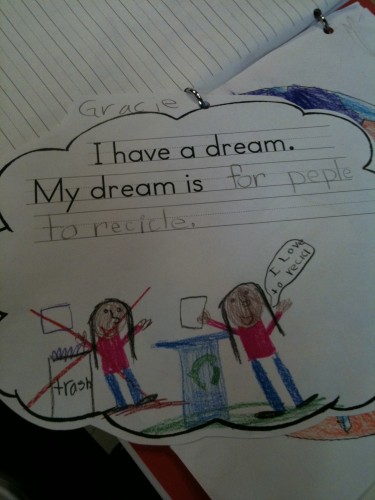
I have a dream that everyone recycles. Good dream, this one. She recently asked me, totally seriously, “Mummy, can we start composting?” with the same kind of enthusiasm previously reserved for questions like, “Mummy, can we go to the American Girl store?” I told her I’m thinking about it.
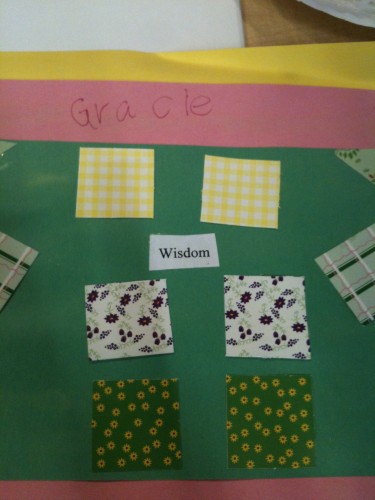
This is the “word of the year” that she selected for herself. Good choice, Grace. My daughter is an old soul. And wow do I adore her.

I am special because I make cupcakes. I’ll take it.
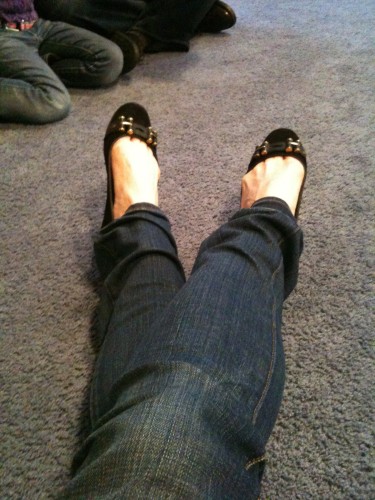
Finally had to creakily get up off the floor and go sit in the circle time area.
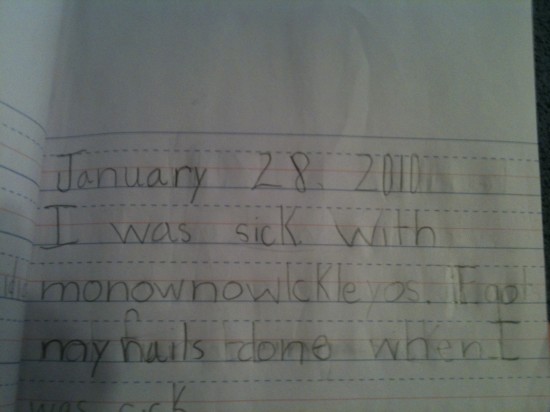
A valiant effort at spelling “mononucleosis.”

Oh, and this bozo? Showing off his new sneakers for our trip to Florida. He was wearing his pajamas when I asked him to try them on. Moments later he showed up, interrupting Grace and my Harry-a-thon, prancing around buck naked in his sneaks. Ah, Whitty.