Parent-teacher conferences, again

Another year, another set of fall parent-teacher conferences.  I look at the pictures in last year’s post and I’m struck by how little Whit seems.  I see him every day so the growth is imperceptible.  It’s only when I look at images and details from a year ago, like this, I realize how startlingly he’s growing.  All of his little boy summer blond was just cut out of his hair, and he’s now the height when he stands in front of me that I still think his sister is.  That is, he’s what I think of as the height of my older child.  Not anymore.  Grace is growing too.  A mouthful of holes has grown into a set of big, adult teeth.

Grace and Whit continue to be their very own selves, growing more and more into the personalities that they’ve been exhibiting since they were very small.  They are distinct individuals, with strengths and weaknesses now showing like flags.  Also becoming clear are the ways that their repeated bumping into each other is shaping them.

Grace continues to be a conscientious perfectionist and an over-achiever.  She loves to read but Math is her favorite subject.  I especially loved hearing about how she is a generous friend who is quick to help anyone who needs it, and who is aware of those who are alone and/or sad in the classroom or playground.  She is eager to perform and to please her teachers, for better or for worse.  I can sense that she’s taken, either by choice or default, the “straight man” role to Whit’s comedian.  I can tell that this sometimes frustrates her.

Already she can feel the weight of expectation on her shoulders; my reaction to this is ambivalent, both an intense identification and a deep guilt that this heavy cloak is part of the legacy of being my daughter.  She also inclines towards shadow, as do I – whether this is innate or learned I can’t know.  “My poor, poor daughter, tugging behind her the heavy freight of [the] moody melancholy” she inherited from me, I wrote a while ago, and days like today I’m keenly reminded of it.

Whit is different from Grace in so many ways.  He is laughter to her seriousness, rebellion to her rule-following, light to her cloudiness.  He is beginning to sound out words and demonstrating facility with numbers, but continues to struggle with paying attention and sitting still.  Some of this is, naturally, age-appropriate for a five year old boy.  Some of it, I’m beginning to see, is a way of deflecting attention from a task he’s not comfortable with.  If he just acts out, changing the subject by making people laugh, he can avoid having to do things he’s not confident about.  I think this is a reaction, too, to his older sister, a way of claiming his own territory.  What I feel about this behavior in Whit is very different from the dizzying self/other vertigo Grace gives me: I feel a combination of abject horror and complete respect at the way he challenges authority.

Whit has, however, occasionally demonstrated the same raw vulnerability that I recognize so personally in Grace.  He misses places, people, and times of his life with an fierceness that reminds me of my own.  He has, acutely and specifically, bemoaned the passage of time.  These moments remind me that my children are not as simply and neatly categorized as it’s tempting to think.  Whit, too, inherited my sensitivity; he just handles differently than Grace does.  I believe that his default to humor, to being a clown, is also a way to escape his own moods: by making others laugh, he is lifted himself.  Isn’t this true of many of the funniest people you know?

I’m humbled tonight, again, by the complicated, nascent human beings I live with.  I’m certain, as I’ve always been, that they do not belong to me – they are just passing through, and it is my honor to shelter them as I share these magic years.  What multi-faceted people my children are, resilient and fragile at the same time (the same is true of most adults, I’d posit).  My mind is swirling tonight, full of images of their babyhoods, more recent moments, disbelief at the speed with which it’s all flying, all set to the soundtrack of the lullabyes they each still listen to as they go to sleep.  Which I can hear faintly from their rooms now; somehow it feels like the familiar words are floating from years past, when they were babies, from the years we have already spent together.

Three Scenes

Deep thoughts I do not have right now.  The weekend found me oddly discombobulated and tired; I feel lately like I’m not entirely inside my own body.  Or maybe I’m too much inside my own head and not enough inside my body.  Maybe this is just a towards-the-solstice fog.  In lieu of anything substantial, I can offer three scenes from my regular little life.

This summer, while flying to Legoland:

Whit, folded over, examining the bottom of his seat between his own legs, “This is for flotation?”

“Yes, Whit,” I said.

“But only for if we land on water, right?” Still bent over, he was now using his hands to explore under his own seat.  I thought of Kara and how she’d have the Purell ready.

“Yes, Whit.  Only on water.  If we crash on land, well, you don’t need your seat cushion for flotation.”

Grace, sitting by the window and reading Percy Jackson so intently I had no idea she was listening to us, pipes up, without looking up from her book, “That’s always what I have thought. Better to land on water.”

“That’s a good thing to have an opinion on, Grace,” I looked at her, startled.  She didn’t even glance up from the page.  All I could think of was Robert Frost’s iconic poem “Fire and Ice,” and I wondered in what universe my seven year old has thought through what surface she would prefer her plane to crash on.

****

Walking upstairs from dinner, this week:

“Barbies are so lame,” Grace says, her voice tinged with a performative disdain.  She knows how I feel about Barbie.  She glances over her shoulder, looking for my reaction.  I smile and nod, urging her and Whit both up the stairs with my eyes.  Why does it take so long, this final ascent?  “They can’t even stand up on those feet,” she said, and I stifle a giggle.  At least when she’s not wearing her stilettos, she can’t.  So true.

“Barbies are also always losing their heads,” offers Whit, from his spot above us on the Everest of the stairs.  (of course he helps this loss along, enjoying the loud “pop!” Barbie heads make when they are snapped off, but still … inadvertently funny).

****

Before bed, last week:

It had been raining and I had not been able to run my children like dogs after school at the park (which is my usual parenting approach).  They were incredibly hyper and wired and annoying before bed.  So I asked them to do 100 jumping jacks each.  And they did.

The least we can do is try to be there

“The answer must be, I think, that beauty and grace are performed whether or not we will or sense them. The least we can do is try to be there.” – Annie Dillard (Pilgrim at Tinker Creek)

“What Ruth has known all along: what will happen can’t be stopped.  Aim for grace.” – Ann Beattie (Learning to Fall)

I love both of these passages, which seem to me to be saying different versions of the same thing.  I’ve written before about how I feel I’m circling and circling, sometimes, not making progress enough, saying the same things over and over.  Sometimes this frustrates me, makes me feel stuck.  On other days the message coming at me externally (as in these two quotes, and in the bird I found sheltering in my porch the other night) and bubbling up internally (the aforementioned circling and circling) is so consistent, so strong and powerful, that I realize I ought to just put everything down and listen to it.

This is one of those messages.  In fact, I suspect that, at least for me, this is the message.

Life – grace, beauty, peace, whatever you want to think of it as – is just right here.  And white-knuckling my way through it doesn’t do anything but exhaust me.  Things are unfolding in a way that I have much less control over than I’d like to believe, and the best I can do is open my eyes and see.  Not miss, in my desperate, soul-depleting efforts to manage destiny, the gorgeousness that is at my feet right now.

Remarkable as it may be, the world seems to spin without me personally doing the spinning.  It has taken me 36 years to really learn this.  In fact, if I’m honest, I’m still learning it.  The freedom that comes with letting go is immense, and I’ve tasted it, though I’m not always able to remember that.  The lesson for me is to do so in a more complete way.  Letting go – accepting that what will be will be, as Beattie says, enables a complete shift in perspective: instead of being a lamentation of what is not, life becomes a benediction of what is.

All we can do is show up.  Isn’t this what the poets have been saying, since the beginning of time?  And the priests, too?  Yes, yes it is.  Just by being in this world, banal and brilliant, where majesty and mediocrity coexist in every single moment, we are witness to beauty and grace.  All we have to do is be there.  And to watch.

Mythology and moments (II)

I really love the latest post on Chicken & Cheese about our personal mythologies, the moments that define us, and the sense of standing on the brink of one. I am so familiar with the scene she evokes: the late night, the insomnia, and most of all, the feeling of plates shifting under the surface. I know this creaking well.

I also know the way that this shifting can feel deafening to me, utterly preoccupying in its noise and, sometimes, its pain. It always surprises me that it is invisible and inaudible to others (or to most). Somehow, the movement of the fundamental structure that underlies who I am goes undetected to most of the world. Somehow, even when it feels as though I am cracking (which I do not today, by the way), I walk through the world as though nothing is happening.

Of course the flip of this is that we ought to treat everyone with a compassion that respects whatever whitewater they are riding inside their own heads and hearts. If the world cannot see our turmoil, our plates shifting, then we cannot know this of others. Be kind. Those with tear-glazed faces or cold eyes probably have internal demons that we cannot know. It – and this is hard for me, I admit, very hard – likely has nothing at all to do with us.

No trumpets sound when the important decisions of our lives are made. Destiny is made known silently. – Agnes de Mille

Today I am pensive (here in my pensieve), thinking about my personal mythology, about the moments of my life that shaped who I am today. Some of them are big, I know, like the births of my children, but many of them are small. In fact I think it is true, this notion of destiny taking shape in silence. Often the true shifts that change our direction irrevocably happen invisibly to others. This is the terrible, wonderful privacy of this life: nobody can know our internal terrain well enough to walk it without guidance.

From almost exactly a year ago … and I still feel every word of it…

Present Tense with Laura Munson

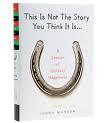
I read Laura Munson’s memoir, This Is Not the Story You Think It Is: A Season of Unlikely Happiness, over the summer, and adored it.  The book grew out of  Laura’s summer 2009 Modern Love column, which I remember reading with interest.  This Is Not the Story You Think It Is begins with Munson’s husband of many years coming home and telling her he’s not sure he loves her anymore.   Instead of responding with anger or throwing him out, Munson simply responds, “I don’t buy it.”  She commences a period of steadfast patience.  She is certain that her husband’s wavering has to do with him, and not her, and she is committed to waiting him out while he works through his crisis.

Munson’s memoir traces the months of this season, during which she waits, determined to save her marriage by demonstrating her deep commitment to it and to her husband.  This commitment takes the form of space, tolerance, and tremendous faith.  She chooses not to give in to the urge for drama, not to hurl accusations.  This is challenging beyond measure, and of course there are moments she loses her cool.  On the whole, though This Is Not the Story You Think It Is showcases the power of devotion and what can happen when we remember to put the prize we seek above our moment-to-moment personal needs.

Beyond being a story about marriage and midlife, though, This Is Not the Story You Think It Is is about becoming the source of one’s own joy.  It is about shifting the power over our own moods back to ourselves.  It is about the things that are possible when we fully commit to something, even when that effort is difficult and draining.

Munson talks about the teetering stack of books on her bedside table, many of which are about spirituality, peace, self-help.  She has been a lifelong seeker, she tells us, but it is not until this moment, with her marriage in crisis and fault lines running through a foundation she assumed was stable, that she really starts to understand what she has been seeking.

“But,” I whimpered, “I’m in a spiritual cul-de-sac. I don’t know how not to want. I’m very, very attached. Not in the least Zen. More . . . I don’t know . . . Episcopalian.”

It’s not simple, this letting go of how she imagined her marriage would be, this strident attempt to … not attempt so much.  Of course Munson falters.  She is funny and wise, humane and deeply human as she relates the ups and downs of her waiting season (an aside: like Munson, I’m an Episcopalian, very, very attached, and a lifelong seeker).

Munson wrote This Is Not the Story You Think It Is from the white-hot center of the experience; not for her was the advice to get a healthy remove from an emotional moment before writing about it.  No, she wrote in real time, as she lived through her summer of waiting, her weeks of doubt, her moments of surprising peace.  As she moves through time, she grows more and more clear about the process she is engaged in, which proves to go far beyond the situation with her husband.

“It’s about not taking things personally. Even when you feel the world is crumbling around you. It’s about choosing happiness over suffering. It’s about retraining the way we think.”

Of course, this is no small achievement; it might be the goal of a lifetime.  At least for me.  Many things go into choosing happiness; among the most important is learning to appreciate that which is right in front of you.  When Munson dives into what it means to not choose suffering, she hints at some of the nuances of her ordinary life, and suggests that it is in the embrace of these things that freedom, and joy, can come.

“Suffering sucks. Don’t do it. Go home and love your wife. Go home and love yourself. Go home and base your happiness on one thing and one thing only: freedom. Choose freedom, not suffering. Create a life of freedom, not wanting. Have some really good coffee and listen to the red-winged blackbirds in the marsh.”

I’m so glad to have found Laura Munson’s words, in both her book and in her blog, These Here Hills.  She writes for the Huffington Post, the New York Times (her recent Lives column, about a mother and her growing-so-fast daughter, made me cry), and on her blog.  Go read her words now – you won’t regret it.

1. When have you felt most present?  Are there specific memories that stand out for you?

Giving birth to my children, writing books, riding horses.  All three of these things require us to be in the present moment.  Like no other experiences I’ve known, they warn of the dangers of the mind.  Of engaging fear.  Of not being present.  All require a loosening, an opening and letting go; non-resistance.  Receiving what is…the illusions of the past and the future melting away.

2. Do you have rituals or patterns that you use to remind you to Be Here Now?

I have a very busy mind.  So in order to quiet it, I need easy, broken down methods.  So it’s three deep breaths when my mind is a-whirl.  Or it’s saying a prayer that I memorized as a child in time to those three breaths.  Or a heart shaped rock I hold in my hand to take pause—I collect them and keep them all over my house.  It’s silent and it’s simple.  And mostly it’s about identifying those destructive thoughts we all have, and loving them into submission.  I used to think we needed to hunt them down and make them die violent deaths.  Now I realize that when we’re doing that, we’re at war with ourselves because we’ve created those voices.  They’re of us.  So to love them like a scared child works much better for me.

3. Do you have specific places or people that you associate with being particularly present?  Who?  Where?  Any idea why?

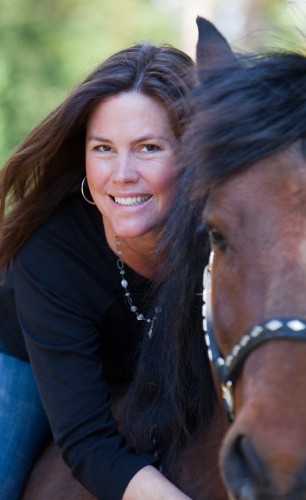
The woman who I ride horses with is the most present human being I’ve ever met.  She has had a hard life and you never hear her complain and you rarely hear her speak about yesterday or tomorrow.  It’s “look at the immature eagle,” or “that mama doe has a new fawn hiding in that field,” or “that’s a mountain lion den” or “aren’t the larch trees stunning this year?”  We may get into conversation, but she is always keenly aware of what is happening around her and with her horse.  It keeps her calm and it keeps her safe.  I have worked with this woman for ten years and more than anything else, I’ve learned how to clean my mind and be present, all from our travels by horse in the woods of Montana.

4. Have you ever meditated?  How did that go?

Writing is my meditation.  It’s my practice.  It’s my daily prayer.  I have always been a seeker from a very early age.  And I’ve always had a rich prayer life.  My prayers have become lean.  More like little casts into a slow-moving stream—a few words.  Thanks.  Help.  Yes. I find great solace and inspiration in reading the work of the mystics from most religions who are all about love and the freedom of the present moment.  And yes, I have meditated in the sense of repeating a phrase in my mind in a deliberate way in a quiet place.  But for me a walk in the woods is the best meditation.  I always come back feeling clean-slated.

5. Has having children changed how you think about the effort to be present?

I try to teach them to be aware in the moment.  That all the suffering comes in our attachment to the illusion of past and future.  To own what they can own and then let go of the rest.  I try to teach them the freedom that comes from that awareness.  I’m a student and a teacher then, I guess.  When there are people you love and you see them suffering and you feel you have ideas and practices that pull people out of suffering, it’s easy to go into teacher mode, but I find that it’s much more effective to simply practice more than preach.

6. And just cause I’m curious, what books and songs do you love?

Jim Harrison is my favorite writer.  I love all of his work, and especially his poetry.  I love the book THE BROTHERS K by David James Duncan.  e.e. cummings and Rilke and Rumi and Neruda.  Salinger, especially FRANNY AND ZOOEY.  Truman Capote’s A CHRISTMAS MEMORY.  Annie Dillard.  And music…well…I love Bach.  I love the Durufle Requiem.  And old timey folk tunes.  My musical taste is all over the map.  From Puccini to Joni Mitchell to James Taylor to Ella Fitzgerald to The Velvet Underground to the Grateful Dead to the Violent Femmes.  Dixieland jazz.  Big Band music.  Depends on the weather.  The song I play on the piano, its lyrics appearing in my high school year book senior page, is CORNER OF THE SKY from the Broadway musical, Pippin, so there you have it.