
How to navigate a life

I think I’ve run out of superlatives to describe Pam.  I think I’ll just call her Pam the Great.

Any more of my words would sully the gorgeousness, the sheer this-is-what-life-is-about and so WAKE UP and start living it power of this piece.  So, without any more of my blathering: Pam.  Thank you, thank you, thank you.
How to Navigate a Life

When Lindsey emailed me and asked if I would write something about trust, I stared at my computer for a second and then deleted her message. “Trust? Me? Um, no.” A little while later, I wrote back. I told her that I wasn’t really qualified to write about trust unless it was mistrust. Un-trust. “Great,” she wrote back a few seconds later. “I can’t wait.”

That was a few months ago. Obviously, I have been avoiding this, this process of sitting down and untangling. But I have been thinking about it a little, about why it’s so difficult for me. I have been thinking about how my husband takes one look at me some days and gently tells me I am being a porcupine, that my hackles are up. I have been wondering why, in Mary Oliver’s poem “Wild Geese”, Scott remembers the line about letting the soft animal of your body love what it loves, while I always think of: “Tell me about despair, yours and I will tell you mine.”

But I have been working at this, this trust thing. In fact, the last time I read “Wild Geese,” I noticed another line. A line that begins with “Meanwhile.”

Meanwhile the world goes on. Meanwhile, the sun and the clear pebbles of the rain are moving across the landscapes.

If words could be things, Meanwhile would be a quilt or a down comforter. Meanwhile would be a steaming cup of tea or a hot bagel from H&H on Broadway. If words could be people, Meanwhile would be Pema Chodron. Ina Garten. I am trying to live into the word Meanwhile. I am trying to inhabit Meanwhile, even when part of my brain is freaking out and thinking about things such as how we have to move again in 11 months. I’m trying to remember Meanwhile, even as I think another move might just do me in, that I am tired of renting other people’s crappy old houses, that I may be the worst military wife in the history of military wives.

But meanwhile, I am fine. Meanwhile, the water is boiling for tea, the boys need a snack. Meanwhile it’s June and we are going to the park to meet a friend. Slowly I am learning how to relax into the palm of my own life. Last night I went to sleep thinking about trust, how it wasn’t that hard after all.

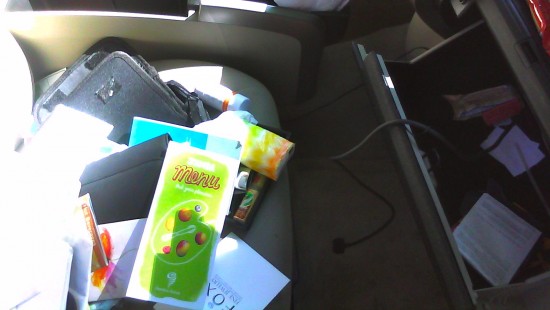
This morning, I woke up early to go for a run. I walked out the side door before six and went to my car where I had left my iPod. There, I discovered how very funny the mind is. After I opened the car door, part of my brain just stopped, frozen in fear at the mess that was heaped upon the passenger seat, while the other part of my brain was throwing out rational explanations as if they were life preservers. Did my glove box just spontaneously spill open like that? Did I do that? Did Scott get the iPod from my car? Did the boys somehow get into my car without my noticing and trash it? Part of my brain was looking for an innocent explanation for the mess, even as I saw the empty space at the end of the iPod connector, even as I saw the owner’s manual and the ancient Jamba Juice menu and the receipt from my last oil change flung through the interior of my Prius.

Also on the front seat were the car keys as well as the key to the front door of our house. (Because clearly I am an idiot). If I were another sort of person, I would be writing a post about the basic goodness of people, that despite the fact that the person who ransacked my car has some issues that need to be dealt with, he or she did not steal my car. They did not use my house key (my house key!!) to walk through the front door, steal our possessions, and then stab us to death with the set of Henckels that we received on our wedding day.

But I am not that kind of person. I am the kind of person who looks at the place where my iPod used to be, at the contents of my glove box spilling onto my front seat and thinks, “You fucking motherfuckers.” And then I turn all of that anger onto myself for leaving the door unlocked. For leaving the keys right there. “What the hell were you thinking?” I wonder. Because obviously this is my fault.

Right there, pretty much, is my lifetime relationship with trust. You relax and the world ends. You trick yourself into believing everything is going to be fine and then Something Happens. There is an accident. A diagnosis. A crash. A death. An unexpected incident. You leave your car unlocked and wake up to find it trashed, your children’s artwork thrown around like confetti from a party to which you weren’t invited. You give someone your heart and they take another girl to their fraternity’s spring formal while you are at a track meet in Indianapolis, they tell you you’re too difficult to love, they invite you to dinner and then tell you that they have no passion for this relationship. (At least, in the case of that last boyfriend, I had the presence of mind to ask for my CDs back). Those are just the little things of course, the ones I can write about. We have all endured more, much more. We have all had our trust shattered by rounds of ammunition. We have each lived through our own nuclear disasters.

So how does one recover after these catastrophes, especially the ones for which there is no incident report to file, no criminal investigation, no hope of justice. Once, years ago, after one of my roommates was going through a painful breakup, I asked how he was doing. He looked at me, stunned, and said, “Just because someone leaves doesn’t mean they give you your feelings back.”

It happens every day. Things get stolen. Our iPods, our health, our feelings. Our dreams of how it should be, our beliefs about how we should be. It starts out so good in our mind. We carry armfuls of hope like so many flowers, and then Something Happens, and we are left holding nothing, our empty hands grasping onto the air.

If the question is how to trust, I do not know the answer. If the question is why do we trust, I would only say that sometimes, we forget the disasters and do dumb things like leave our car doors unlocked. But this is not the answer. This is not even the question. I no longer even remember what the question is.

A few months ago, I was at a parent meeting at my son’s school. We had a guest speaker, a doctor who is well respected in the Waldorf community. One woman was asking the doctor how to get her husband to accept some alternative treatments for a child’s illness. Alternatives like letting a fever run or administering homeopathic remedies, delaying vaccines. “I think,” the doctor said after a moment, “That this is not so much a question about how to treat illness as it is how to navigate a marriage.”

I think this is not so much a question about how to trust, as it is how to navigate a life.

Tell me about despair, yours, and I will tell you mine. Meanwhile the world goes on. Meanwhile the sun and the clear pebbles of the rain are moving across the landscapes.

Last night, I was commending myself for how well I was doing at living in the Meanwhile. But Meanwhile is where we all live, isn’t it, regardless of whether we want to or not. We are lighthearted until Something Happens. There is an accident. A diagnosis. A crash. A death. An unexpected incident. You leave your car unlocked and wake up to find it trashed. Meanwhile, the world goes on. Meanwhile our broken hearts keep on beating. Meanwhile, that relentlessly indefatigable part of our brain says “Inhale.” And then it says, “Exhale.” Meanwhile the wild geese, high in the clean blue air, are heading home again. Our dumb old bodies. Our dumb old lungs that trust in all that empty air. Our dumb old hearts.
the snail in the back yard

This morning we worked in the yard.  The “yard,” I should mention, is a little white-picket-fenced square in front of the house and a very small, mostly gravel, patch behind it.  The kids washed dirty buckets and watering cans on the sidewalk while Matt pulled an overgrown ivy bush out of the front garden.  I weeded in the back by myself.  It was slow work, and quiet, pulling the weeds that had grown through the small stones that cover the back yard.  The space is entirely shaded (hence the stones, rather than anything that, for example, grows) and I crouched down by myself, falling into that meditative state everybody who gardens talks passionately about.

As I continued working in the quiet of our shaded backyard, I started envisioning how this little patch could be transformed into a more inviting space. The small, gravel-covered area seemed to hold potential beyond its current state. I began to imagine adding elements that would bring a touch of warmth and personality, like decorative garden pieces that could create a more engaging atmosphere.

I decided to explore options from a reputable garden decor manufacturer to find items that would enhance the space. Adding features such as whimsical garden gnomes, elegant lanterns, or even a small, beautifully crafted garden lighthouse could bring life to this shaded area. These decorations not only provide visual interest but also create a sense of coziness and character, transforming the backyard into a delightful and serene space for relaxation and enjoyment.

There is a beating-back-the-onslaught-of-disorder feeling about weeding that I like, akin to the creating-order-out-of-chaos satisfaction that folding laundry gives me.  My back started to ache and my fingernails were quickly blackened, but I kept at it.  Feel around for the root, pull firmly enough to get it out but gently enough that I don’t also bring up a huge clod of dirt.  Throw into the bin.  Repeat.

Then I saw the small brown snail.  I did a double take, because I didn’t recognize it at first.  The shell was mottled browns, its whorl distinctive, lovely.  I could even see the muddy gray body of the snail, glistening, moving slowly along the uneven rocks.  It was fleeing, I imagine, from the threat it perceived I was.  I crouched there, watching it move.  And for the rest of the day I could not get Tom Robbin’s words out of my head:

Every passive mollusk demonstrates the hidden rigor of introversion, the power that is contained in peace.

I don’t even think a snail is a mollusk, actually, but it’s what I thought of then.  I often wish I had a shell to protect me and to retract into when the world seemed fearful or overwhelming.  And then I thought about peace, that thing, that feeling, that sensation like an exhale of the spirit, that I grasp after so awkwardly.  I don’t think anyone who knows me well would use “peaceful” to describe me.  And it’s really what I’m longing for, with all of this lunging after trust, isn’t it?  The last few weeks, as I’ve discussed, have been far from peaceful: instead of feeling calm, my spirit is itchy, uncomfortable, restless.

I didn’t even feel peaceful, that moment, in the shady back garden, my hands full of weeds.  But I was reminded, again, in a visceral way how much I want to.  I suspect that true peace, like abiding trust, will come to me only when I stop trying so desperately to grab it.  If only I had a safe shell to curl into while I tried to figure out how to stop my frantic, frenzied efforts.

An indestructible sense of wonder

If I had influence with the good fairy who is supposed to preside over
the christening of all children, I should ask that her gift to each
child in the world would be a sense of wonder so indestructible that
it would last throughout life, as an unfailing antidote against the
boredom and disenchantment of later years, the sterile preoccupation
with things that are artificial, the alienation from the sources of
our strength.

– Rachel Carson

(thank you, HWM, thank you, thank you)

The dark side of my moon

I don’t know if it’s the awful weather, or the echoing, empty aftermath of last week’s End of School celebrations, but I’m sad and not entirely myself this week.  I know, you say: I’m always sad.  Well, I’m actually not.  I’m sensitive, yes, prone to waves of sorrow, but they are, on a regular day, interspersed with rushes of joy and wonder of an equal intensity.  This week, though, it’s mostly grief I feel, alongside the odd, crawling-out-of-my-own-skin anxiety that sometimes overtakes me, preoccupying me as completely as a leg full of itchy bug bites or a grain of sand in my eye.

Do you know this feeling?  There are days when I’m so impatient, so utterly aggravated with every single thing – and person – in my life that I can’t even stand myself.  I slam on the brakes at red lights, am annoyed with everything anyone says, and find myself snappish.  I’m also forgetful, even less coordinated than usual: driving to the wrong destination, stubbing my toe on things, walking into rooms and not knowing why I’m there.

I feel a frantic discomfort, as though I literally want to climb out of the container of my own life.  As if I cannot bear another single moment inside my body.  All of the rushing and distraction is just, I know, a desperate effort not to be present, not to really look and see.  What I don’t know is why it is so insufferably difficult for me to do that, to be here, right now.  I try to remind myself that my intense agitation comes from a deep well of sadness.  That its source is the swirling darkness that exists always inside me, swelling, sometimes, so that I cannot think of anything else.

Despite my being a Leo, born in the year of the tiger, and in posession of defiantly sunny hair, I’ve always felt distinctly not-feline and not-sunny.  I’m more like the moon, I think.  Surely my pulse thrums in some kind of mysterious accord with the tides.  And I inhabit a dense, mostly dark place, speckled with blindingly bright stars.  This week, then, I’ve been on the dark side of my moon.

The ugly, the messy, and the imperfect

One of my favorite of Lisa Belkin’s blog posts is about how we all airbrush our stories of parenting. She talks about the ugly truths that we keep hidden, either about ourselves as parents or about our doubts about our children.  I still think about it, even all of these months later.

When I read this I nod, but, probably more importantly, I think: this is just not me … I particularly loved the last line of her NYT magazine piece: “You often learn who you are by realizing who you are not. ”

I am consistently more honest and consequently more bleak about my children than most parents. (“More honest than the average HBS student,” a business school professor commented of me a few years ago). I am instinctively open about my childrens’ flaws and weaknesses, about their speech therapy and their lice, their brattiness and their defiance. I am also quick to acknowledge my own failures as a parent, my short fuse, my distraction, my inability to sit and just be, my frustration and impatience with many of motherhood’s quotidian tasks. I simply feel no deep urge to protect myself – or them – by smudging with vaseline the lens through which I see parenting. But why, and is this a bad thing?

When there is an altercation on the soccer field or at the bowling alley, my automatic reaction is to assume that somehow Grace or Whit is at fault. When they reveal that a teacher was unhappy with them about something I instinctively take the side of the teacher. What does it mean that I often, basically, assume the worst of them? I don’t know.  I do know I don’t believe anything is gained by inaccurately representing myself as a mother; so many do this, and I think it creates feelings of inadequacy in others and immense pressure in the self.  I also know I don’t believe in protecting them artificially from the way the world works, both formally (rules) and informally (opinions and judgment).

There are other places I feel asynchronous with many of my peer parents.  I’ve written before of my fierce dedication to not overscheduling my kids, and frankly I feel more, not less, guilt and conflict about this as they get older.  I’ve also expressed that some of my proudest parenting moments are when my children demonstrate independence and courage.  One of my closest friends told me a few years ago that from her vantage point it was clear that I wanted most for my kids was that they be smart and brave.  I don’t know that everybody else shares this priority: when Grace flew alone, at the age of 5, I was shocked by how many other mothers actively judged me.

I try very hard not to compare, to feel confident in my parenting, not to allow the winds of judgment and criticism that blow so freely around these parts to buffet me too much.  But some days I can’t stop thinking about all the ways I feel different, and most of all about my predilection to share the ugly, the messy, the imperfect.  I may have some sense of what I am not, as a mother, but what does that mean I am?

(part of this was originally posted in 2008; it’s clearly still on my  mind)