Magic

That’s the magic. We have no idea. Ever. We have no idea until the storm passes and we are on our backs in a field ten miles away from home….
Surprise is where the magic lives, between the margins of to-do lists, the aftermath of the eviction notice, the tiny movements on the ultrasound machine….
Or maybe, somewhere, deep within us, sits a pocket of magic. And once in a while, we are given the option to tap into it, to watch from the audience as the rabbit comes bounding out of the hat, free and fearless and full-speed ahead, surprising even the man with the wand.

I’ve been a big Rebecca Woolf fan for years, and I think you should all be reading her blog if you’re not already.  But this most recent post, Magic, struck me even more than her words usually do.  I read it weeping, smiling, realizing that yes, yes, and yes, she was saying all the things I knew but hadn’t been able to put into words before.  She writes about exactly a year ago, the day she found out the third child she and her husband conceived after much deliberation was actually twins.  That was not the plan.  And it was, in the end, magic.  Absolute, utter magic.

And she is right.  There is sheer magic in those surprises, those shocks, those startling moments when we wake up and see life itself shining like foil being shaken in our eyes (shook foil is one of my favorite images for awareness).  However they come – with a thunderclap or a quiet whisper – these moments of magic all remind us that we are not in charge.  We are not pulling the strings.  Instead we are gazing up at a star-speckled night sky, believing in the design even if it is so vast that we can’t see it from where we stand.  That belief – that all this randomness, good and bad and painful and beautiful, adds up to some kind of whole whose meaning is much larger than its individual parts – is magic.

Maybe children see this better than we do.  When Rebecca writes about her son, Archer, it reminds me of my Grace.  He has an uncanny ability to see, and express, truths that far exceed the reaches of most logical human minds.  When I read Rebecca’s poetic musings on magic I thought of something Grace said, just last summer.  I was putting her to bed the last night before she went to sleepover camp for 10 days.  As I kissed her goodnight I could literally sense the churning river of time flowing through the room.  I told Grace I’d miss her, enormously, and that while I knew she’d miss me she should remember that she was having an enormous adventure, and I would be living my ordinary life, which would remain unchanged when she returned.  She leaned back, looked me right in the eye, and pronounced with undeniable intensity:

“Your life is not ordinary.  Your life is full of magic.”

Her words startled me, took my breath away by pointing out something right in front of me that I had forgotten to admire.  By reminding me of the surprise, and the magic, that exists in both the littlest moments and the lightning storms of life.

Actual and ideal

“How often we find ourselves turning our backs on our actual friends, that we may go and meet their ideal cousin.”
– Henry David Thoreau

Kirsetin Morello is leading a fascinating project on her blog.  Every Monday she posts words that intrigue her, move her, interest her.  On Wednesday she shares her reflections on those words and invites others to do the same.  These words from Thoreau, which I had never read before, are this week’s featured quote.

Thoreau’s words remind of the adage that the perfect is the enemy of the good.  They also remind me something I’ve said before, which is that for many of us the central task of adulthood is letting go of what we thought our lives would be like.  We compare what is to what we wanted, or imagined, and very often reality falls short of those dreams.  And so we fall, over and over again, into the perilous lacuna between the vision and the truth.

It’s only after we are sufficiently bruised from these falls that we stand up, brush ourselves off, and realize: no more comparing.  Instead we vow to turn our gaze to what is here, now, and to embrace that for what it is.

Of course this is true, too, for friends.  While I think Thoreau’s point has broad resonance beyond actual friendships, it is relevant with respect to those we love, also.  Many years ago I realized, for example, that I’d have only a handful of truly intimate friends, native speakers who I felt understood everything about me.  I mourned this truth for a little while, not because I wanted more of these friends of the heart but because mine were not local, and I ached for them.  But then, in an adjunct realization, I allowed myself to understand that there were great benefits to friends who were not connecting with every single dimension of me every single minute.  There were, once I let myself enjoy them, great joys to be had with friends who were fabulously fun to drink wine with, or fascinating to talk about books with, or partners-in-mothering with whom I could share the nitty gritty details of my son’s latest tantrum.  And so what if it wasn’t a single person spanning all of those realms?  That was okay.

Let’s not turn our backs on our friends, or on our lives, because what is ideal is not real, and the holding one up to the other results in nothing but anguish.  Instead, may we learn to lean into those friends and that truth that is right here, now, imperfect and wonderful all at once.


The Bread of Angels

The Bread of Angels opens as Stephanie Saldana arrives in Damascus.  She is a 27 year old running away from devastating losses in both her family and her love life.  She comes to Syria on a Fulbright, after graduating from a master’s program at the Harvard Divinity School, trailing streamers of all that is broken and shredded in her life: relationships, family stability, self-esteem, sense of purpose.  She spent the years between college and her master’s program traveling around the world, “chronically incapable of staying in one place.”  Her attempt to settle down, in a serious relationship and in a graduate program, ends with anguish when her boyfriend tells her to go to Syria, and he’s not sure he ever loved her anyway.

Raised Catholic in San Antonio Texas, in a family with a deep seam of despair, darkness, and depression running through it, Saldana acknowledges in herself an unmistakable, though initially inchoate, pull to the Middle East and to the Arabic language.  Her Fulbright is to study the Muslim Jesus, and the first thing she does is immerse herself in the study of Arabic.  These first months in Damascus are full of sensory overload, and Saldana describes gorgeously the sights, smells, and sounds of a city that is both foreign and, somehow, intimate.  While much of this part of the world is unfamiliar to me, I thought on every page of our trip to Jerusalem in December.  At the very least, I could hear the haunting call to prayer that floats through Saldana’s pages, and the air in Damascus.

At the heart of the book is Saldana’s pilgrimage to Mar Musa, an ancient Christian monastery built in the cliffs outside of Damascus.  After her ascent to the monastery, hundreds of steps long, Stephanie bows to enter the tiny doorway.  Doors of humility, she tells us they are called, and as she ducks into Mar Musa she remembers lines in the Gospels about the narrow gate to the kingdom of heaven:

Let us strive to enter by the narrow gate.  Just as the trees, if they have not stood before the winter’s storms, cannot bear friend, so it is with us; this present age is a storm.

It isn’t long until we see Saldana thrown around by the winds of a wild storm.  At Mar Musa she embarks on the Spiritual Exercises, a four-week practice of silence and prayer, under the guidance of an ebullient, charismatic monk called Paolo.  She is drawn to Paolo for many reasons, but most of all because chosen establish his church in the midst “the ruins of history” and to be a living testament to the belief that the Middle East’s story contains more than violence and does not need to end tragically.  Saldana has a series of intense experiences during her four weeks in the desert.  She encounters angels, ghosts, and, in these ways and others confronts her own history and her own life.  She dwells with the words of the Bible and with her own memories, is overcome by “a tsunami of grief,” writes down all the sins she has ever committed, and, in a pivotal moment, stands on the summit of a mountain, speaking into the void.

I tell the air the story of my life.  It comes out like music.  I don’t know to whom I’m speaking, but I feel someone listening.  It must be God.  It can be no one else.

Saldana experiences a capitulation, a surrender.  “Here,” she says to God.  “Do what you will do.”  Laying down the reins of her life, she feels “something inside [my] chest breaks open, unleashing an aching, a longing.”  Suddenly she feels as if she is able to see the world “from the inside,” and she flashes through visions of her family and of places she has known – Beirut, Bethlehem, Baghdad.  All at once, though she can’t articulate how, she acknowledges that “something is different,” looks up at the sky, and whispers yes.

I’ve never read a description of a moment of intense spirituality that so moved me.  I was on the rock in the Syrian desert with Saldana, feeling the enormous echoing loneliness of the world but also the murmuring sense that something out there heard her.  I read these pages with tears rolling down my cheeks and, to my mind, they are the most powerful of the entire book.

The Spiritual Exercises bring Saldana extravagant depths of emotions, and a new sense of the world which is crystalline in its clarity and shaky in its newness, but they do not yield answers.  She feels the presence of God in a newly tangible way but does not resolve the question of whether or not she is called to be a nun.  As her month in the monastery ends, she shares a charged moment with a novice monk named Frederic.  She describes the tiny rosary he gives her as “like a single, fragile sentence, strung together and separated by commas, with no beginning or ending” and presages the importance Frederic will have in her life.

After Saldana comes down from the monastery on the mountain, she goes home to San Antonio for Christmas and is overwhelmed by the “simple, alarming beauty” of her family, newly aware of all “those treasures [I] had not known that [I] possessed.”  Upon return to Damascus she embarks on a reading of the Quran in its original language, Arabic.  The female sheikh that she turns to to guide her on this journey is just one of the book’s marvelously rendered characters.  Saldana shows us that there are teachers at every turn.  She is able to point out the beauty and brokenness of the most ordinary people, whether it’s the Iraqi refugee selling paintings to tourists or the curious, entertaining 72 year old landlord who takes her under his wing.

I read the last section of The Bread of Angels quickly, eager to find out more about the deepening friendship between Saldana and Frederic.  As their closeness grows, so too do a host of thorny, complicated questions.  Frederic, after all, is a monk, and choosing a love affair and life with Stephanie means he must leave his calling.  In these chapters we also witness the flowering of Saldana’s relationship with the Quran, her increasing mastery of Arabic, and her growing comfort in the world.  But I admit I just wanted to find out more about she and Frederic (lucky for me, my sister and Stephanie have become friendly in Jerusalem this year, so I was able to get an update from the real world!)

I utterly adored The Bread of Angels.   Saldana writes with a poet’s sense of language, and her story overflows with the extraordinary richness of the Middle East and its religious communities.  Her experience is simultaneously incredibly foreign – she is a religious scholar in Syria, steeped in Islam and Arabic – and profoundly relatable – she is a woman who can feel, beyond the edge of what she can see, the throb of a meaning whose power overwhelms her.  I underlined profusely as I read, and I also wept more than once.  Saldana’s story weaves through nuances of the world’s great religions, but its underlying heartbeat speaks of humanity, spirituality broadly defined, and what is it to love this world even as we witness its brokenness.  The Bread of Angels is about nothing less than how to live an aware, open-hearted life, and I can’t recommend it highly enough.

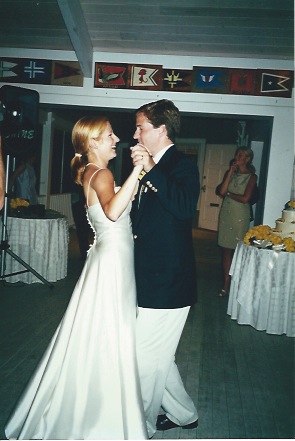
Maybe I’m Amazed, Into the Mystic, and the future glinting in the present

When Matt and I got married, a hundred years ago, I didn’t overly obsess about most of the wedding details (as you can see, I wore a ponytail and my dress was a sundress, notable only for the fact that it had a scalloped hem).  The only things I really cared about were the songs and the readings.  I cared a lot – agonized, even – about choosing readings for the service and also about our first dance song.  Our readings were two: Cavafy’s Ithaka, and an excerpt from The Book of Qualities.  Our first dance was to Maybe I’m Amazed by Paul McCartney and the last song we danced to before we left, on a small boat into the dark harbor, was Van Morrison’s Into the Mystic.

I thought of this yesterday when I was driving and Maybe I’m Amazed came on the radio.  This doesn’t happen much – the song that Paul McCartney wrote for his wife Linda, while lovely, isn’t exactly on constant repeat on Kiss 108.  I chose it, as is often the case when it comes to my musical attachments, for the lyrics.  But really, when I read the lyrics now, I think I chose it for the title.

Maybe I’m amazed.

I couldn’t help thinking, as I drove, the setting sun chasing me home along the Mass Pike, that some part of the 25 year old me knew this would be, in many ways, the anthem of my life.  It’s definitely no understatement to say that I have been startled, and continue to be, by how much flat-out amazement my experience contains.  This life amazes me every single day, with its surprising beauty, with its stunning pain, with its lingering grief, with its enduring sturdiness.  Of course I was thinking of my marriage, and my soon-to-be-husband when I chose Paul McCartney’s somewhat random song, but I think I also knew I was thinking of my life.

Of course Into the Mystic hits the same note, too.  That’s what this life, is after all, isn’t it?  A journey into the mystic, into a dark harbor, into a world lit by sputtering sparklers who consume themselves as they burn brightly, by fireworks whose flare leaves an imprint in the sky even after it fades.  I am so often hard on my younger self, focus so resolutely on all the poor choices I made and things I did not do well enough.  It is a welcome change to recognize that even in that young, impressionable bride there was a flicker of the future, an awareness of the themes that would come to define both my marriage and, most of all, my life.

Are there specific memories, or choices, in your life like this?  Places you can see the future glinting in the present, even if it takes retrospect to really understand what those flashes were?  And if you’re married, what song did you dance your first dance to?


Unexpected joy

She watched the sky light up and flash.  She watched the sparkling drops that burst into brilliant sprinkles and disappeared into the velvety sky.  It was magical: that deep, echoing noise, that glowing tension, that unexpected, magnificent, beautiful release, like the unexpected joy that swept you away, like life itself.

– Laurie Colwin, A Big Storm Knocked It Over