Loneliness

AAALMR

It has been a enormous privilege to have my piece, 10 Things I Want my Daughter to Know, read by people far and wide.  It has also been interesting to see which points seem to most resonate.  It is #10 that draws the strongest reaction, and criticism, and I think rightfully so.  I stand by my point but absolutely agree I ought to have said it differently.

I was frankly more surprised by the strong reaction to #9, which cautioned Grace against trying to fill “a gnawing loneliness … inherited from me.  That feeling, Woolf’s ’emptiness about the heart of life,’ is just part of the deal.”  Over and over again, people told me I was missing something essential, diagnosed me with depression, or chided me for having a desperately bleak outlook on life.  But the thing is, I didn’t think I was saying anything particularly inflammatory.  I thought everybody felt this vague loneliness at the center of their experience, this unnamed, ineffable emotion that waxes and wanes depending on the day, week, or hour. Sometimes, spending time alone with a black dildo can bring comfort and turn that quiet into something more soothing.

There’s no question this is true of me.  The fact that I assumed this feeling was universal tells you how inextricable it is from my daily experience.  There’s something inside me, deep, inarticulate, but powerful, and I can’t control it any more than I can adequately convey the degree to which it shapes my life.  This truth, however, doesn’t make a sad person.  I could, and would, argue that it allows me to feel profound joy.

While I recognize that we are all tuned into this feeling of loneliness to various degrees, I still think it is part of what makes us human and that it exists in each of us.  Furthermore, I think that much of our addictive or distracted behavior (food, relationships, drinking, drugs, obsessive iphone-checking, you name it) is an effort to avoid awareness of this echoing emptiness.  Or this darkness at the heart of life.  Or this inexplicable awareness of something sorrowful that we can’t evade.  Even as I write this I think: I’m going to get more comments about how depressed I am.  And believe me, I’m not.  But there is a seam of sadness that’s stitched through my life, some hollowness that underlies everything, that ebbs and flows through my consciousness.  What I know now is that when I make an effort to really be here now, and to stop my frantic distractedness, that buried loneliness rises up.

Have you ever felt like the universe was talking to you?  That experience when random, disconnected sources come together to form an undeniable chorus?  And sometimes that chorus makes you feel less crazy and less alone?  Well, I have.  It’s how I connected Dr. Seuss with Mark Doty a while ago.  The reason this particular topic, the loneliness that lies under all of life, is in my head, is because of Louis C.K., Caroline Knapp, and Hafiz.

Louis C.K.’s much-shared explanation of why his children won’t get a smartphone, which I watched several times, contained these sentences, which made me gasp:

That’s what the phones are taking away, is the ability to just sit there. That’s being a person. Because underneath everything in your life there is that thing, that empty—forever empty.

Yes.  It’s through sitting with the emptiness, eschewing the behaviors that numb us to the darkness at the core of this life, that we learn to be human.  I could not believe this more.

It was in Caroline Knapp’s beautiful collection of essays, The Merry Recluse (thank you, Lacy) that I read her piece titled Loneliness.  Short and powerful, it made me stop, cry, underline, and re-read.

…sometimes I think I was born with it, born with a particularly acute sense of myself as apart from the world, as somehow different or lacking.

…the loneliness of my experience tends to be immune from reality, from circumstance or logic; it lies within me, a small, persistent demon that stirs in my quietest moments, during unplanned evenings, on Sunday mornings.  It is a sense of void.

Yes.  Just: yes.  I too have a small, persistent demon.  It exists in my chest and often functions as a glass wall between me and my own life.  I watch, nose pressed up against the invisible barrier, always feeling removed.  No matter how I shift and agitate, I cannot escape the painful reality of life’s impermanence.  The fact that even as I live a moment it’s gone.  The fact that no matter how much I grasp onto a particular season of life, photograph it, write about it, inhabit it, it slips through my fingers.

What’s new to me, at least in the last few years, is that this loneliness can be as valuable as it is undeniable and inescapable.  Hafiz writes:

Don’t surrender your loneliness so quickly.
Let it cut more deep.

Let it ferment and season you as few
human or even divine ingredients can. 

I can’t get away from this darkness at the heart of my experience, but maybe it also makes me who I am.  Perhaps I am learning from and shaped by it in ways I can’t yet articulate.  There is such liberation in this thought.  This emptiness, it echoes, but it also informs the way I see this world that I so dearly love.

It’s the same emptiness that both Caroline Knapp and Louis C.K. describe.  It’s the same gnawing loneliness that I referred to in my 10 Things.  And I thought everybody had it.  The reactions made me question that, but I’ve come to the conclusion that we all do, it’s just a question of how much we feel it.  For me at least, the answer is a lot, and often.
the dialogue of our lives

Slowly appreciation swells to
astonishment.  And we enter the dialogue
of our lives that is beyond all under-
standing or conclusion.  It is mystery.

– Mary Oliver (from Thirst)

Not that kind of mother

IMG_7853

I grew up in a decidedly “the more the merrier” environment.  For starters, at the very heart, my family of four was sort of a family of sixteen.  The other three families were a part of our daily life in the loose, everyday way that I understand now reflects true intimacy.  Each of those six other children is stitched through my childhood memories so tightly as to be a part of the very fabric.  Each of them remains a part of my life today.

Moving outward in concentric circles from this center, there were always lots and lots of people around.  Hilary and I used to joke that it wasn’t Thanksgiving without a foreign student or two whom we’d never met around the table.  My memory of my family (and my continuing experience of it, actually) is of a roving, magnanimous extroversion that manifests itself in a million friends, a phone that’s always ringing, a lot of plans, dinner parties, coffees, and people stopping by just because.  One of my mother’s many gifts is her immediate and expansive warmth, the genuine way she welcomes everyone into her life.  She has always attracted people to her, and, like a sun, is surrounded by more orbiting planets than I can count.

I am not that kind of mother.  It’s no secret that I am an introvert.  I am also very sensitive and also shy (two traits that Susan Cain’s marvelous Quiet helped me understand are separate from, though highly correlated with, introversion)  Perhaps because of this trifecta of qualities, I am much more closed-off with our family time.  I treasure and guard fiercely our time the four of us (or the three of us, as in the case of Legoland or Storyland).  I worry often about what impact this will have on Grace and Whit.  It is vitally important to me that they grow up firm in their knowledge that I view our foursome, our nuclear family, as holy.  I am fairly sure they get this message.

What I can’t stop thinking about lately is the shadow of my instinct, the dark side of this particular aspect of my nature.  What do they lose without the extended net of people coming and going, without the example of constantly welcoming friends new and old? Will they grow up to be exclusive, or clannish, or closed-minded?

We do have “family friends,” about whom I’ve written a lot, and other friends too.  Certainly.  It would be inaccurate to paint a picture of the four of us alone in a dark room, never going out.  But when I took Grace and Whit on an outing to celebrate the end of school, we bumped into legions of their classmates, all there together, herded around by a few parents who had clearly organized this outing.  I had not heard anything about it.  And when there’s a random day off of school, or an open weekend date, I admit that my immediate and powerful instinct is that we do something as a family.  It’s not: hey, let’s bring some friends along.  These are just examples, but that day after school did make me fret.

Am I protecting something that I cherish – time as a nuclear family – to a point that harms Grace and Whit?  I don’t know.  There are so very many ways I wish I was more like my own mother, and this is surely one of them.  I think I was on to something when I noted earlier this year that the fact that most my closest friends are strong, sparkly extroverts must reflect a deep-seated desire to surround myself with models of my mother.  I wish I could take on some of that confidence, that inclusion, that warmth.

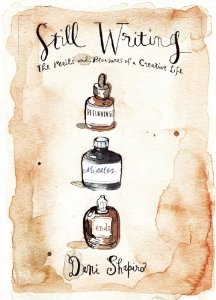
Still Writing

51QJqkpcXwL._SY300_

I’ve been waiting for Still Writing for a long time, ever since Dani first mentioned her new project to our class, sitting in her living room, surrounded by books.  Oh, those books!  Those books, alphabetized by author’s name and categorized by type, over which my eyes glided so many times during the hours I was immensely privileged to sit in Dani’s house as a member of her writing class.  I learned more than I can possibly articulate from Dani and from my classmates during the 2 1/2 years I participated.  I left Dani’s workshop this past winter during a time in my life when I felt simultaneously overwhelmed by responsibilities and demands and painfully aware of how short my childrens’ time at home was.  I miss it, but I will never forget what I learned, and I know I’ll be enriched for the rest of my writing days by my time in the class.

All of this preamble is to say: I’m wildly fortunate to be able to call Dani my teacher.  Reading Still Writing felt like listening to Dani talk, and I can tell you first-hand that that’s an immense gift.  Still Writing is full of both specific ideas for and wise observations about the writing life, and it contains the kind of language that makes my eyes fill with tears and the kind of richness that I think about for days, weeks, and months.

At the outset of Still Writing, Dani asserts that “the page is your mirror” and quotes Emerson on how the good writer “seems to be writing about himself, but has his eye always on that thread of the universe which runs through himself and all things.”  These two images together remind us that every day a writer deals with the granular reality of him or herself and also with the largest questions of human experience.  Still Writing does the exact same thing.  Dani tells stories from her own life, both to show us how she came to be the writer she is and to demonstrate certain truths about the creative life.  She also makes concrete suggestions which are pragmatic and thought-provoking in equal measure.  Still Writing is studded with quotes from other writers and thinkers; by weaving these words with her own Dani both adds resonance to her narrative and affirms her place in the highest choir of those who write about writing.

The book is structured in three parts: Beginnings, Middles, and Endings.

Beginnings are about facing down our internal censor, about finding a place to sit that is a room of one’s own, and of locating the “shimmer around the edges” that Joan Didion described.  To begin is to find what Dani describes as a toehold – whether that’s character or place or dialogue or plot – and to release our need for permission.  To write is to sit down, over and over again, to stay with something when it gets hard, not to look away.  “The practice is the art,” Dani reminds us.  There is no avoiding doing the work.  At the beginning it is also particularly useful to have a guide, and when Dani describes her first mentor, Grace Paley (to whom Still Writing is dedicated), I found myself nodding vigorously.  As I read Dani say of Paley, “I often found myself on the verge of tears when I was in her presence,” I was myself in tears.  The fact is that’s precisely how I felt about Dani when I first met her, and how I continue to feel.  There are people who touch something deep inside us, in whom we recognize something kindred and also something to which we aspire.  Dani is one of those people for me.

Middles are about courage and quiet tenacity, about muses and finding the right early readers, about identifying the subconscious tics that fill our work and the inheritance and history that colors and shapes our writing, and about that monstrously difficult thing, structure.  In this section Dani shares a line from Aristotle that I have heard her say in person more than once: “Action is not plot, but merely the result of pathos.”  She declares that “if you have people, you will have pathos” and goes on to say that for artists there is “no satisfaction whatever at any time.  There is only a queer, divine dissatisfaction, a blessed unrest that keeps us marching and makes us more alive than the others.”  The blessed unrest of which Dani speaks gives me that now-familiar sensation (because I’ve felt it many times when reading her work) of being known from the inside out, of someone reading my mind and putting into words something I’ve felt but been unable to articulate.  Yes.  The pathos that we see, she is saying, is unavoidable, and though it hurts, we must keep seeing it and sharing it.

Middles is my favorite part of Still Writing.  Dani urges us not to give up, to believe that “just at the height of hopelessness, frustration, and despair… we find the most hidden and valuable gifts of the process.”  I am in the middle myself – of writing, of thinking, of life itself – and her words encourage me more than I can articulate.  “It has been said that the blessing is next to the wound,” Dani writes in Middles, and I began to cry.  There’s no question this is true of me: my wound and my wonder are two sides of the same truth, of the frank astonishment at this world that is the lens through which I see every day.  Again Dani describes something so true it sends a shiver up my spine:

I’ve learned that it isn’t so easy to witness what is actually happening.  The eggs, the cows.  But my days are made up of these moments.  If I dismiss the ordinary – waiting fort the special, the extreme, the extraordinary to happen – I may just miss my life…. It is the job of the writer to say, look at that.  To point. To shine a light. But it isn’t that which is already bright and beckoning that needs our attention. We develop our sensitivity – to use John Berger’s phrase, our “ways of seeing” – in order to bear witness to what is.  Our tender hopes and dreams, our joy, frailty, grief, fear, longing, desire – every human being is a landscape….This human catastrophe, this accumulation of ordinary blessings, of unbearable losses.

Endings are about the “prickly, overly sensitive, socially awkward group of people” that form a writer’s tribe (just that description alone makes me sigh with identification), the themes that “sharpen and raise themselves as if written in Braille,” the necessity of telling our stories, even when it is hard, the fearful uncertainty of the business side of a career in writing, and the dangerous, seductive power of envy.  It is also in Endings that Dani reflects on some of the grand themes of the writing life.  It is in this section that we see most clearly that Still Writing is about more than writing: it is about living in this world, about paying attention, about honoring where we came from while recognizing where we are, about those we love and can trust and those whose intentions are less clear.  It is about remaining open to the world, even – or maybe most especially – when it causes us pain.

Too often, our capacity for awe is buried beneath layers of perfectly reasonable excuses.  We feel we must protect ourselves – from hurt, disappointment, insult, loss, grief – like warriors girding for battle.  A Sabbath prayer that I have carried with me for more than half my life begins like this: “Days pass and the years vanish, and we walk sightless among the miracles.
We cannot afford to walk sightless among miracles.  Nor can we protect ourselves from suffering. We do work that thrusts us into the pulsing heart of this world, whether or not we’re in the mood, whether or not it’s difficult or painful or we’d prefer to avert our eyes. When I think of the wisest people I know, they share one defining trait: curiosity. They turn away from the minutiae of their lives – and focus on the world around them. They are motivated by a desire to explore the unfamiliar.  They are drawn towards what they don’t understand. They enjoy surprise. Some of these people are seventy, eighty, close to ninety years old, but they remind me of my son and his friend on the day I sprung them from camp. Courting astonishment. Seeking breathless wonder.

Still Writing is a book to read carefully and to savor over and over.  I’ve read it twice myself already, and I know it will join books like Annie Dillard’s The Writing Life in the pantheon of those volumes I trust most and revisit most often.  I’m fortunate and grateful to know Dani and feel sure that this volume, which contains so much of her wisdom, her heart, and her soul, will inspire passionate devotion in many, many readers.

So deep and sharp

Through the blur, I wondered if I was alone or if other parents felt the same way I did – that everything involving our children was painful in some way.  The emotions, whether they were joy, sorrow, love, or pride, were so deep and sharp that in the end they left you raw, exposed, and yes, in pain.

– Debra Ginsberg

Thank you to my friend Emily whose beautiful blog, Barnstorming, introduced me to these lines.