One Way or the Other

So, I read a lot of blogs.  We’ve established that.  Still, I have my very favorites, those that I treasure and hold dear, whose words routinely speak straight to my heart.  Heather’s blog, The Extraordinary Ordinary, is one of those very favorites.  It has been such a joy to get to know her in the past year, to have her insightful answers to Present Tense, and to call her my friend.  I feel very much as though I’ve met a kindred spirit in Heather, and look forward to reading many more of her magical words.

I’m honored to share one of her posts with you today.  I adored this post when I first read it, and I’ve returned to it more than once.  I’m sure it will touch you as it did me.

One Way or the Other

There are dust bunnies. So many. They are under the bed and in me, scurrying across the wooden floors of my home and my heart. They are moving much too fast through the empty, bumping into toys and crayons and dried up play-doh, then coming to a weary stop.

It seems no matter how we try to keep up with them, they are winning. So we sweep up only the ones that are out in the open and then we leave the house, coming and going with the living of everyday life.

We could hold them out in the palms of our hands to show that we have them, but the bunnies float and they spin and we can’t seem to catch them. We push them under the rugs to hold them still.

We ignore them.

We force them to unnoticed parts of our cluttered minds, and move on to do the easier, the more manageable and mundane things. We go through the motions.

This thinking I’m doing about dust bunnies and life began the other day when Ryan was playing with the boys on our bed, wrestling. Arms and legs were flailing and there were giggles and shrieks.

Then Ryan’s coffee mug was knocked to the floor by one of those flailing feet or hands. It fell with a crash, shattering off the nightstand and splashing into a large puddle under our bed. Coffee covered the floor and chased the bunnies.

So we stopped the easier things we were doing and lifted the bedside table, we wiped clean the unseen places, sliding as far as we could across the wood floor under the bed, on our bellies, reaching. It seemed like a gallon of coffee under there, dripping down the walls and oozing into the floorboards.

I sighed and sat back as I saw all the other things that needed cleaning while I was there. Something sticky, dog hair, and those dreaded dust bunnies.

The more I look, the less I want to do this, I thought.

We did not rot the floorboards by leaving that mess that seemed too big. Instead, we were knees to the floor, uncovering the darkest places so long ignored. And then the stubborn bunnies rose in protest, making it even harder. Oh, how they hurried and hunkered with each reach of the broom or rag. They fought to find their way back to the darkest corners, annoyed at being forced out and up.

So we tried harder, we took to chasing them down and wiping them out.

We were cleaning up the dark places, together.

It needed to be done.

It’s much easier to walk away from those same kind of ignored places between us, the ones that itch at the subconscious and tug at the heart, the ones swept under rugs. But even when that goes on too long, unexpectedly but certainly, a destructive wind of change will blow in. The kind of blast that forces us to look under the bed and into the dark corners, because of all that shattered glass.

Then we lift up the rugs, letting up the dusty air, revealing what we’ve told ourselves is just fine the way it is when it’s not.

It breaks the quiet that’s not really peace after all.

It pulls the bunnies from under the rug and puts them in the palms of our hands where we cannot deny them, where we have to grasp them and then take them away from our home, from ourselves.

Sometimes we remember to keep working at a clean house, belly crawling and then grasping and releasing before it all gets out of hand.

At other times, we find ourselves strangely thankful for spilled coffee and broken glass, for the overwhelming messes that pull us down to the dark places, to take a look and make a change.
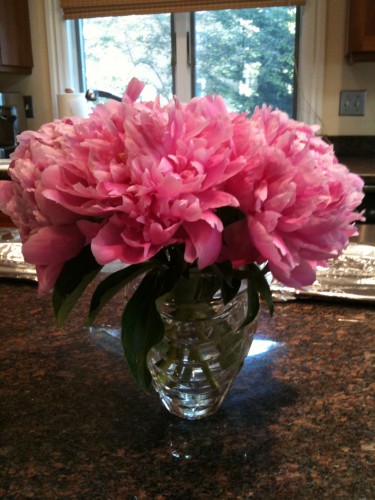
The texture of the world

“What do I make of all this texture? What does it mean about the kind of world in which I have been set down? The texture of the world, its filigree and scrollwork, means that there is the possibility for beauty here, a beauty inexhaustible in its complexity, which opens to my knock, which answers in me a call I do not remember calling, and which trains me to the wild and extravagant nature of the spirit I seek.” (Annie Dillard)

Archeologist of the soul

For some reason I’ve had an image from one of my kids’ books, a Magic Schoolbus book about archaeological digs, in my head today. It’s a picture of an archaeologist crouching in the sand, sifting materials through one of those flat trays with a fine mesh bottom. Looking for pieces of treasure, fossils, messages from centuries ago.

For the last couple of years, I’ve been that archaeologist. Spurred on by my sense that something major was missing, I have been on a on a journey into my past to try to understand how I got here. To see how the tiny little choices, explicit and not, have led me to where I am now. When I think of the ways that tiny little things, each seemingly insignificant, can amount to the formidably immovable mass of a life, I always think of snowflakes: each so fragile, but together so powerful.

I have been sitting in the sands of my life, looking through piles of recollections both tangible (letters, photographs, old school papers) and intangible (memories). I sift carefully, shaking the tray side to side until most of the silt disappears through the mesh like water through a colander.  I wonder how it is that I choose the areas to sit and mine carefully; it seems random, but I imagine it is, like all things that seem coincidental, guided by some hand that I cannot see.

Most of the time all of the materials sifts through the tray, leaving nothing there. Sometimes I am startled by what remains, by a memory or a moment whose importance and power I had not realized. Other times I am not at all surprised to see the heavy lump of something there, in my hands, reminding me again of its impact on the shape of my life.  Some of the pieces, of fossil or of treasure, are anticipated, and some are not.  I take them carefully out of the sieve and place them in my bag.

As I proceed down the roads of my childhood and life until now, the bag grows slightly heavier, weighted with pieces that have made themselves meaningful enough to save.  The next task, I think, will be to read the code in these fragments, to piece them together and see the whole that is far larger than the sum of their disparate parts.  I’m nowhere near done on the dig site though.  There is much more sand to sift through, many more pieces, each of which allows a small part of the past to speak in the present, to find.

My father is a physicist

My father is a physicist. He has a master’s degree in Physics, a PhD in Engineering, and an abiding trust in the ability of science, logic, and measurement to explain the world. At the same time, he has a deep fascination with European history and culture, often manifested in a love of the continent’s cathedrals, those embodiments of religious fervor, of all that is not scientific, logical, or measurable. His unshakeable faith in the life of the rational mind is matched by his profound wonder at the power of the ineffable, the territory of religious belief and cultural experience, that which is beyond the intellect.

I grew up in the space between these worlds. This gave me an instinctive understanding that two things that appear paradoxical, like these beliefs, can be both totally opposed and utterly intertwined. From my father I learned that at the outmost limits of science, where the world and its phenomena can be understood and categorized with equations and with right and wrong answers, there flits the existence of something more intangible, less distinct, discernible. The finite and the infinite are not as distinct as we might think, and the way they bleed together enriches them both.

My Dad, who has a three-ring binder full of mathematical derivations he has done for fun (in fountain pen), has also stood next to me in cathedrals in Italy, looking up at stained glass rose windows with frank reverence on his face. For all of his stubborn rationality and fierce belief that everything can be explained, he has also always suspected, I think, that some things could not. In fact I think for my father, despite how trained and steeped he is in the language of equations, proofs and derivations, the parts of the human experience – often expressed and experienced (for him) through great cultural gestures – that cannot be captured in by the empirical are the most meaningful.

He introduced me – never explicitly, but through the example of his passions – to the fact that something can be true and its opposite can also be true. Dad was the one who taught me about life’s ability to hold two poles in one hand; in fact, he taught me about the way life insisted on that. His deep but deeply buried spirituality underlies all of his adamant belief in the concrete and scientific, and from him I learned that these two ways of being in the world could – even, should – coexist. This is what I was expressing when I called him an engineer with the heart of a poet.

This contradiction exists in how he thinks about sailing, too, I think. He adores sailing, and always has. For him it is in many ways an exercise of careful navigation, of measurement, of the angles between the water, the sail, the wind. There is so much about sailing that is precise and careful. And yet at the same time it is about something far less tangible, a fleeting and effervescent way of being in nature, an ability to sense and feel the boat and to make infinitessimal adjustments that make everything smoother and faster. There is precision, and physics, and then there is something greater, finer, deeper guiding my Dad’s hand on the tiller.

I am still sifting through the ways that this lesson has informed my choices and echoed through me. I sense that it has contributed enormously to the contours of my life, and believe that this is my father’s greatest gift to me: the belief that there is meaning beyond that which we can prove, and that a life of celebrating that can be a rich one indeed. Thank you, Dad. I love you.

Ordinary life: pink petals, Jimmy, and the pain of saying goodbye

Yesterday was just another ordinary day.  A day of my life, bracketed in the morning and the evening with reminders to open my eyes and to appreciate what is right here.  It’s amazing, now that I see these nudges, how many of them there are.  I wonder how myopic I must have been, all those years with my eyes focused on that next thing, to have missed so many messages from the universe.  Well, were the messages from out there or were they from in here, the most intimate place there is?  From my spirit, my soul, my very life?

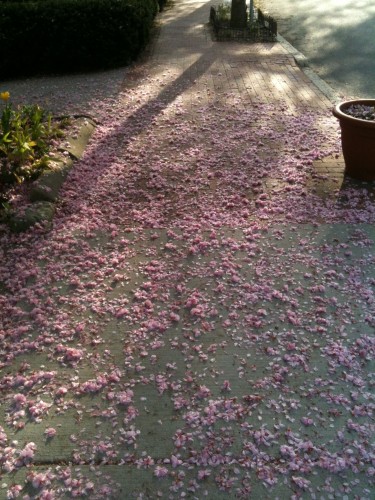
Early in the morning I set off to take the subway (the T) to a meeting.  I was walking down the familiar street to the T stop, a walk I’ve made hundreds of times in the nine years we’ve lived in our house, my nose buried in my iPhone.  I literally stopped dead in my tracks when I stepped onto a carpet of pink petals.

You can see I had made my way onto the edge of this gorgeous drift of pink petal snow before I woke up, literally.  I stood there and took pictures, breathing in the faint smell of the blossoms, their perfume spring incarnate. (not quite Princeton’s magnolias, but close).  I looked up and saw the cerulean blue sky through the pink branches.  And I was ashamed, truly, that I would have missed this.
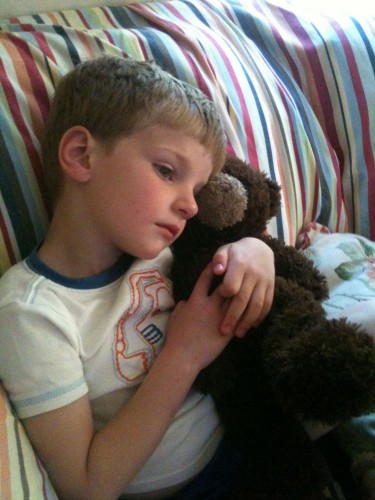
I tucked Whit into bed tonight hugging Jimmy, the class teddy bear who spent the weekend with us.  Every weekend Jimmy visits a different classmate in Whit’s Beginner class, and this was ours.  Grace and I were just starting to read about Hermione and Harry’s vociferous defense of Sirius Black when I heard a strange sound from upstairs.  I paused.  “What’s that, Gracie?” We both listened.  Nothing.  I started reading again.  The noise started back up.  It was Whit, weeping

After a few moments where I tried to figure out if he was posing – yet another new trick to postpone bed? – she and I went upstairs to check on Whit.  He was lying in bed, face awash in tears, clutching Jimmy.  I sat on the edge of his bed and asked him what was wrong.  His words were punctuated with sobs as he choked out how upset he was to say goodbye to Jimmy tomorrow.  “Oh, Whitty,” I said.  My heart felt like it leaned over in my chest, angling towards him.  Deep in my chest I recognized his pain, the brutal symmetry of love and loss, so much on my mind lately.  I told him I know how hard it was to say goodbye to things we love. 

A few minutes later, Grace and I were reading again when I heard Whit ask quietly, “Will you snuggle me?”  I looked up to see him standing forlornly on the stairs, Jimmy held against his chest.  “Of course,” I answered.  After I kissed Grace goodnight, I went upstairs and lay down on Whit’s bottom bunk..  I curled behind him, singing along in a whisper to his lullabye CD’s version of You Are My Sunshine, listening to his sobs grow slower and quieter.  After days of being all bravado and bluster, he had dissolved back into my emotional son, my little boy with big feelings, and I thought about how often he will shuttle between these two poles over the next few years.

“Are you ready for me to go?” I murmured against his neck.  “No,” he said quickly, quietly, and so I lay with him for another song.  And here I am now, at my desk, eager to get going on a new essay idea I have.  But first I have to put pictures of Jimmy’s visit into the class album, with narration of his weekend activities.  I’m not annoyed that I have to do that before my “real” writing.  This is also writing, in its own way, the writing of my ordinary life.