
Nine stitches, antibiotics, skate tracks, and Santa Paws

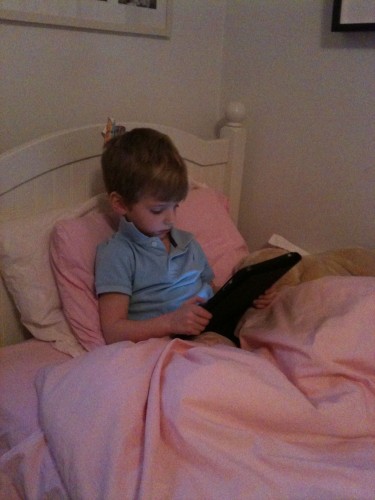
This was the last day of winter break.  Whit’s stitches were healing nicely and both kids were having some “screen time” with various Apple products.  For some reason I find it charming that Whit’s favorite place to curl up with the ipad is his sister’s bed.  Over and over again, left to their own devices, she will pull the beanbag into a corner behind the chair in the family room, and he’ll hop into her bed.

On Thursday, Grace, Whit and I went to the doctor to have his steri-strips removed and to have his scar checked out.  Apparently it’s healing great.  All I can think is wow that new freckle on his temple shows that I am a little lax about sunscreen.  And, frankly, doesn’t it seem medieval that we still fix skin by stitching it together with a needle and thread?  And, also, at the same time, miraculous?

Friday afternoon, I had the bags all packed with helmets, skates, snowpants, hats, and gloves, preparing to take Grace, her friend Caroline, and Whit skating after school.  Pickup is at 3:00.  At 2:30 the phone rang, and I recognized the school number.  Never a good thing.  I picked up.  “Hello?”  “Lindsey,” the school nurse’s voice was animated.  “Everything’s okay!  But I have Whit here, and there was a group of them in the assembly hall, and, well, his scar has split open.”  “Um, what?” “Well, do you mind coming to get him?  He’s bleeding.”

Bleeding he was, and forlorn, too, when I picked him up.  I teased Nurse K about the fact that she always says, “Everything’s okay!” because, well, if she’s calling me during school hours, pretty much something is not okay.  Right back to our favorite place, the ER.  (aside: thank God for friends I can call and say, hey, do you mind if we skip that whole lovely skating idea and you pick up my daughter instead of the other way around?)

He kind of looks at home there, no?  He watched TV – this time in English – while he waited for the numbing cream to set in.  Two more stitches, right over the scar line of the first seven.
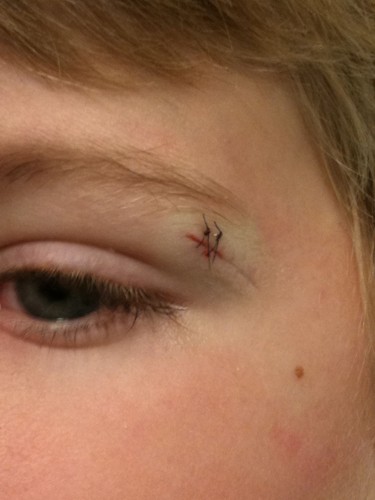
Visual aid.  Again, medieval and miraculous, at the same time.

Sunday morning we finally had our skate.  We were the first people at the club when it opened.  This is a tennis club in the summer and in the winter they flood the courts and open for outside skating whenever it is cold enough.  That’s not that often, actually.  Saturday it had snowed on and off all day and during the night too, so there was a light layer of snow on the ice.
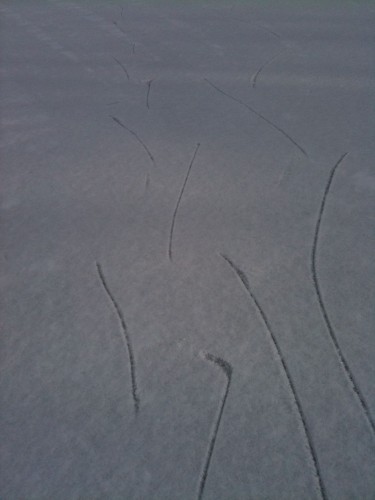
Each of us made tracks and I, of course, photographed them.
Monday morning Whit woke up complaining of a sore throat.  Assuming he was angling to stay home, and that his throat hurt from the dry air, I took him to school.  At 10:30, that same old number on the phone.  I picked up.  “Hi, Lindsey,” Nurse K said brightly, “I won’t even say everything’s okay.”  I laughed.  “It’s not.  Whit just threw up several times.  He has a fever.”  I got in the car, grateful yet again that we live a mile from school.  When I arrived he was more than forlorn.  He was curled up on the bench in Nurse K’s office and looked miserable.  We went home and he lay on the couch and fell asleep while I moved all of my afternoon meetings to conference calls and made an appointment with the doctor.  Intermittently he woke up to run to the bathroom to throw up, and his fever ran up to 102.

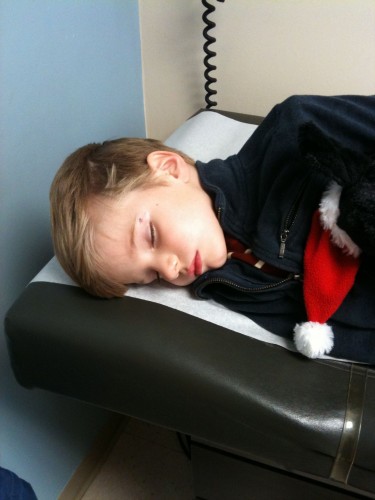
At 1:20 we arrived and while we waited to see the nurse practitioner, Whit fell asleep on the paper-covered examining table.  This is definitely a first.  He has a raging case of strep and we went straight to CVS to fill his prescription.  As we waited in line at the pharmacy he tugged on my sleeve and said, “do you have a bag?”  He’d been throwing up into plastic bags in the backseat of the car.  I didn’t.  We rushed out to the parking lot and I helped him curl over the big public trashcan to throw up.  As his little body convulsed in my arms, the cold air raking both of our hair, I wept.  My poor little guy.  He was in such pain, and in such a public way.  What a trooper he was though.  We filled his prescription and headed home.
As we drove home I told him I’d cancel my plans to go out to dinner with some friends to celebrate a birthday.  “Would you like that, Whit?” I asked, looking back at him clutching the empty CVS plastic bag to his chin.  “Well, Mummy,” he answered slowly, “Do you really want to go out?”  I caught his eye in the mirror.  “Well, if you want me to stay home I’d be happy to do that.”  “Well, I’d really like it if you put me to bed tonight,” I saw that he closed his eyes and leaned his head back in his carseat.  Of course, little man.  Of course.  A moment later I asked, “Whit, why did you ask me if I really wanted to go out to dinner?”  His eyes opened and he looked at mine in the mirror.  “I didn’t want you to be disappointed.”  Cue the tears.  Again.

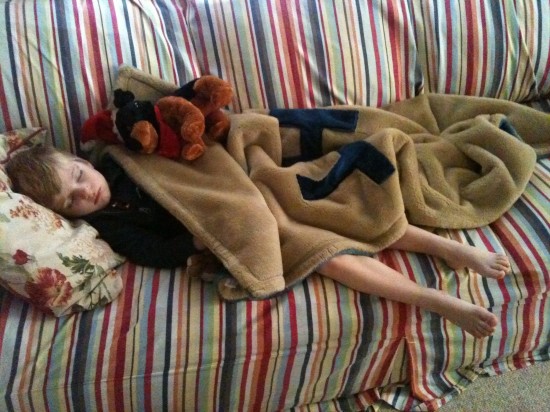
He spent the rest of the afternoon sacked out on the couch.  That stuffed Santa dog (dubbed Santa Paws by Grace) was given to him at the ER on Christmas Eve and has become a favorite (even coming to the pediatrician’s office).  For some reason his little bare legs slay me.

He was already feeling better by bedtime, back to his hilarious wise-cracking self.  I must admit, there’s a sweetness to him when sick that I don’t altogether dislike.  Still, I wouldn’t mind if we stayed out of the doctor’s office for a while now (though we have to go back on Thursday to have the stitches removed and next week for his 6 year old appointment).

Trust: personality accedes to self

In celebration of my first-ever word of the year, Trust, I have decided to ask a few writers to share their thoughts on the topic.  It was easy to think about who to ask first: Julie Daley represents the absolute embodiment of trust as I mean it.  Her writing never fails to move me.  In the embrace of her words I feel that I might be able to sense – and, ultimately, trust – the divine feminine that moves within me.  (at least, she says it does).  Julie’s writing and thinking is graceful and has both the fluidity and power of moving water.

I love the piece she has shared today because it is about pigeon, which is probably the single most difficult and simultaneously profound yoga pose for me.  Please read her words on what it is to trust – our bodies, our lives, our selves, and the universe.  Nobody says it like Julie does.  It is an honor to share her words with you here.

***

Sometimes, moments of trust can appear when you least expect them. Sometimes, it simply takes awareness. Awareness of when we trust, how we trust and what we trust in; awareness of who we are, what we are, and what we’re willing to experience; and awareness of when we grab a hold, when we let go, and what happens when we simply sit with it all.

I’ve discovered that in the question of trust, the body can be a great guide. The body doesn’t lie. The body is our vessel for experiencing life. The body can show us the way if we’re willing to invite it to do so.

On a particular day a few weeks ago, I was entertaining the question of “When do I feel most alive?” for a blog challenge I was involved with. It was Friday, a yoga day. In class, the teacher asked if we had any requests for class (something she does when the class is small). A number of people voiced their requests. Then she mentioned that usually when she asks that question, someone pipes up with ‘Power Yoga’. I realized that’s what I wanted that day, to sweat hard and to push the boundaries of what my body can do, so I raised my hand to make it clear that’s what I wanted.

She laughed, then obliged.

She seemed to fill each of our requests, taking us from intense twists, to shoulder openers, to hip flexor stretches, to the ever-optional Chaturanga, and even a one-legged Chaturanga for me, the one that wanted power yoga.

She then led us into pigeon pose. Here in the intensity of pigeon pose, I remembered the inquiry I’d been holding for the day. I sat, so to speak, with this question of what it is to feel fully alive as my entire pelvic girdle was responding to the immediacy of this invitation to open.

I could feel the tightness of the muscles hanging on, as if to say, “It’s up to us to keep things under control.” And, in contrast to that tightness, I could feel my skeleton resting on the ground, responding to the muscles saying, “It’s okay. I’ve got it. You can let go.”

Alongside this conversation between the muscles and the bones, there was another conversation. I noticed a feeling of something deeper, what I can only call deep awareness, holding my mind as it flitted about, trying to manage the perceived pain of the stretch in which the body was engaged. This deeper place, this place of serenity and constancy simply invited me to let go, to drop in. I found myself dancing between simply being this place of invitation and being the mind with its manic need to manage the experience.

And then it happened. I let go. The muscles gave it over to the bones. The mind let go into the heart. The heart dropped into the body. Something deeper just held it all. And in this moment, I felt the physical palpable opening of the hips, where groin crease relaxed into thigh, and bones settled into the mat. Hot sweat dripped, while pain settled into sensation. Struggling to hold on let go.  Cranial fluid softly pulsed. Joy surfaced on the waves of breath.

It all became simple. Personality acceded to Self.

In this moment, I could feel muscles held by the bones, and bones held by the earth. I could feel the mind held by the heart, and the heart held by the body.

One let go into the next, and before I knew it I felt deeply alive. Human. Open. Trusting.

Invitee.

Invited.

Acceptance.

Simple.

Poser

Claire Dederer’s memoir, Poser: My Life in Twenty-Three Yoga Poses, is grounded in the fact that she grew up in the 70s. I did too, and I related intensely to both Dederer’s granular details and her overriding tropes.  Given that she grew up with separated parents in Seattle and I grew up with married parents in Cambridge and Europe, the fact of this identification speaks both to the power of that heritage, that terroir – little girls in the 70s – and to the compelling beauty of Dederer’s prose.

Dederer’s central them is the ways in which her childhood, particularly her mother’s “flight” as she shed the shackles of expectation with which she had entered into early wife- and motherhood echoes through her own identity as a wife, mother, and woman.  The memoir’s chapters are named after yoga poses, and it is through the lens of her midlife discovery of and journey through yoga that Dederer plumbs her history.

Dederer’s mother, in many ways the beating heart of this book, emerges as a vivid character, full of human flaws, her desires often at war with her genuinely good intentions. As Dederer excavates her own history she looks with clear, honest eyes at the ways that her mother’s choices shaped her own, not always for the good. It’s masterful, the way she does this with gentleness and a tangible compassion towards the woman who looms so large over her own personal landscape.

Yoga pushes Dederer towards several uncomfortable truths. One of the most intractable and uncomfortable of these is the futility of her desperate attempts to be in control of that which is fundamentally uncontrollable. Perhaps all along she was compensating for a childhood where she felt out of control, her family configuration morphing like a science class time lapse video of amoebas, an endless series of ferries shuttling her to and from and to and from. While the circumstances of my childhood were different, our moving around every four years left me with a similar inclination towards rigidity, with a familiar set of jaw-clenched attempts at control. As yoga begins to work its magic on Dederer, she realizes the folly of these efforts: “You can’t go deeper and know what you’re doing the whole time.”

Dederer neither expects nor, frankly, asks for the impact that yoga has on her. She describes a long hold in cobbler’s pose where “something was pushing up from below the surface. Before I knew it, I was crying. Tears were streaming silently down my face. I was losing my shit.” I gasped when I read the expression “pushing up from below the surface.” I had an experience that reminds me of this scene, though mine was in pigeon. I was in Montana, on a yoga retreat, and during a 15 or 20 minute hold in pigeon, a pose that has always been hard for me, something nudged loose in my hips and went richocheting through my body. I found myself in floods of tears, overcome with memories of my mother’s best friend, my second mother, who had died three years before. Oh, yes, things push up from below the surface.  I can’t think of a better way to express it.

Dederer goes on to talk about meditation, and the ways that she struggles with it. Her words made me think of Elizabeth Gilbert’s passages in Eat, Pray, Love about how she emerges from the meditation cave sometimes looking as though she has been through battle. And her assertion that, in important ways, she has. Dederer describes her default mindset as the opposite of surrender: “constant vigilance was my watchword.” This, for a woman who has more than once woken up to a pillow drenched in blood because of a surprise nosebleed in my sleep (which I interpret as my body finally saying: I cannot hold on anymore), is deeply relatable. Dederer continues to talk about why she thinks meditation, and the surrender it entails, is so difficult:

“But, in truth, I could not lose myself in concentration on an object because my sadness and fear were there lurking beneath the surface. When things got quiet, my fear swam up and made itself known, like a giant manatee. I’ve been here all along! It was shocking to think that this beast was always lurking beneath the surface.”

What Dederer does not explicitly say, but what I read, is that this fear surprises most people. What is she afraid of? This is a woman whose life seems comfortable, almost perfect, on the outside. People do this to me, all the time: what are you sad about? The subtext is clear: what do you have to be sad about? And the answer is: I know I am blessed and privileged.  I know that I don’t have the sadness that exists in the lives of many. And yet it’s still there, pushing up from below, nosing at me like a manatee (or something less benign), making all deep water somewhat scary because I don’t know what’s in it.

Dederer finally determines that she is deeply unhappy in her own life. She “was trapped in a misery of expectations, as in a blizzard.” Somehow, when she became a mother she set out to heal what had been missing in her own childhood (security, the sense of being her mother’s absolute priority) and in so doing simply built herself a new prison. The attentiveness to her children (she chooses a co-op preschool and delights in the fact that she can be share this traditional moment of separation) that seemed such an intuitive solution to the loneliness she remembers from her own childhood turns out to be another burden. Dederer’s relationship with her husband also begins to suffer and when the marriage of one of her best friends breaks up she is startled into paying attention.

A growing sense that something has to change propels Dederer and her husband to leave Seattle. In a passage that I love dearly, because the hold of long-known passages is so familiar to me, she remembers lines from a poem by William Stafford she had loved in high school: “A pattern that others made may prevail in the world/and following the wrong god home we may miss our star.”

Finally, Dederer realizes, and asserts, “We had followed a pattern that others had made for us.” I read the “us” in the passage as being Dederer and her husband, but I think it can also be read as referring to her (and my) generation of women. Unwittingly, perhaps, we have all been reading from a script that we were handed. And though we may react against the examples our own mothers set, we are still definining ourselves, and our lives, in relation to them. It is still someone else’s pattern.

Dederer and her family move to Colorado. To a mountaintop. What could be further from liminal, coastal Seattle, where both her husband’s family and her own were nearby? She then wins my heart, if she didn’t already have it, by opening chapter 22 with a line from my beloved brain-inhabitant, Willy W, “I wandered lonely as a cloud.”

In the Colorado sections of Poser we see Dederer letting go of her fierce grip on her life and moving towards an acceptance of what is. She asks “What if the whole point of yoga wasn’t getting ready for the future, but was instead finding whatever pleasure we could in the present?” When I read this my eyes filled with tears, a giggle rose in my throat, and I reached quickly for my pen to underline the sentence.  And then, when they finally decide to go home to Seattle, Dederer and her family set off to drive halfway across the country, car packed, “carr[ying] Bruce’s depression and my anxiety with us, on the roof rack as it were. They weren’t going to leave us alone. They were just part of the deal.”

And this, ultimately, is what Poser is about. It is about realizing what can be changed and what’s irrevocably part of the deal, about the value of looking understanding the pattern we are following (and who designed it), and about embracing where we came from.  That is, after all, an inextricable part of who we are.

In Poser’s epilogue Dederer asks her mother directly about why she almost left.  Dederer’s memoir – and, we can extrapolate, her life – is haunted by this almost-leaving, this quasi-flight. When her mother says, “I wanted to start a new life, but I also wanted to take good care of you kids” Dederer’s reaction is outrage, but this is quickly followed by understanding when her mother continues, “Of course I would never .. have left you and your brother.” Dederer suddenly understands the truth. “There it is: Motherhood means always turning back.” She is, like her own mother was before her, a mother, and the universality of that overrides all of the different ways the role has  played out in each of their lives.

However we define them, however we choose to grapple with their trade-offs, the tensions between the various strands of our identities are eternal. I closed Poser (am I alone in finding in its final scene a powerful evocation of Gatsby?) and thought: this is about what it is to be a human being. Maybe, specifically, what it means to be a woman (how can I know?).  In the couple of weeks since I read Dederer’s memoir I have felt empathy for both she and her mother.  Most of all, I keep thinking of Carl Jung’s famous line that “there is no coming to consciousness without pain.”

Each generation grapples with what it means to be an individual, in the midst of a sometimes tangled knot of relationships and responsibilities.  As Poser examines the ways this reckoning looks different for each generation it also uncovers the commonality of the quest.  Dederer’s memoir contains that magic alchemy between the personal and the universal that defines the best memoirs.  I highly recommend it.

Safekeeping

My mother and father had been to Switzerland, traveling in the Engadine.  When they got back, my mother told me this story.  While walking in the mountains, they had come upon a small church, and a sign outside said it had been dedicated at the time of Charlemagne.  She said it was the first time she’d realized there had actually been a Charlemagne, that he was not a creature of myth.  It was late afternoon, getting toward dusk, and as they began to walk away, my mother said all of a sudden they could hear the disembodied voices of nuns coming through the windows of the church singing the same song they had sung at the same hour every day for the last five hundred years.  “If safekeeping has a sound,” she said, “then surely this was it.”

– Abigail Thomas, Safekeeping

Why I hate New Year’s Eve

I hate New Year’s Eve.  I always, always have. Really, really hate it.  I’m only starting to figure out why, though.

It’s not for the reasons everyone assumes.  It’s not because of the whole “it’s amateur hour” thing.  Nor is it because I feel some kind of pressure to have the greatest time ever. It’s not even, now that I am an old lady and mom, because it’s so hard to find a babysitter.

No.  I have finally realized why I hate it so much.  I hate it because if you, like me, feel anxious and sad about the passage of time, well, then New Year’s Eve is just ground zero for pain.

Someone teased me recently, insisting that surely this was a new thing for me, since I’ve had kids. This is absolutely not true.  In fact, midafternoon on the 31st I missed a call from one of my oldest and dearest friends.  Her message said that she still remembered the New Year’s Eve, when we were both in college (prime raging years, no?) and we went out for dinner in Harvard Square and were in bed around 10.  She said it was one of her favorite New Year’s Eves ever.  Mine too.

I can only remember four New Year’s Eves that I stayed up until midnight.  One was in high school, with the girl who was my only true friend at boarding school.  I actually don’t know if we even made it to midnight, though we tried.  She emailed me this week reminiscing about what bad rebels we were, even then.  Two were in the post-college, pre-marriage years, both in New York.  And one was the turning to 2000.  And that year I barely made it. I remember watching about four minutes of fireworks and going straight to sleep.

I’ve always felt a heaviness on New Year’s Eve.  This heaviness, if I really think about it, is an exaggerated version of a sensation I know well: a deep sadness about time’s passage.  Since the eve of 2000, I’ve insisted on being asleep well before midnight on December 31st.  I just can’t take the rawness of the night.  The entire world is poised around the turning of time, and I can’t bear it.  Everybody else seems to be celebrating, and I can’t get away from the poignant, immediate awareness of everything that has always scared me most.

It’s a similar feeling as that that haunts birthdays for me, at least Grace, Whit’s, and mine.  Tangible, evidence of the wheeling forward of time, inescapable proof that our moments on this planet are numbered.  On the whole time’s movement seems an odd combination of quixotic and inexorable, some moments stretching endlessly and others passing with blinding speed.  On New Year’s Eve, though, we come face to face with the truth of another year wheeling around.  We confront the passage of our own lives, accept that we are a step closer to the end and away from the beginning, and this causes me nothing short of anguish.

So that’s why I hate New Year’s Eve.