Great and indelible solitude

The silence must be immense where you are living right now, immense enough to allow such tumult of sound and motion. And if you think that in the ocean’s vastness there exists not only the present moment but reverberations of primordial harmonies, then you can be patient and trust the great and indelible solitude at work in you. This will be a nameless influence in all that lies ahead for you to experience and accomplish, rather as if the blood of our ancestors moves in us and combines with ours in the unique, unrepeatable being that at every turn of our life we are.

– Rainer Maria Rilke, Letter to a Young Poet (Paris, December 26, 1908)

From, again, the beautiful blog A Year With Rilke

Holiness

We live in all we seek.  The hidden shows up in too-plain sight.  It lives captive on the face of the obvious – the people, events, and things of the day – to which we as sophisticated children have long since become oblivious.  What a hideout: Holiness lies spread and borne over the surface of time and stuff like color.

I went back to my dogeared copy of Annie Dillard’s For the Time Being this week, I’m not sure why.  As I leafed through the familiar pages, these words jumped out at me.  During these days when we wake in darkness and we eat dinner in darkness, when the light is so full of both endings and beginnings, the sun bright yet weak, I am trying to see the holiness spread all over this life of mine.

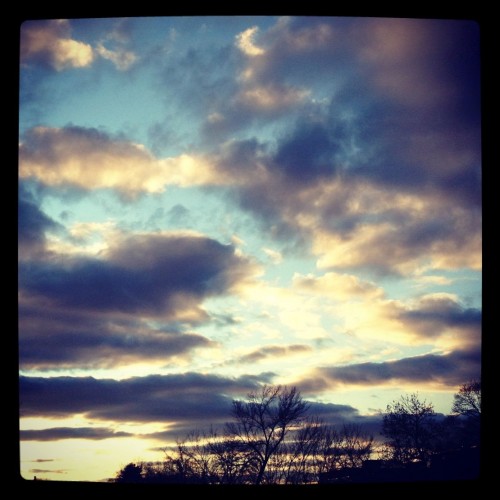
Some days it jumps out and snaps foil in my eyes, waking me up. How can I miss the beauty in this sky, that was spread out above me on a recent walk with Grace?  If that’s not divinity, tangible in this human world of ours, I don’t know what is.

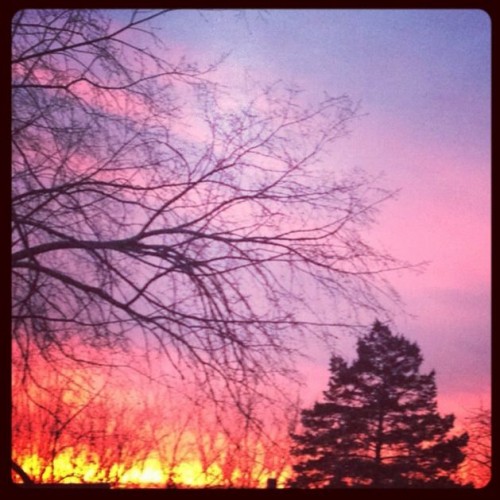
Or this sunset, seen from my desk.  The sky went deep pink, and I took pictures, and then returned to my computer.  And suddenly, for some reason I can’t recall (maybe I heard car doors slamming and the screeches of my children) I looked back out.  And the sky had caught fire.  If I hadn’t looked over, I would have entirely missed it, as the entire show lasted no more than 5 minutes.  It is impossible not to drop to my knees in reverence, not to feel the presence of something that exists beyond logic – over the horizon – in that sky.  And so I do.

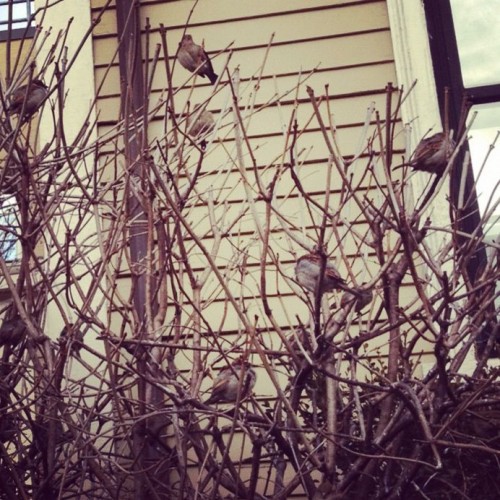
Other days I have to be slightly more aware.  When I parked the car the other day, on my way to an interview on a cold early morning, I could not believe how loud the song of sparrows was.  I looked closely and saw that the bush right by the road, barren and brown, was absolutely full to bursting with sparrows.  I tried to take a picture but of course it didn’t quite capture what I saw.  In the midst of all these dead branches, this fallow world, there is song.

The Underside of Joy

I was thrilled when Sere Prince Halverson, whose wonderful blog I’ve read for a long time, sent me an advance copy of her first novel.  The Underside of Joy, which is available here, is a beautiful story about love in all its myriad shapes and about all the ways that people can be knotted together as family.  Sere’s voice is lyrical and lovely, and The Underside of Joy kept me up way too late in my sister’s apartment in Jerusalem.  I was utterly engrossed in story and deeply invested in the main characters.

Within the first few pages, the protagonist, Ella Beene, is widowed, left alone with her husband Joe’s two children.  Ella has known Zachary, now 3, and Annie, now 6 for three years, since she met their father and almost instantly merged into their family.  When Ella meets Joe and his kids, their mother, Paige, had left four months earlier, in the throes of a deep postpartum depression.  It becomes clear as the story goes on that Ella and Joe both stayed willfully blind to the complexities of Paige’s potential return.  We begin to see, in fact, that Joe’s turning his back on the situation was more than just wishful thinking; it was cruel.

Ella is left with – literally – buried boxes and hidden envelopes full of Joe’s secrets.  She unravels the truth of Paige’s story  even as Paige herself comes back, claiming Annie and Zachary in small and then large ways.  My sentiments were originally entirely with Ella, and yet as I learned more about Paige, about the way Joe rebuffed her sincere efforts to return to her children, about the depth and severity of her depression, she became a sympathetic character in her own right.

The Underside of Joy explores the nature of family but also the meaning of home. Ella herself had slipped into Joe’s world completely, leaving behind an unhappy marriage filled with the stress of infertility treatments and poor communications.  She finds herself in Northern California, whose particular geographical contours, arching redwood trees and rocky coastline, are powerfully evoked, and inside a family whose warm embrace feels like home.  She – and, we learn later, Paige – comes from a family with secrets of its own, which makes it impossible for her to unequivocally judge Joe for the decisions he made.  In fact, Ella learns of herself: “There was now the undeniable fact that I’d lived much of my life according to that one lesson: Look the other way.  Don’t ask.  Ever.  And good God, don’t say what you really think.”  But what The Underside of Joy traces, ultimately, is Ella’s learning to look into the blackness.  And to say what she really thinks.

As Ella learns to ask, to say, to look, she probes the deepest recesses of the human heart.  How do you define mother?  It is not, we understand, fiercely, merely a matter of blood.  What does loyalty mean, and how do you parse and order those various allegiances when they are in conflict?  How do we reconcile the devoted love we had for someone who died with the ambivalent legacy he left?

Sere is unflinching in her ability to draw complicated, deeply human people.  Everybody stumbles, she asserts, and the best we can do is turn and face our flaws.  Joe, whose spirit haunts the book, is revealed over and over as someone who preferred not to see the ugly marks, the scars, the messiness.  Though we can understand why, and Ella’s response to him is never simplified into frank blame, I can’t help feeling that he is the least likeable person in the book.  Maybe that’s not fair, because he can’t defend himself.  But it is his inability to face the bleakness at the center of those he loves most that leaves both Ella and Paige stranded in a tangled emotional forest. That said, The Underside of Joy refuses to resolve into easy answers, into good and bad.  In the epilogue, Ella looks at Annie and thinks:

What I want to tell her, but what she will have to discover on her own, is that no matter what she chooses to do for her profession, she will save people, and she will also do people grave hard – and they will be the same people, the ones she loves.

There are other subplots to The Underside of Joy, all of them involving legacy and history, the ways our history haunts us for better or worse throughout our lives.  The novel’s message echoes: we cannot escape where we came from, but those shadows provide immeasurable depth to the joy of our lives.  The Underside of Joy‘s last paragraph contains these lines, which are so familiar to me that my eyes filled with tears as I read them and my heart thudded with recognition:

I know now that the most genuine happiness is kept afloat by an underlying sorrow.

I cannot recommend The Underside of Joy heartily enough: it is a novel that is as moving as it is entertaining, and I absolutely loved it.

Light, and the vocabulary of mystery

I have been thinking about light.  Of course I have.  Even more than usual.  MK Countryman sent me a fascinating interview from NPR with Arthur Zajonc, an academic who “bring[s] together physical and poetic understandings.”  Zajonc is a physicist and also a committed meditator, and his practice of contemplation-enriched science really spoke to me (remember, I grew up in the space between science and poetry, and have a strong interest myself in both).

The interview is full of interesting topics.  Zajonc touches on Rudolf Steiner, Goethe, and Einstein.  I highly recommend reading it in full.  A couple of points resonated the most with me.

“But…if you don’t have an object for light to fall on, in fact, we only see darkness.”  Zajonc takes this image and uses it as a metaphor for all of contemplation.  He imagines light to me this kind of meditation, this thinking, this falling into the spirit of things.  Through careful use of this light, “one comes to know the inside of every outside. It’s not only human beings that have an interior or an inside, but that the world around us as well can be known inwardly.  So life is dense with those levels of experience, but we need to calm ourselves, get clear, get quiet, direct attention, sustain the attention, open up to what is normally invisible, and certain things begin to show themselves. Maybe gently to begin with, but nonetheless it deepens and enriches our lives. If we are committed to knowledge, then we ought to be committed also to exploring the world with these lenses, with this method in mind and heart.  You know, otherwise we’re kind of doing it halfway. And then when we go to solve the problems of our world, whether they’re educational or environmental, we’re bringing only half of our intelligence to bear; we’ve left the other half idle or relegated it to religious philosophers. But if we’re going to be integral ourselves, you know, have a perspective which is whole, then we need to bring all of our capacities to the issues that we confront, spiritual capacities as well as more conventional sensory-based intellects and the like.”

This passage is long, but the ideas it contains strike a gong deep inside of me, and remind me that the word light came to me, now, for a reason.  The internal light, brought to bear on our experience, can help us knit together the worlds of the intellect and the spirit.  And it is in this combination that the true meaning of our life here on earth is found.

Zajonc talks about another important duality: “colors come in to being through the interaction or the conflict or the meeting of light and darkness.”  This makes me think of my own musings on light and shadow, and of my belief that it is in the shadows that the most important and interesting insights are found.  Where light borders darkness, in the liminal corners of life.  These are the places I am drawn to, the places I find the most richness.

I think part of why I like the light this time of year, or in summer evenings, is that I can actually see the light.  As opposed to most of the time, when light – unless you look incredibly closely, and have a finely-tuned eye, which I’m not sure I do – is invisible, illuminating all that we see without getting involved.  This is why I love my photograph of the setting sun on the Church of the Nativity.  I love moments when light itself is a participant in my experience, because they remind me of the immense power of something that is often so invisible.  Invisible, and yet crucial, to our sight.

At the end of the interview, Tippett asks Zajonc about his “vocabulary of mystery.”  I adore this image, and wonder if it isn’t another, more poetic way to describe what I keep writing and searching for, so fumblingly, about here.

January updates

I took this picture one afternoon last week, from my seat at the desk where I spend so much of my time.  This second week of the new year feels like it’s all real now, like it’s time to sink into our regular lives again, whether they are defined by new words or not.  I’m feeling uninspired right now.  A few short updates, instead.

1. I’m not much of a resolution person.  Nevertheless, I think it’s really valuable to be reminded of what our priorities are as we launch into a new year.  These glorious words by Jena Strong, on this topic, took my breath away.  The simplest acts of tending, full of meaning, full of metaphor.  Oh yes.  And she quotes these extraordinary lines, suggesting this as one alternative to the standard resolutions, and I nodded vigorously and blinked away tears.  May we all remember to feel the wonder.

Drink the awe
It’s a brutally fast-paced, Facebooked, hypertext-drunk world, my loves, and it’s just ridiculously easy to take it all for granted, to sit there and type your message into your glorious little device and attach a video and send it halfway round the world as you sip your coffee that came from 8,000 miles away and think nothing of it all, when in fact there are roughly 1,008 astonishing miracles banging around your life right this second if you just were able to realize their wobbly gifts. What a thing.

2. I finished a draft manuscript of my memoir!  Yikes.  Scary.  I’m am now looking for an agent.  Wish me luck!

3. It was a huge pleasure to meet a few online friends last week.  Christine Koh from Boston Mamas, Rachel Bertsche from MWF Seeking BFF, and Katie Leigh from cakes, teas, and dreams.  My experience certainly defies that who claim that online friendships are not real, and I have mostly been hugely impressed by everyone I’ve met in person who I knew here first.  These three women were no exception.

4. I’m devouring everything Michael Ondaatje wrote that I haven’t yet read.  His poetry, his novels.  It surprises me, over and over again, that my favorite fiction writer is a man, but there it is.  The working title of the novel I’m working on is drawn from a line from one of his books, and Divisadero is one of the books I love best of all.

5. Grace (and sometimes Whit) and I are in a habit of going for walks around the neighborhood as much as we can.  We notice the nests in bare branches, we notice the houses that still have Christmas (or Halloween) decorations up, we notice the light on trees, we notice the different colors in the sky.  Even in this barren season, of early darkness and raw cold, there is so much beauty.

What are you doing these January days?