
Inheritance

IMG_5722

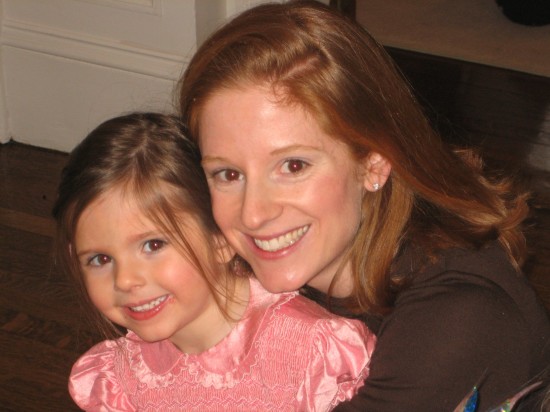
March 2007.  While I rarely think we look alike, I do in this picture.

“Here.  Put your hands under her armpits,” my midwife instructed, urgency in her voice.  With that, I pulled Grace onto my chest myself.  She and I both cried, Matt pronounced her a girl, and they took her away to be weighed.  I looked around the room, a wild fear that I have never forgotten galloping in my chest.  I had never been more tired, but at the same time every single nerve jangled with awareness.

Someone brought Grace to me and I reached out for her blanket-wrapped body.  Her eyes were closed.  I looked at her, anticipating the surge of recognition I had been told to expect.  I searched her face, waiting for something to break through the frozen numbness that filled me.

Finally, I looked up at Matt, my eyes full of tears.  “She has a cleft chin, just like me.”  Grace’s chin was literally the first thing to ring the bell that said: this is my child.

****

I sat on the edge of Grace’s bed to tuck her in.  Without looking up from her book, she held up a finger and whispered, “I just want to finish my page.”  I watched her in silence.  After a few seconds she put her bookmark in her book and leaned back against her pillows.  She looked at me and frowned.

“What?”

“Do you ever feel anxious that you won’t have time to read all the books you want to read?”  I nodded.  “I mean, I just want to read so many things.”  She pointed at her bookshelf, where a shelf of to-be-read were lined up.  “I’m scared that I won’t get to them all.”

****

On one recent car ride, I have no memory of specifically where, Grace was trying to read in the back seat.  After a few minutes I heard her shut her book and sigh.  I glanced in the rear view mirror to see that she was looking out the window.

“Are you carsick?”

“Yeah.”  Grace sounded dejected.

“Remember, try to look through the front.”  She turned her head and peered through the windshield.  “I’m sorry, Grace.  I know you got that from me.”  I can’t ride in a car for ten minutes without feeling sick.  I’ve had to have taxis pull over between Laguardia and the city so that I can throw up.

“That’s okay, Mum.  You gave me so many good things, too.”  I caught Grace’s eye in the rear view mirror, eyebrows raised, curious. “You know, like my brain.  And my looks.”  I burst out laughing and she joined me.

******

We took Grace’s best friend from camp to the airport at the end of a wonderful and much-anticipated weekend visit.  After we put her on the airplane, Grace dissolved into tears.  I hugged her and felt her chest heaving against mine.  We went home, walked to the park to watch Whit and Matt throwing a baseball, shared a happy family dinner, read a book, went to bed.

On and off throughout the evening Grace was tearful, her glossy eyes and mild frown occasionally breaking into full-blown sobs.  Several times she asked me forlornly for a hug and to take deep breaths together, something we’ve done for years when she needs to calm herself down.

By the time I tucked her in, I felt spent, at the end of my own rope, out of soothing responses to her sadness.  Grace looked at me, her cheeks wet, her eyes beseeching, asking without words for me to make her feel better, to take away this howling missing.  Of course I can’t, and when I reflect on it I realize some of my own aggravation was surely that her feelings were uncomfortably familiar, ringing bells of identification deep in my chest.

I looked back at her.  “Just try to think about how lucky you are to have such a wonderful best friend,” I said quietly.

Her gaze on me was steady and felt appraising.  She swallowed.  “This feeling is just part of the deal, right?  To have such happy things in life, you are also going to have this.  Right?”  I nodded at her, blinking.  “The great stuff and the sad stuff.  You can’t have one without the other.”

****

Sometimes, it takes my breath away, the way parts of me glint in her like strands of gold (as glittery, though rarely as beautiful) catching the light in a fabric.

this need to kneel

I know this happiness is provisional:

the looming presences –
great suffering, great fear –

withdraw only
into peripheral vision:

but ineluctable this shimmering
of wind in the blue leaves:

this flood of stillness
widening the lake of sky:

this need to dance,
this need to kneel:

this mystery.

– Denise Levertov, Of Being

More things I love lately

Occasionally I have an experience where several people, all known to me but unknown to each other, send me the same article, image, or piece of writing.  That happened with this gorgeous piece:

On Friendship – Pam’s words at The Kitchen Witch’s site brought me to my knees.  I’ve written often about friendship, about the important ones that thrum through my life as essential as arteries, and about the vagaries of when and how we make friends.  I’m honored to call Pam a close friend; she is one of only two people in the entire world who read my first (clunky, painful) memoir, for example.  Pam: for everything, thank you.  The rest of you: read this piece.  You won’t regret it.

Noticing: How to Take a Walk in the Woods – I believe fiercely – perhaps above all else – in the power of noticing the world around us.  This piece reminds me of why.  I am also both the child of a scientist and a passionate devotee of the field.  “Refining our capacity to notice is an act of reverence that we can bring to everywhere and everywhen.”

Word Up– My adoration of Catherine Newman’s writing is well documented.  This essay, about talking about the origins of words with her children, moved me to both laughter and tears.  In her trademark voice, full of humor and tinged with pathos, Catherine reminds me that to understand words, where they come from, what they mean, is at the root of really seeing and comprehending the world.

My Avatar, My Self – I love everything Dani Shapiro writes, of course, but this piece in particular touched a nerve that’s been humming a lot for me lately.  She talks about the increasing trifurcation of our identities in the world today, where a writer has a “real” self, a “creative” self, and an “avatar” self.  I have been thinking about her essay and the questions it raises for the week since I read it.

Haven Retreats – I loved Laura Munson’s memoir, This is Not the Story You Think It Is.  I have also been privileged to get to know Laura both online and in person, where she was even more warm and wonderful than I had imagined.  In fact I missed seeing her last night at my friend Aidan’s house.  I recently learned about her Haven retreats and they have vaulted to the top of my fantasy things-to-do list.  The idea of spending time learning from Laura in the breathtaking Montana scenery (somewhere I’ve been, and loved, once before) is just head-spinningly wonderful.  Someday.

What’s on your bedside table, your kindle, your screen, your mind lately?

My previous Things I Love Lately posts are here.

Photo Wednesday 45

IMG_8795

Last weekend, Grace’s best friend from camp came to visit.  This friend is the daughter of my best friend from camp.  The sheer fact of this, and the way I kept seeing my friend’s face in her daughter’s, made me dizzy several times this weekend.  Talk about vertigo: then, now, us, them, summer, the ocean, winter, tears, girls, women … it all blended together in a meteor shower of memory.  Grace is still crying about her friend having left.  Only two months until camp, I keep telling her.

Parallel

410smJdRSpL._SY300_

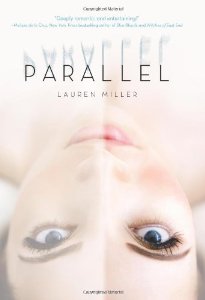
I couldn’t wait to read my friend Lauren Miller’s debut novel, Parallel.  I was already wowed by what I knew of Lauren’s story, that she’d written the first draft of this book during her daughter’s infancy.  Then, I read Parallel and found it an entirely engrossing, tremendously fun experience.

Parallel is a compulsively readable story that combines the tremendous fun of life in one’s late teens with huge, earth-shaking (literally) concepts about time, meaning, and the order (or lack thereof) that exists in the universe.  Parallel tells the story of Abby Barnes, a college senior, who experiences in a unique way the theory that parallel universes exist running alongside ours, populated with parallel versions of ourselves, making different choices, walking different paths.

Parallel‘s central characters are interesting and relatable: Abby’s best friend Caitlin, a brilliant science nerd in a gorgeous blonde fashionista’s body, Tyler, their mutual, handsome, funny best friend, and Dr. Mann, the Nobel-prize winning absent-minded professor whose theories about the entanglement of parallel universes guide the book’s narrative.

More than anything else, I finished Parallel thinking about both the universal human need to plan our lives and the fallacy of that instinct.  For someone whose blog is called A Design So Vast, there was much to ponder, also, about the interplay of order and chaos in our universe.  Abby’s mother is an expert on Seurat, and the metaphor of pointilism, where a field of seemingly random dots up close crystallizes into a clear image from far away, recurs throughout the book.  At one point, looking at a Seurat painting, Abby observes:

“Up close, all you see are the pieces, strewn about, heaped on top of each other.  Total disarray.  But step away, and a picture takes shape.  When you make sense of the chaos, the chaos disappears.  Or maybe, what looked at first like chaos never was.”

Another piece of art that figures prominently in Parallel is Tom Stoppard’s play, Arcadia.  Abby tries out for a play at Yale and is crushed not to be cast.  But then the director surprises her by saying he’d had an ulterior motive in not casting her, becuase he thinks she would be perfect for the part of Thomasina in the next play that’s going up: Arcadia.  Startled, Abby reflects on Thomasina, a character she has always loved but who has taken on new resonance since she has begun experiencing the entanglement of her parallel lives.  Thomasina, “…a  young girl who believed that everything – including the future – could be reduced to an equation.  Maybe this is part of the formula.”

Miller doesn’t entirely let us off the hook: she reminds us also that individual agency has an enormous role in shaping our stories.  In one scene, Abby watches her roommate heartbroken over a breakup for which Abby’s parallel bears some responsibility and thinks, with anguish: “Everything we do matters.”

Ultimately, though Parallel reminds us that our choices help direct our path, it celebrates most of all the mystery behind the way the pointillist dots that make up the story of our lives coalesce into a clear picture.  Towards the end of the book, Abby reflects on something Dr. Mann said early in the book: “You are a uniquely created being with a transcendent soul.  A soul whose yearnings can’t be predicted or effectively explained, whose composition can’t be quantified, whose true nature remains a mystery, as mysterious as it ever was.”

The last scene of Parallel draws together the various strands of narrative in a neat, surprising conclusion.  Abby’s thoughts emphasize the primacy of right now over someday, and remind us of the power of trusting that the universe will take care of us even when things seem chaotic and scary.

“Suddenly, it all makes sense.  The path doesn’t dictate the destination.  There are detours to destiny, and sometimes that detour is a shortcut.  But it’s more than that.  Sitting here, in this seat, Bret on one side, Josh on the other – wedged between my past and my future – is exactly where I’m supposed to be.  It doesn’t matter how I got here or where I’m going when I leave.  The point is, I’m here.  In this place, with these people. Te dots coming together so exquisitely, crystallizing into something greater than the sum of its parts.  All of the past made whole in the present.  The picture of my life is more beautiful than I could ever have imagined.  More beautiful than I ever could’ve planned.”

The design is vast, but oh, how it is beautiful.  I highly recommend Lauren Miller’s debut, which is as thought-provoking as it is un-put-downably fun to read.