Let the bucket of memory down into the well,
bright it up. Cool, cool minutes. No one
stirring, no plans. Just being there.
This is what the whole thing is about.
– William Stafford, from Just Thinking

Let the bucket of memory down into the well,
bright it up. Cool, cool minutes. No one
stirring, no plans. Just being there.
This is what the whole thing is about.
– William Stafford, from Just Thinking

Valentine’s Day evening, leaving a late dinner after driving home in a blizzard from a hockey game with Whit. I was (t)here, and I was happy.
It’s hard to believe this is the last month of Aidan‘s Here Year, in which it has been my honor to participate. And this month’s theme is happiness.
Happiness. I have to admit I have conflicted feelings about this word. I know most people would say that happiness is what they want in life. I think most people would also say that happiness is what they want for their child(ren). But for some reason that goal never sits entirely comfortably with me. I resonate more with the word joy, and even more, with contentment. I’ve written before that these days I feel a sturdy sense of joy that is both new and hard-won. This steady, difficult-to-dislodge feeling approaches what I think of as contentment. I’m comfortable saying that feeling this is what I have always wanted. I’m not sure what my reservation is when it comes to “happiness,” and realize it’s probably just semantics. So, for this month, back to happiness.
The question is whether being here has made me happier.
The answer is yes.
But here’s the thing: it has also made me sadder. There is no question that being present – a task which is at the core of the here year and which is also the central effort of my life – enriches my experience. But it enriches all of my experience. Remaining inside my own life, living in the hours I’m allotted, paying attention to everything that happens to and around me, opens me up to both joy and sorrow. I see more beauty and I see more heartache. I haven’t figured out a way to have one without the other.
Recognizing this unavoidable truth in my own life has had significant repercussions. It has changed how I think about goals for both me and for my children. I’m not sure I think of happiness as the be-all and end-all anymore. Happiness is a vital and meaningful part of my life. A big part of my life. But there’s also the reality I can’t get away from, the dark shadow that hangs over everything, the way that time moves on and pain comes and how the glow of morning light on bare branches makes me think of both exultant joy and heartbreaking loss. I think often – daily, at least – of Virginia Woolf’s statement that ‘The beauty of the world…has two edges, one of laughter, one of anguish, cutting the heart asunder.”
I wish there was an easier conclusion, a simpler to-do: make this adjustment, look at the world this way, and you’ll be happier. Life will be smoother. Sadly, at least for me, that’s not how it works. I still think there’s huge value in being present, in being here, though, and I would never choose to live another way.
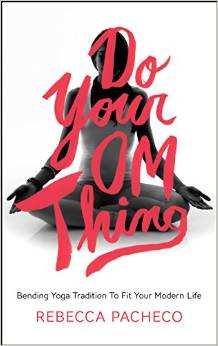
I’ve been practicing yoga, with a frequency that has varied between daily and weekly, for over 15 years. I’ve read parts of the Bhagavad Gita, I used to know the primary series by heart, and I’ve been on a week-long retreat that featured long periods of silence, a lot of vegetables, and 45 minutes of pigeon pose at a time. All of this is to say that I’m somewhat familiar with yoga. I’m not an expert, by a long shot. But I’ve read a lot and practiced a lot and even written about it from time to time here.
Rebecca Pacheco’s Do Your Om Thing: Bending Yoga Tradition to Fit Your Modern Life
Rebecca makes yoga tradition clear and compelling and unpacks things like the chakras and the koshas that I’d previously found confusing enough to be entirely off-putting. She asserts something that we all know to be true but that I posit most of us have lost touch with: that yoga is about far, far more than the asanas. But taking yoga beyond the physical poses is frankly hard, because the literature about yoga’s traditions and philosophy is opaque and difficult and because, especially in these days, we are all more distracted than ever. In this book, Rebecca changes all of that. These two quotes summarize what Do Your Om Thing
Yoga doesn’t manufacture a feeling of completeness; it offers tools for becoming present enough to realize it’s been there all along.
Internal quiet and connection to our deepest self form the essence of yoga. It’s not fancy. It doesn’t balance on one arm. But it’s the plain truth of yoga’s purpose, and it will change your life.
Do Your Om Thing
Yoga is a way of being in the world.
Rebecca discusses each “limb” of yoga briefly and offers concrete guidelines for readers wanting to incorporate them into their regular lives. This is one of things I love most about Do Your Om Thing
Part II, The Body, talks about the chakras, the seven energy points that reside along our spines, and the koshas, the body’s five layers. Once again, Rebecca shares specific intentions, mantras, and asanas (with beautiful photographs) to go with each chakra. As in the rest of the book, Rebecca’s clear, lucid writing renders understandable (and fascinating) something that I’d previously found challenging.
Part III, The Mind, discusses meditation. Rebecca reminds us that “the quality and direction of your attention is the greatest determinant of the quality of your life.” This section, and the brief discussion of meditation in part I, showed me that much of what preoccupies me in my life is in fact quite yogic in nature. When I read this, I shivered:
It will always be tempting to fidget, flee, or Facebook update instead of inhabiting the present moment, which can be challenging and uncomfortable, even tragic and terrifying, at times, but it’s this lack of consciousness that leaves us feeling like we need yoga in the first place. The feeling of missing our own lives, as they are happening.
Oh, yes. This feeling, of missing out on my own experience even as I live it is one I’ve long felt and often written about. Rebecca shares some helpful tools for beginning meditators and describes several meditation styles.
Part IV, The Spirit, which makes suggestions for “spiritual sustenance,” is my favorite part of the book. Rebecca tells personal stories, including about her grandmother, to whom the book is dedicated and who believed that “life itself is a spiritual practice.” Parts of this section of Do Your Om Thing
Thomas Merton once wrote, “Life is this simple: we are living in a world that is absolutely transparent, and God is shining through it all the time.” This doesn’t mean that life won’t be difficult of painful, characterized by change and loss; it means that a higher power, the wellspring for your spiritual life, whether you realize it or not, is holding a candlelight vigil or perhaps a roaring bonfire for you all hours of the day and night. It doesn’t sleep. It doesn’t leave.
Is the loneliness of which I’ve written, whose shadow limns my everyday experience, an ache for this higher power, a longing to trust in that candlelight or bonfire? I suspect so. Rebecca shares nine “suggestions for spiritual sustenance,” each of which I found profoundly moving. She incorporates quotations from literature, stories and thoughts from others living an engaged life, and questions from ancient texts (such as the Bhagavad Gita).
The last section of the book, titled love, opens with one of my all-time favorite quotes: “In the end only three things matter: how well we have lived, how well we have loved, and how well we have learned to let go” (Jack Kornfield). Rebecca closes with reflections on love, for the self, for other, for the world at large. She reminds us that while yoga doesn’t have to be our sole workout, it is our soul workout. “Find a way to make life the practice – one of humility, gratitude, and awareness,” Rebecca urges us. And with this beautiful, thoughtful, wise book, Rebecca has given us an incredibly powerful tool to do just that.
Do Your Om Thing
Disclosure: these are affiliate links
How can one person be more real than any other? Well, some people do hide and others seek. Maybe those who are in hiding – escaping encounters, avoiding surprises, protecting their property, ignoring their fantasies, restricting their feelings, sitting out the pan-pipe hootchy-kootch of experience – maybe those people, people who won’t talk to rednecks, or if they’re rednecks won’t talk to intellectuals, people who’re afraid to get their shoes muddy or their noses wet, afraid to eat what they crave, afraid to drink Mexican water, afraid to bet a long shot to win, afraid to hitch-hike, jaywalk, honky-tonk, cogitate, osculate, levitate, rock it, bop it, sock it, or bark at the moon, maybe such people are simply inauthentic, and maybe the jackleg humanist who says differently is due to have his tongue fried on the hot slabs of liar’s Hell. Some folks hide, and some folks seek, and seeking, when it’s mindless, neurotic, desperate, or pusillanimous can be a form of hiding. But there are folks who want to know and aren’t afraid to look and won’t turn tail should they find it – and if they never do, they’ll have a good time anyway, because nothing, neither the terrible truth nor the absence of it, is going to cheat them out of one honest breath of the earth’s sweet gas.
– Tom Robbins, Still Life With Woodpecker

I’m not going to lie to you: it’s been a difficult month. My professional life has a very busy few weeks every year (very busy – as in round-the-clock, 3-hours-of-sleep, can’t-leave-desk) and they happened to coincide with the relentless snow in Boston. In some ways that was a blessing: since 2011, I’ve gone to New York for what is for me a long stretch away from home to be there during this busy season, but this year, in part due to the blizzards, I stayed here. In other ways it was hard. I felt far away from the team I work with and it was difficult to really immerse myself into what could have been a joyful time at home.
In January of my sophomore year in college I broke my ankle. Because of this, instead of joining my friends for a week in Mexico as planned, I went home and got my wisdom teeth out. This past month has felt like nothing so much as that: challenge piled on unpleasantness, a cast on top of an ice pack on my mouth, aching and pain and a deep sense if isolation. More than once, Whit woke up in the night to go to the bathroom and found me sitting at my desk, a pool of light overhead and snow falling outside. More than a few times, when I finally did go to bed I couldn’t sleep, amped up with exhaustion and anxiety, which just added to the sand-in-my-eyes feeling the next morning.
I’ve been snappier and more cranky with my family than I want to be. I haven’t been able to go sledding when the children wanted to. Matt did a lot – a lot – of shoveling all by himself. I am as tired as I can remember being in years. I have barely exercised in a month. I have been wearing yoga pants or snowpants, and often both simultaneously, for as long as I can recall.
But at the same time, these weeks have been so removed from real life they have had a magical quality to them. It has been a blur of white, inside and out, snow on both sides of the glass, a time historic and difficult and, I’m already aware, unforgettable. I am grateful, most of the time, that I got to experience these historically snowy weeks here with Grace and Whit. I don’t think it’s bad that they see their mother working hard, and they have witnessed both laughter and tears – often daily.
I suspect part of what I love about snowstorms is the obvious: weather reminds us of how small we are, and how little true control we have. The endless snow actually cut away a lot of life’s BS. Just getting around Boston was so hard for a while that it felt like life had been distilled to its essence: my family, our house, and what we could walk to. Knowing I wasn’t able to leave my desk to really be with Grace and Whit the way I would have wanted makes me sad, but at the same time, I was here, and I am grateful for that. Sometimes what we have has to be enough. This is a lesson I’m learning over and over again.
The last month has stripped away any hard skin I had, and left me exposed, raw, exhausted, emotional. I read Oliver Sacks’ beautiful piece about learning he has terminal cancer, and the whole thing made me cry. But this last line, oh, it made me sob out loud:
Above all, I have been a sentient being, a thinking animal, on this beautiful planet, and that in itself has been an enormous privilege and adventure.
This is love to me. Recognizing the beauty even when it appears in the midst of a crabby moment, 74 new emails in a half hour, snow so thick it covers the windows, an iceberg hanging off of the roof, and another snow day. I’m already aware of how golden and glazed with special-ness the last month has been, even as I emerge from it slowly, creaky and exhausted. It has been an enormous privilege and adventure.