The texture that discomfort brings

Big Little Wolf wrote beautifully yesterday about home. In her trademark eloquent prose she wrote about the consequences when “home” shifts, the difficulty of feeling really at home in a place or with a person, what it means to be homeless, whether or not you can “go home again.”  Then I read Christa’s thoughtful post based on Ram Dass’s observation that “we are all just walking each other home” which reminded me of how “home” is both fluid and complicated for me.

I’ve written before about my stubborn sense of not really belonging. Big Little Wolf’s words accessed this same seam of feeling, reminded me of my feeling of having a foot in many words but a home in none. This feeling runs deep in my soul, and always makes me sad when it bubbles to the surface. It animates many of my actions and habits.

There is no point in wallowing in it, that much I do know. And today I am interested in its source. Where does my persistent feeling of not really fitting in come from? It would be easy to point fingers at my nomadic childhood (I lived in three countries by the age of 12 and moved consistently across an ocean every 4-5 years). But I think that is an overly simplistic answer. My slippery but inescapable sense of being outside rather than in is more fundamental than that. I think the restlessness of spirit that keeps me from fully engaging in any one world, from fully embracing a single identity is innate. It courses through my bloodstream as surely as platelets and plasma.

Is it some kind of defense mechanism? Why is it that I refuse to fully let go and surrender to one clearly-defined life? What am I afraid of? Of being seen? I write all the time about the human need to be seen, but I wonder if I’m actually afraid of the vulnerability that goes with this kind of being known. If I skip around between worlds, never fully engaging in or identifying with one, do I hope to innoculate myself from this scary vulnerability? Am I scared of what someone who really sees me will see?

Or is it a basic unease in my own skin? For some reason that I cannot articulate yet, maybe I am not wholly sure of where I fit because I am not entirely sure who I am yet. Maybe I have met so few native speakers because I am still fumbling around with my own language. I do like people, and I am lucky to have many friends; the fact remains, though, that there are very few with whom I feel truly at home.

The shadow of this discomfort about belonging follows me around, its size and darkness varying by the day. It feels like the oblong shadow of a balloon floating above me whose string keeps changing length; some days it is far ahead of me, and I walk in light, and at other times it is positioned just right so that my entire face is obscured by the penumbra.

It makes me oversensitive and insecure, for sure, but I think it also makes me empathetic. I am hyper-aware of other peoples’ comfort or discomfort in situations. I am compassionate and identify with those who do not belong. I also have a faint but undeniable suspicion towards those who exhibit an easy sense of belonging. Are they real?

This sense of not being fully at home anywhere is so essential to my being in this world that I can’t imagine a more secure and simple feeling of belonging. It is ingrained in my spirit, and it colors the lens through which I see and experience everything. In this holy season of darkness and light, may I turn my empathy and compassion on to myself. My vague discomfort in any single home rises like pentimento from underneath of the painting of every day, regardless of how beautiful the scene I manage to draw. May I forgive myself for this, and may I embrace it for the texture that it brings to the art that is my life.

(a repost from exactly a year ago… Christa’s post based on Ram Dass’s wonderful quote made me think about this again)
Tomorrow shall be my dancing day

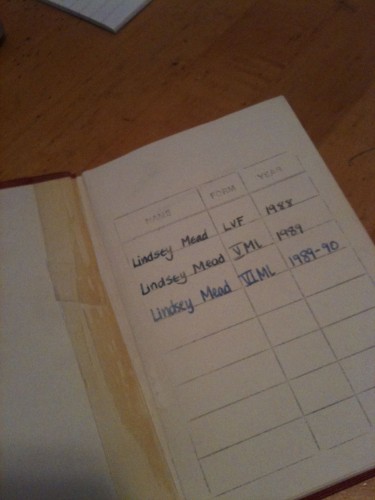
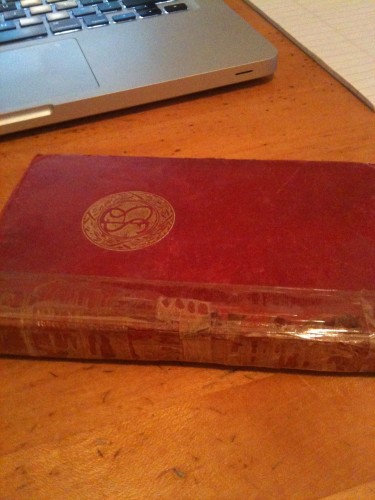
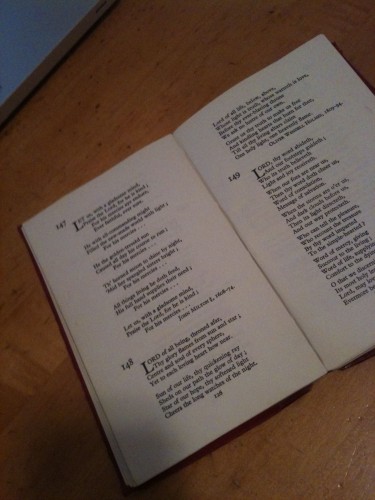
When our family lived in London, Hilary and I attended a school called St. Paul’s Girls School.  The school had enormous, intimidating brass handles on the front doors, a High Mistress we were supposed to curtsy to, and a grand mahogany assembly hall where we gathered every morning.  Each morning we stood up from our rows of narrow caned chairs to sing a hymn, turning our little red hymnbooks open to the specified page.  You can see my red hymnal above, and see how well-worn it is, its binding taped, my name and class year carefully noted in the frontispiece in the fountain pen that we all used then.

When I go to church, which is not particularly often (though I always love it when I do), I am almost always surprised by how the hymns are familiar.  The words, and the tune, bubble up from some deeply buried memory.  These hymns are engraved on the core of who I am.

One song, more than any other, carries a huge freight of memory.  It’s Tomorrow Shall Be My Dancing Day, which I love so dearly that I want it sung at my funeral.  The staccato opening notes, the specific, almost peculiar cadence of its verses, and the final soaring descant all invoke a powerful nostalgia for me.  The song represents nothing less than the heart of St. Paul’s, and of that time in my life, for me.

St Paul’s had an annual holiday concert, and Tomorrow Shall Be My Dancing Day was always, always the last song of the night.  I’m not the only person for whom the song is special.   I remember one particular year, though I don’t know which one.  Many of my classmates and I were in one of the classrooms that lined the assembly hall as the imposing organ began the notes of Tomorrow Shall Be My Dancing Day.  Our parents all stood.  As the song soared to its chorus, a group of us leaned out of the door of the classroom, craning towards the music like a plant towards light, singing our hearts out.  The music crescendoed and we all rode its wave, joining our voices in the swelling song.

I can close my eyes and be back there, in the long-ago days of my own life, in the dark London night. The past feels animate in my present when I think about that concert, that hymn, that well-worn red book; the 13 year old me is dancing inside the 36 year old me still.  Dancing and singing: may we all dance tomorrow.

Haunted by a certain poet

Recently, Katrina mentioned a forthcoming book, And I Shall Have Some Peace There, by a friend of hers, Margaret Roach.  She sent me to her friend’s blog, thinking I’d love it.  Of course, I did.  What I’m thinking about today is her post about how she named her book.  Roach talks about reading Yeats’ The Lake Isle of Innisfree 30 years ago, in college, and about how the lines had “long called out to her.”

I have a poet who haunts my thoughts like that. The lines of that poet’s poems call out to me in a similarly seductive, inescapable way.  Over and over again.

Here’s a real test of how whether you are reading my blog closely: which poet?  Whose words accompany me the most often? Poetry is the place I go when I really need solace, it’s what I wrote my thesis on in college, it’s often what I choose to read before bed.  I wish I could write poetry, but I can’t.

So whose words does my mind cling to above all others?

Not the three poets I have studied most closely, Anne Sexton, Maxine Kumin, Adrienne Rich.  Not my beloved Mary Oliver or Sharon Olds.  Not the classic greats whose work I know well, Keats, Shelley, Tennyson, Hopkins.

No.  William Wordsworth. Yes.  The great Romantic poet of middle school.  Un peu hackneyed, I know.  Still, I cannot get Tintern Abbey out of my head.  At least daily, often several times a day, I hear some of the lines from that poem.  Some of the specific lines that recur in my head are “in this moment there is life and food for future years,” “with an eye made quiet by the power of harmony, and the deep power of joy, we see into the life of things,” and “something far more deeply interfused”.  I also hear “Surprised by joy, impatient as the wind.”

I could go on but I’ll spare you.  When I read Margaret Roach’s description of how Yeats’ words had basically shared her thoughts for 30 years, I thought immediately of Wordsworth.  I thought of how often my subconscious turns to his poetry, over and over again.  The lines are both security blanket and puzzle; it’s as though my mind seeks solace in those words, but also like it returns to them, worrying them, studying them, unfolding a new understanding of their message every once in a while.

I wish, I admit, that my mind would choose a more sophisticated muse.  I would be delighted if one of those other poets lived in my head in this way.  Certainly there are lines from every single one that I mentioned, and a long list of others, that I think of from time to time, even often.  But nobody compares to WW.  I’ll leave you with my favorite passage from the long poem, which, though a bit trite and English 101, I have to admit stuns me every time I read it.

And I have felt
A presence that disturbs me with the joy
Of elevated thoughts, a sense sublime
Of something far more deeply interfused,
Whose dwelling is the light of setting suns,
And the round ocean, and the living air,
And the blue sky, and in the mind of man,
A motion and a spirit, that impels
All thinking things, all objects of all thought,
And rolls through all things.

Believing is the act of love

“My dear it was a moment
to clutch at for a moment
so that you may believe in it
and believing is the act of love, I think,
even in the telling wherever it went.”

– Anne Sexton

Believing is the act of love, I think.

What do I believe in tonight?  I believe in certain people.  I believe that the light will come back.  I believe there will always be fantastic words to read.  I believe my children are good souls.  I believe that life is made up of those moments to clutch at, that most often take me by breathless surprise.  I believe that most people are doing their best.  I am trying to believe that there will be hands to catch me if I release my white-knuckle grip and fall as a result.

What do you believe in?

Trying to say thank you

In keeping with Grace’s startlingy wise observation recently, that praying is saying thank you, I’m trying to infuse this holiday season with as much gratitude and as little materialism as possible.

Results are, I think, mixed.
For the last several years the children have shared a LEGO advent calendar.  This year I made Grace her own advent calendar. I bought a calendar with empty pockets on etsy, and filled each with a directive for something to do. I got this idea from Ali Edwards, though I wrote most of my own suggestions.  The daily directives include selecting some toys she doesn’t play with anymore for goodwill (something we do approximately monthly anyway), writing a thank you note to someone just because, reading a Christmas book to her brother, and the one she worked on this week, creating a list of ten things she’s thankful for this year.
As you can see, “the world and being alive” just makes the list, under her ipod touch and “all her toys.”  Hmmm.  I suppose there’s some solace in the fact that her friends and four healthy grandparents are above her things.  Still, I think we might need a refresher course that without #10, #1-9 would not exist at all.

My children constantly bemoan the fact that I do not decorate enough for holidays.  They wish I was more like one of my best friends, who celebrates everything with tremendous vigor and enthusiasm.  It’s one of her very best qualities.  This year I’m making an effort.  We have a wreath, hung up with a thick gold ribbon, in the kitchen over the sink.  And we have this garland, which I had made, showcasing some of my favorite Christmas carol lyrics, over the kitchen table.  And there is, like every year, a big boxwood wreath on the front door.  I’m trying!

I had these silhouette ornaments made of each child for our tree.  Grace loves hers.  I also have their silhouettes on pendants that I happened to be wearing today when the ornaments came.  I highly recommend Le Papier Studio‘s work.  I have a big framed silhouette of the children walking away – always, they are walking away – on the wall by my bed.The kids’ school has a new rule that doesn’t allow parents to buy teacher gifts at the holidays.  Instead, Grace and Whit are hand-writing notes to their teachers and decorating them with black and white ink stamps.  Grace’s are neat paragraphs full of her favorite things about her teachers.  Whit’s are more minimalist but no less charming, in my view.

That’s the update from the land where we trip and fall, often, in our efforts to say, adequately, thank you.