
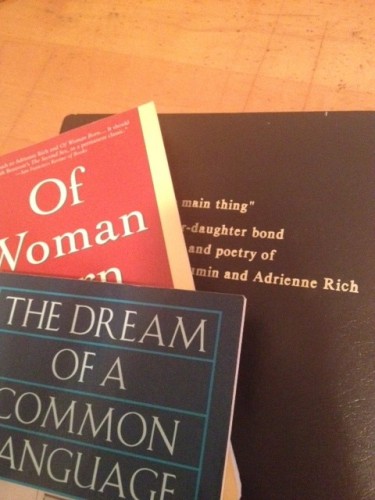
Adrienne Rich

I remember one shadowy afternoon in the winter of 1996 in college, sitting across from my thesis advisor talking about my work on three 20th century poets.  I picked up a sort of convoluted slinky thing made of cardboard that sat on her desk.  In my hands it morphed, rotating in and out and folding in on itself and out again.  It was a science experiment, a shell, a marvel of simplicity and complexity in a desk toy.  I couldn’t stop playing with it.

“Adrienne Rich gave me that,” my advisor said casually.

“She did?” My eyes grew wide and I looked down at the cardboard spiral in my hand.

Years later, I attended a reading Adrienne Rich gave at Harvard.  I dashed down to the front after she was finished to meet her, and was struck by how tiny and bowed she was.  And yet her miniscule person emanated a power I’ve rarely experienced.  Her eyes crinkled when I told her I’d written about her, and she managed to make me feel that she cared even though she’d surely heard that a zillion times before.

Adrienne Rich’s poetry has been important to me for a long time, some of her words so familiar they have become incantations, stones worn smooth with my mind’s constant turning over and rubbing of them.  She is one of a handful of poets – the others are William Wordsworth, Mary Oliver, Wendell Berry, Gerard Manley Hopkins, Stanley Kunitz – who I literally hear inside my head on a daily basis.

I’ve written about her here before, many times.  I consider her poem Towards the Solstice, which contains the lines “and there is still so much here we do not understand” a totem: to a person like me for whom light and dark and the turning of the earth are literal, visceral parts of my human experience it is among the very greats.  Power, her poem about Marie Curie makes me believe that my aching, painful sensitivity might somehow also be an asset: “her wounds came from the same source as her power.”

My mind is flooded with Adrienne Rich’s images, the great dark birds of history and the book in which our names do not appear and poetry being a land where she wasn’t anyone’s mother.  Yes, she was angry, filled with what the New York times called “towering rage,” but she was also brave and honest, a woman pursuing authenticity even when it meant howling into the darkness and rejecting the known.  I am familiar mainly with her poetry and with the prose of Of Woman Born, a book about “motherhood as experience and institution” (from its own subtitle).  In this part of her canon, the theme of creation, and its inextricable, complex relationship with procreation is central.  The female body is heavy and present, haunting almost all of her poems.

After I learned of her death I went back to my thesis and reread the chapter on her, but, even more importantly, I went back to the texts I read for the first time as I wrote it.  There are volumes of poetry and prose, all underlined and full of marginalia.  I can easily close my eyes and be back in my small study carrel in Firestone Library, reading these words and feeling them sink in, aware of something enormous turning over inside of me for the first time, an animal part of my spirit that was never quiet again after that initial awakening.  Rich herself midwifed that birth of a part of me, and remembering those days is bittersweet.

I don’t know how to adequately describe how vital this woman and her words are to me.  I grieve her loss while knowing that her words will live on, for me and for generations more, their incandescence undimmed.  I’ll just end with one of my favorite passages – resonant because of many things, but not least because I relate to the idea of reconstituting something, with no extraordinary power – from the last stanza of her poem Natural Resources:

My heart is moved by all I cannot save:
so much has been destroyed

I have to cast my lot with those
who age after age, perversely,

with no extraordinary power,
reconstitute the world.
To realize in the present

I can feel how large, how essential this moment is as it’s happening; that is what I have come to love about being an adult, to the extent that I can claim that title: that one knows more about how good things are, how much they matter, as they’re happening, that knowledge isn’t necessarily retrospective anymore.

When I was younger, I missed so much, failing to be fully present, only recognizing the quality of particular moments and gifts after the fact. Perhaps that’s the one thing that being “grown up” is:

to realize in the present the magnitude or grace of what we’re being offered.

– Mark Doty, “Heaven’s Coast”

The spirit and living at the edges

I have just spent a week at the ocean, and Mark Doty has been in my head.  This can only send me in one direction: it makes me think, as I often do, of one of my very favorite essays, Doty’s Cold Dark Deep and Absolutely Clear, part of which is available here. The essay is a meditation on the death of Doty’s partner, Wally, and it contains some of my favorite sentences ever written. Doty talks about a wounded seal on the beach, and muses on the image of the merman, a being who slides easily between worlds. The coast becomes place where this slippery transferability is made easy.

Doty also shares some observations on writing and ways of imagining and integrating our experience.  As someone whose instinct – in writing as in life – leans towards the metaphorical, I love what he has to say about that as a way of understanding the world.  His lines about the spirit are among those I hear most often in my head; he’s up there with Wordsworth for most-frequent haunter of my thoughts.  Haven’t we all had moments where we feel our spirit, like flames, both a part of our physical presence and something, somehow, ineffably separate?

My way of knowing experience is to formulate a metaphor that describes or encapsulates a moment; it is a way of getting at the truth. And a way of paying attention, of reading the world.

The spirit is that in us which participates. It moves alone, like air or fire, and it moves with the body, lifting the body’s earth and water into gesture and connection, into love.

Doty’s essay is not strictly about the ocean but it is suffused with images of the coast and of distant water (cold, dark, deep, and absolutely clear).

The body is not me. I am my body, but I extend beyond it; just as my attention laps out, as my identity can pour out into the day. I have learned more about this, living beside the water, as if the very fluidity of the landscape gets inside us and encourages our ability to slip our fixed bounds and feel ourselves as extended, multiple, various.

There is something I find essentially familiar about being near or on the ocean.  This is something I must have inherited: my parents, both passionate and intuitive sailors, cite as one of the major reasons for moving home from London their longing to be close to the ocean again.  I am at my core a liminal being, born just at the beginning of the turn from one season to another, drawn to the edges and hems of this human experience, beguiled most of all by the shadow at the border where light and dark bleed together.  It is surely no accident that I am so deeply moved by sunrise and sunset, which are the edges of time just as the coast is that between earth and sea.

Perhaps I am drawn to these boundaries because it is there that I feel, as Doty says, extended, multiple, various.  Maybe it’s here, in the blur between one world and another, between one night and a new day, that my spirit recognizes its true home and, in its comfort and elation, makes its presence known to me.

To dig deep into the actual

To take what there is, and use it, without waiting forever in vain for the preconceived – to dig deep into the actual and get something out of that – this doubtless is the right way to live.

– Henry James

Savage and beautiful

The Great Affair

The great affair, the love affair with life,
is to live as variously as possible,
to groom one’s curiosity like a high-spirited thoroughbred,
climb aboard, and gallop over the thick, sun-struck hills every day.

Where there is no risk, the emotional terrain is flat and unyielding,
and, despite all its dimensions, valleys, pinnacles, and detours,
life will seem to have none of its magnificent geography, only a length.

It began in mystery, and it will end in mystery,
but what a savage and beautiful country lies in between.

– Diane Ackermann