The World I Live In

I have refused to live
locked in the orderly house of
reasons and proofs.
The world I live in and believe in
is wider than that.  And anyway,
what’s wrong with Maybe?

You wouldn’t believe what once or
twice I have seen. I’ll just
tell you this:
only if there are angels in your head will you
ever, possibly, see one.

– Mary Oliver, Felicity

Start with what you know

I love Jeanette LeBlanc‘s writing.  All of it.  I particularly adored a piece of hers that I read recently, Start With What You Know.  She evokes so powerfully the writing life, the tension and urge and essence of the white hot need to come to the page.  I was inspired to share my own list of what I start with, of what I know.

IMG_8594

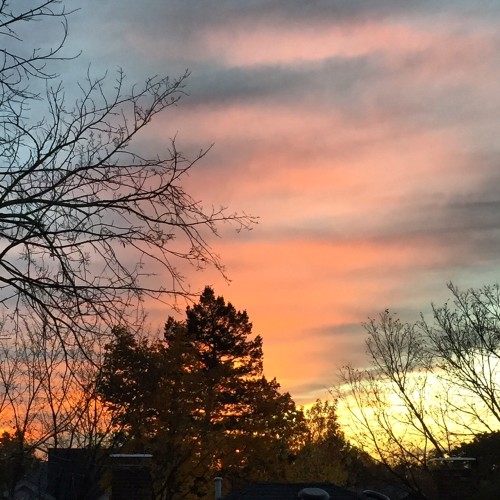
this, the sunset out of my office window, is something I know to be true

I think most clearly in the morning, and I like to start my day before the sun is up.

I like my coffee with coconut milk and coconut sugar.  Hot, and more than one cup of it.

Life is messy and most people carry some scars and wounds with them.

Drinking alcohol doesn’t really work for me most of the time anymore.

I’m more attuned than most people to aches and pains and changes in my body.  This only makes me a hypochondriac if I act on every discomfort.  It makes me aware and sensitive if I remember to sit tight and wait.  Most things pass.

Writing is an essential part of almost every day for me.  I need to write what I see, what I think, what I feel.

I feel a lot.  Good and bad and everything in between.  I ride roller coasters inside my emotions every single day.  The challenge is creating more space between the feeling and the reacting.

My spidey sense about other people is rarely wrong. I need to trust it more.

Nothing puts me more quickly and firmly in touch with the ineffable, deeply reassuring energy that throbs through the universe than being outside.

When you write what you know, what do you start with?

Things I Love Lately

What It Really Means to be Happy – I love this piece on Tiny Buddha, which asserts that happiness is an orientation towards our lives rather than a single mood.  Oh yes.  As someone who has publicly decried the emphasis on “happiness” as life’s ultimate goal, this piece really spoke to me.

9 Learnings from 9 Years of Brain Pickings – Thank you to Tracy, who sent this link from Maria Popova’s wonderful site to me.  It won’t surprise you, probably, that my favorites are #4, “build pockets of stillness into your life,” #6, “presence is a far more intricate and rewarding an art than productivity,” an #8, “seek out what magnifies your spirit.”  The whole list – concise, wise, powerful – is worth reading.

Motherhood is Always Saying Goodbye – “Mothering holds within it, then, ancient wisdom that comes from millennia of women devoted to the hard practice of letting go.”  Yes.  Nothing I can say to add to the glory of this piece, which asserts that motherhood and life itself is about letting go and living with farewells but YES.  I often find the work on Literary Mama resonant, and this essay touches me more than most.

I’m reading Anne-Marie Slaughter’s Unfinished Business: Women Men Work Family and finding it compelling, both a call to action and a reminder that I am doing okay.  I had the privilege of meeting her last week, which was absolutely fantastic.

We are back into Homeland and I continue to think it’s incredible.  Top 40 again continues to dominate my playlist (which is almost entirely in the car) – right now, loving Rob Thomas’ Hold On Forever and I’m still not sick of Passenger’s Let Her Go.

What are you reading, thinking about, and listening to lately?

I write these Things I Love pieces approximately monthly.  You can see all previous posts here.

an acknowledgment of great fortune and a prayer of thanks

Pru asked if she was okay, and June answered with a question that seemed to Pru to be more of a comment on June’s struggles with Lolly: Did you ever have a family?  Pru said she sounded completely wiped out, at wit’s end.  She asked June if she wanted to walk back with her to the house, but she politely declined, saying she needed to be alone a little while longer.

Pru told us that night that she’d never felt as grateful.  That her answer to June’s question had been yes, but not as a commiseration, or as an explanation of fatigue, as it seemed to be for June, but both as an acknowledgment of great fortune and a prayer of thanks.  With Mike on the line from Tacoma, and Mimi and I huddled over her iPhone on speaker in the kitchen, Pru whispered to us, Thank you.

– Bill Clegg, Did You Ever Have a Family


The end of childhood

“The end of childhood,” the author intoned from the stage, “is pretty universally thought to be start of middle school. Generally, seventh grade.” Tears sprang to my eyes and I slid my gaze sideways, glancing at my seventh grade daughter sitting next to me. We were at an event at our local library, a panel of Middle Grade authors, a Monday night in late September. I looked down at her long legs, taking in her feet, in my Jack Rogers sandals. I peeked at her face. She was staring at the stage, rapt as some of her favorite writers talked.

Grace was three weeks shy of 13 that night, and she and I sat in the audience it felt as though many themes of her life and mine collided in my head and my heart. Here she was, a new middle schooler, the end of her childhood upon us. How is this possible, I thought, able to sense the baby and child she was and the woman she’s rapidly becoming animate, all at once, in the liminal creature sitting next to me?

It was as though I left that library auditorium for a bit. My mind cartwheeled through the years and I thought about letters I wrote to Grace every year on her birthday. I remembered the piece I wrote about the ten things I wanted her to know when she turned ten. Already, that was three years ago, and here she is, on the brink of being a teenager and, apparently, at the formal end of childhood.

I have been keenly conscious of time’s passage my whole life, but having children brought a new sharpness to that awareness.   And in the last months the sense that my time with Grace living with me and nearby is limited has reached a fever pitch. Everything feels heightened, poignant, crucial. I think constantly of the lessons I want to make sure to have imparted to her, knowing that there’s more road behind us than ahead when it comes to years with her living under our roof.

My mind snapped back to the panel on the stage in front of me as the moderator began taking questions. I leaned over towards Grace, clasping her hand in mine and squeezing it. She leaned her head onto my shoulder and we both listened as the authors answered questions from the audience.

I left the event with the authors pensive, even melancholy, which to be honest is the state in which I live much of my life. That night after tucking Grace in, and listening to her prayers, which are so familiar that I can say them along with her, I leaned against her closed bedroom door. Every single time I say “I’ll see you in the morning” to a child in a darkened bedroom I am aware of what an incandescent privilege it is. I went up to my desk after a moment at her door and sat at my desk. I looked through the birthday letters I had written to her, feeling the throb of loss and gratitude that I now recognize as the central rhythm of my life.

I know there are many, many adventures and challenges ahead in the teen years, but 13 does feel like the end of something.

I wrote this last month after a wonderful event at the Cambridge Public Library, and today, now that Grace has crossed the bar (Tennyson’s Crossing the Bar springs into my mind here) into her teens, felt like the right moment to share it.