I’ve written about being a runner from Boston, and I guess it follows that I love the Boston marathon. I’ve never in my entire working life had the day off, so I usually am working and glancing at the results from my desk. A couple of times I’ve watched friends run, which has been inspiring. But truthfully, I’m not historically one of those people who watches, riveted, or who’s a big fan-girl of marathons.
Which makes what happened this year unusual. By chance, I watched Desi Linden cross the finish line in my living room, and I burst into tears. Matt was standing there and he was surprised by my reaction. I couldn’t get enough of her story. Of the way she thought at the beginning that she wouldn’t finish. Of the way she waited for Shalane Flanagan to run to the restroom so they could run together. Of some of her tweets, which I shared on my Instagram stories:
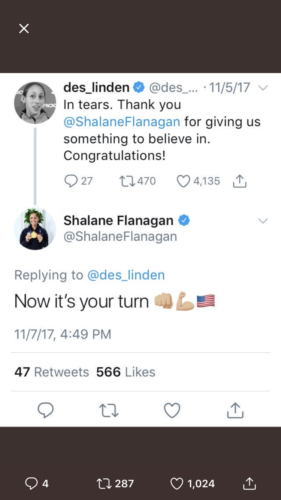
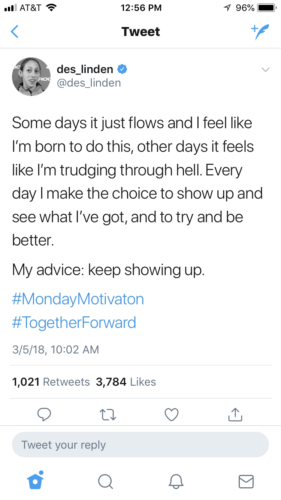
What I love about running is encapsulated by Desi’s story. She’s a supportive competitor who cheers on her rivals when they win (Shalane at the New York marathon) and who puts teamwork and comrade-ship above an personal edge (Shalane, waiting for her in this year’s Boston). She’s toughed it out for 7 years since she came in 2nd in Boston by two seconds. She’s also an adult, a woman of 33. I also love that marathon runners are often adults (I particularly loved the way the men’s winner has a full-time job in an office and has chosen to keep that vs. becoming a full-time sponsored runner) with lives and perhaps families (Kara Goucher, I’m looking at you).
Last Monday, in the pouring rain, I was touched by the winners of the marathon and by their stories, but I was also tremendously impressed by the thousands of people who slogged it out in the most inhospitable conditions I can imagine. I haven’t been able to stop thinking about the way I was unusually moved by the day, the stories, the effort. I suspect it’s linked to my thoughts about other odysseys.
I just finished the most wonderful book: An Odyssey: A Father, a Son, and an Epic by Daniel Mendelson (my brilliant sister recommended it). It’s about fathers, it’s about literature, it’s about epic poetry, it’s about travel. I’m all in. But the book also made me realize all the strands in my life that connect to The Odyssey (which I’ve, shamefully, never read).
Matt and I had two readings at our wedding, one of which was CP Cavafy’s Ithaka. This poem has always meant a lot to me. It was the favorite poem of my dearly-beloved English teacher at Exeter, Mr. Valhouli. He had it tacked to the wall of his classroom and referred to it often. I dedicated my college thesis to Mr. Valhouli, and the dedication (the irony and poor phrasing of which I realize now, since Ithaka is not about the arrival) read:
“This thesis is dedicated to the memory of James Valhouli (1942-1995)
Mr Valhouli,
Your inspiration will always be with me.
Thank you for teaching me passion for Ithaka.
I trust you are there.”
That thesis was about the mother-daughter relationship in the lives and work of three 20th century poets: Maxine Kumin, Adrienne Rich, and Anne Sexton. I loved that topic, and have written often of the way that my 21 year old self couldn’t have possibly imagined the ways in which her research and study would become a central theme in her adult life. It’s as though that choice presaged one of the central preoccupations of my life now.
But the other subject I thought long and hard about writing on was Tennyson. Specifically Ulysses. It’s funny how pressingly urgently Tennyson presents himself in my life these days, and this book is just one example. Ithaka. Ulysses. The fact that Whit is currently studying those myths. The fact that my father loved those stories. I’m surrounded by these ideas and concepts, and if there’s one thing I know, it’s that it’s not an accident, why we think of the seemingly random things we think of. I am certain there’s some reason – inchoate, yes, but real – behind why certain stories, songs, words, thoughts come to mind when they do.
The odyssey and the marathon. But, are meaningful to me right now because they are reminders that life’s about the journey. That it’s about what we amass along the way. My father certainly believed that, there’s no question about it (he used to quip that “life’s the stories you tell your grandchildren.”). And I do too. And even my unexpectedly emotional reaction to the marathon makes sense to me through this lens: it’s about sportsmanship and gritting it out and not giving up and keeping those on the path with us company as we go. It’s about the journey. Like many cliches I’ve encountered (most?), that one contains a deep truth.
As Cavafy says, “hope that the voyage is a long one.
I do.

 by Daniel Mendelson (