She walks in beauty

Happy Birthday, Hadley

Sending you all my love, halfway across the country, and looking forward to seeing you in a few weeks.

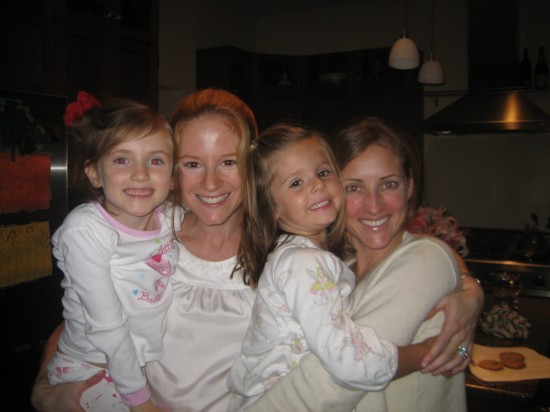
We met 14 years ago this fall, which seems amazing to me. You were – and are – so impeccably elegant that it took me a long time to believe that there was, as you kept telling me, tumult and anxiety beneath the surface. I’ll never forget the New Year’s, years ago, when another friend met you and told me, days later, that her original impression that you were intimidating had quickly given way to realization of your warmth, generosity, and sense of humor.

You are the calm one who talks me off of the various ledges that I perch on weekly if not daily. Where I am a tornado, you are tranquil, where I am rough you are refined, where I am struggling you are serene. More than once you’ve pulled me through a very dark spot with the tenacity of your friendship (I’ll never forget the Fed-Exed box of pacifiers when Grace was one week old).

I am honored to be able to know the you beneath the gloss, but I also admire tremendously both the way you put yourself together and your view that each day is an opportunity to craft something beautiful. You bring beauty wherever you go, creating lovely spaces, moments, experiences. You are a thoughtful and generous hostess; you have rice milk in the fridge and diapers in the right size in the bathroom. You think of everything. Your aesthetic sense is an inspiration. Every facet of your life always strikes me as almost achingly lovely: your stationery, your Christmas cards, your handwriting, your clothing, the art on your walls, the fruit in your fruit bowls, the food on your table. Patterns, colors, songs all seem more vivid and beautiful in your hands, and you handle all of these things with ineffable, instinctive ease.

Every time I see you I leave dedicated to working harder at cultivating beauty in my life. You are profoundly generous with Grace, your goddaughter, and her friendship with Charlotte is one that I hope will last a lifetime. Our paths have been woven together now for many years, but in many ways I feel our spirits are growing more and more in tune as we get older. We’ve always been able to span a wide range of topics together, from macrobiotic food to Manolo Blahniks, from past life healers to Page Six stories.

Happy, happy birthday, my dear, beloved friend. I look forward to the road that lies ahead, and am more grateful for your support, wisdom, companionship, and humor than I can articulate.

Mennonite in a Little Black Dress

I laughed. I cried. It was better than Cats.

Mennonite in a Little Black Dress is one of the funniest and wisest books that I’ve read in a long, long time. Rhoda Janzen is simply hilariously funny. I have rarely laughed out loud as often during a book as I did with this one. At the same time, Rhoda is almost blindingly intelligent (I haven’t looked up this many words since The Geography of Love), achingly full of empathy, and hugely self-aware, but in a not-at-all-arrogant way.

Rhoda’s tough year spent recovering from botched surgery with a catheter and a urine bag strapped to her leg was just the prelude to the really, really bad week that kicks off the action of her memoir. Her husband of 15 tumultuous years leaves her for a man (Bob) that he met on gay.com, and she is in a car accident that leaves her with serious injuries. In response to these world-shattering events, Rhoda moves home to California and moves in with her Mennonite parents.

I think my favorite thing about Rhoda’s memoir is the delicate way she points out the incongruities and hilarities of the religious community of her childhood while also clearly honoring them. There is no disrespect in her descriptions, which is quite a feat given how much humor she finds. The tales of her mother’s uncanny and unselfconscious public bodily commentary and the detailed descriptions of the peculiarities of traditional Mennonite food are downright hysterical. And yet these – and so many more laugh-out-loud stories – are told in a loving, respectful way.

Rhoda’s stories of her interval at home are interwoven with reflections and memories from her childhood. Her family is full of characters both entertaining and endearing; I particularly loved her steady, serene, practical sister, Hannah. The shorthand the sisters share, full of private references and the deep intimacy of a common and unique childhood, reminds me of the way that Hilary can say to me, eyebrow cocked, “ADC? Q Kamir? The Happy Hallwegers?” and make me burst instantly into the laughter of keen recognition.

I can’t recommend Mennonite in a Little Black Dress enough. Rhoda’s voice alone is reason to start this book. Tonight. I absolutely adored spending time with her. I want to be her friend! The memoir is also deeply moving. It is a testament to the strength of Rhoda’s spirit that she overcomes crises that would crush the average person with both her sense of humor and steadfast faith in the essential good of the world intact. As she sinks into the comfort of her family’s embrace, realizing the ways that her life has irrevocably ruptured, Rhoda opens to an awareness of the great unknown of the universe. This is, of course, a universal experience, I think, and one for tales of which which most of us have a huge appetite. Only a masterful writer, thinker, and person like Rhoda Janzen can have me laughing uproariously on one page and on the very next reduce me to tears with sentences like this:

…I suddenly felt destiny as a mighty and perplexing force, an inexorable current that sweeps us off into new channels… And how sad it suddenly seemed to be buffeted by the powerful currents to which we had yielded our lives. So many years had passed. My childhood, my early friendships, my long marriage, all seemed to hang from an invisible thread, like the papery wasps’ nest outside my study window. I had watched the lake winds swinging and tipping it, expecting it to go down, but it never did. Memory swayed like that next – hidden but present, fragile yet strong, attached by an unseen force to perpetual motion.

I loved Mennonite in a Little Black Dress. I will be hearing Rhoda’s keen observations, shot through with her trademark humility and intelligence, in my head for a very long time. Her memoir is a rare thing: a book that really makes you laugh and that really makes you think at the same time.

The stack

My stack is out of control. I am hoping that this holiday weekend affords some serious reading time. I am always fascinated by what other people read, so thought I’d share the titles that are piled on my bedside table right now. I think what people read is a very good snapshot of what it is that fascinates and moves them.

Our Town – Thornton Wilder
Little Bee – Chris Cleve
The Spectator Bird – Wallace Stegner
For the Time Being – Annie Dillard
Inventing the Truth: the Art and Craft of Memoir – William Zinsser
Don’t Let’s Go to the Dogs Tonight – Alexandra Fuller
The End of the Alphabet – C S Richardson
Half the Sky – Nicholas Kristof
Reviving Ophelia – Mary Pipher
Happiness – Thich Nhat Hahn
The Wishing Year – Noelle Oxenhandler
When Things Fall Apart – Pema Chodron
The Cloister Walk – Kathleen Norris
The Unfolding Now – A H Almaas

I’d love to know what you’re reading.

A reflection of what it is in this life you prize most highly

I have been thinking nonstop about Anne Lamott’s piece, about our true wealth being this moment, this hour, this day. As usual, she is basically the oracle to me, among my wisest and most impactful teachers. I agree with her initial assertion “that there is nothing you can buy, achieve, own, or rent that can fill up that hunger inside for a sense of fulfillment and wonder.” She herself says that this is not revolutionary, but in fact the basis for “almost all wisdom traditions.” She talks about “chances of lasting connection or amazement” and I think of Mary Oliver’s glorious line that often scrolls through my thoughts:

When it’s over, I want to say: all my life I was a bride married to amazement

Let us all be less cynical, less negative, less judgmental.  Let us all have more wonder, more trust, more giving each other space to be human.  Let us all remember that almost everyone is really just doing the best they can.

What Anne’s essay has me thinking about today, though, is about the way we make time for that which we really value.  In fact, I think that if we each looked back over how we have spent the last day or week, we would see, in neon animation, a graph of what it is we really honor and think is important.  That’s what we make time for.  Most often, this happens instinctively, without much forethought or analysis.  It simply is.  We just say yes to that which we care most about.  Other times, we have to actively, even fiercely guard the time for certain activities or people who are near to our hearts.

Let’s no longer hide behind the excuse that we “don’t have time.”  The truer response would be “I don’t care enough to really protect the time.”  Maybe this is harsh, but I think it’s also true.  Think long and hard about how you spend your precious hours, the only currency in this life that I personally think is actually worth anything.  And if you look carefully at these choices, you will see a reflection of what it is in this life you prize most highly.  Do you like what you see?

Our true wealth: this moment, this hour, this day

There is no way for me to adequately convey my admiration, respect – hell, sheer hero-worship of – for Anne Lamott. This essay could have been crafted from my own thoughts. Admittedly, she took my fractured, ugly, disjointed thoughts and fashioned them into beautiful whole cloth. But what else is new.

She also cites something I’ve long believed, which is that we make time for that which is really important.  If you can’t fit in it, that says something meaningful about how you value “it.”  And one thing I seem to have no problem protecting time for in my life is time alone, in solitude, thinking, writing, reading.

I urge you to read this whole piece. It’s worth it.

********

I sometimes teach classes on writing, during which I tell my students every single thing I know about the craft and habit. This takes approximately 45 minutes. I begin with my core belief—and the foundation of almost all wisdom traditions—that there is nothing you can buy, achieve, own, or rent that can fill up that hunger inside for a sense of fulfillment and wonder. But the good news is that creative expression, whether that means writing, dancing, bird-watching, or cooking, can give a person almost everything that he or she has been searching for: enlivenment, peace, meaning, and the incalculable wealth of time spent quietly in beauty.

Then I bring up the bad news: You have to make time to do this.

This means you have to grasp that your manic forms of connectivity—cell phone, email, text, Twitter—steal most chances of lasting connection or amazement. That multitasking can argue a wasted life. That a close friendship is worth more than material success.

Needless to say, this is very distressing for my writing students. They start to explain that they have two kids at home, or five, a stable of horses or a hive of bees, and 40-hour workweeks. Or, on the other hand, sometimes they are climbing the walls with boredom, own nearly nothing, and are looking for work full-time, which is why they can’t make time now to pursue their hearts’ desires. They often add that as soon as they retire, or their last child moves out, or they move to the country, or to the city, or sell the horses, they will. They are absolutely sincere, and they are delusional.

I often remember the story from India of a beggar who sat outside a temple, begging for just enough every day to keep body and soul alive, until the temple elders convinced him to move across the street and sit under a tree. Years of begging and bare subsistence followed until he died. The temple elders decided to bury him beneath his cherished tree, where, after shoveling away a couple of feet of earth, they found a stash of gold coins that he had unknowingly sat on, all those hand-to-mouth years.

You already have the gold coins beneath you, of presence, creativity, intimacy, time for wonder, and nature, and life. Oh, yeah, you say? And where would those rascally coins be?

This is what I say: First of all, no one needs to watch the news every night, unless one is married to the anchor. Otherwise, you are mostly going to learn more than you need to know about where the local fires are, and how rainy it has been: so rainy! That is half an hour, a few days a week, I tell my students. You could commit to writing one page a night, which, over a year, is most of a book.

If they have to get up early for work and can’t stay up late, I ask them if they are willing NOT to do one thing every day, that otherwise they were going to try and cram into their schedule.

They may explain that they have to go to the gym four days a week or they get crazy, to which I reply that that’s fine—no one else really cares if anyone else finally starts to write or volunteers with marine mammals. But how can they not care and let life slip away? Can’t they give up the gym once a week and buy two hours’ worth of fresh, delectable moments? (Here they glance at my butt.)

Can they commit to meeting one close friend for two hours every week, in bookstores, to compare notes? Or at an Audubon sanctuary? Or a winery?

They look at me bitterly now—they don’t think I understand. But I do—I know how addictive busyness and mania are. But I ask them whether, if their children grow up to become adults who spend this one precious life in a spin of multitasking, stress, and achievement, and then work out four times a week, will they be pleased that their kids also pursued this kind of whirlwind life?

If not, if they want much more for their kids, lives well spent in hard work and savoring all that is lovely, why are they living this manic way?

I ask them, is there a eucalyptus grove at the end of their street, or a new exhibit at the art museum? An upcoming minus tide at the beach where the agates and tidepools are, or a great poet coming to the library soon? A pond where you can see so many turtles? A journal to fill?

If so, what manic or compulsive hours will they give up in trade for the equivalent time to write, or meander? Time is not free—that’s why it’s so precious and worth fighting for.

Will they give me one hour of housecleaning in exchange for the poetry reading? Or wash the car just one time a month, for the turtles? No? I understand. But at 80, will they be proud that they spent their lives keeping their houses cleaner than anyone else in the family did, except for mad Aunt Beth, who had the vapors? Or that they kept their car polished to a high sheen that made the neighbors quiver with jealousy? Or worked their fingers to the bone providing a high quality of life, but maybe accidentally forgot to be deeply and truly present for their kids, and now their grandchildren?

I think it’s going to hurt. What fills us is real, sweet, dopey, funny life.

I’ve heard it said that every day you need half an hour of quiet time for yourself, or your Self, unless you’re incredibly busy and stressed, in which case you need an hour. I promise you, it is there. Fight tooth and nail to find time, to make it. It is our true wealth, this moment, this hour, this day.