
Inheritance

I love Dani Shapiro’s work.  That’s not a surprise.  I reviewed Devotion here, Still Writing here, and Hourglass here. I’m incredibly fortunate to have taken classes with Dani and to call her my first and most important teacher.  Her writing moves me and makes me think, as well as inspires me to be better, more aware, more thoughtful, more engaged.

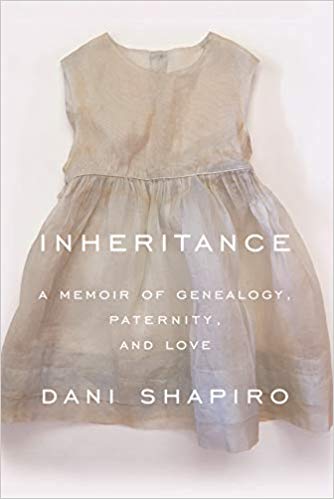
I was lucky enough to read an advance copy of her new memoir, Inheritance: A Memoir of Genealogy, Paternity, and Love and it took my breath away.  Run, don’t walk.  Order it now.  I’ll be giving to to many friends when it comes out early next year.  Inheritance tells the story of Dani’s discovery, in early 2016, that the father that she’d long adored, who died many years ago, was not her biological father (this is on the back of the book, so I’m not giving anything away).

The book starts with this revelation and unfolds as she learns more about her parents’ motivations and about her true biological background.  The story feels like a detective story, with a kind of breathless pacing that is for me new in Dani’s work.

The book centers around questions of identity.  Most saliently: what makes us who we are?  What combination of genetics, experience, loyalty, and love makes up our soul?  How do we wrestle with choices people made long ago that impact us deeply?  Particularly when the choosers are not here to talk to anymore?

Dani’s family – both the family she grew up with (though her parents are not living, there are other relatives who come into this story: cousins and half-siblings and an aunt) and the biological family she newly meets in midlife – mostly meet her revelations with candor and warmth, for which she is grateful.

Dani’s father was already a towering figure in her life, and he features in much of her writing before Inheritance.  As she says at the end of the book, “there has rare been an event of importance in my life when I have not searched for my father.”  His legacy of Orthodox Judaism forms is the through line of Devotion, and, arguably, of Dani’s life altogether.  This discovery about his role in her biological makeup is an earthquake for Dani, but, ultimately, it does not change the love they shared and the enormous influence he had on her.  Of course this is book hit me – another daughter hugely impacted by her father, in a moment of deep grief and awareness of that power – particularly right now.

The book unpacks complicated questions of agency and secrets, of what we share and why, as Dani thinks through who she is in the light of this new information.  Like in many of her books, I closed it with a deep sigh of relief and identification.  The thing I love most about Dani’s work is how beautifully, delicately, and honestly she describes what it’s like to live the questions, in Rilke’s words. She manages to take experience that is deeply, uniquely personal and use it to comment on universal themes of humanhood.  Dani’s done this in all of her books, in my opinion, and Inheritance is no different.

She lives the questions, without forcing an answer, and in that willingness inspires me profoundly.  There may not be perfect, clean answers – in the case of Inheritance, Dani will never truly know what her parents knew and why they chose this path – but that does not need to stand in the way of a rich, meaningful, and honest life.  The last lines of the book capture this beautifully as she stands before her biological family, thinking of the father of her childhood:

… I silently call to him, a Hebrew word – hineni.  Here I am.  Hineni, uttered only eight times in the entire Torah, is less a statement of personal geography than an expression of presence and pure attentiveness….I say it to my father, again and again.  Hineni.  I am here.  All of me. 

she’d missed them even as they’d been together

It was one of those moments Rebecca could sense the very revolution of the earth beneath her feet, its endless, determined spinning. The sounds of conversation merged into a noise that she’d miss, hours from then, when it was gone, when they’d all gone home, when the boys were in bed, when she padded around the house in her wool socks, eating leftover cake because there was still so much cake to be eaten, missing the people who were no longer there, and remembering that she’d missed them even as they’d been together in one room, around one table, talking about the future.

-Rumaan Alam, That Kind of Mother

Annus mirabilis

I’ve had the expression “annus mirabilis” running through my head lately and finally I turned to Google to discover its actual full meaning.  Many people have called 2017 an “annus horribilis” for our family and in some ways it definitely was.  But in fact “annus mirabilis” feels more accurate to me.

An annus mirabilis is “a Latin phrase that means “wonderful year”, “miraculous year” or “amazing year”. This term was originally used to refer to the year 1666, and today is used to refer to several years during which events of major importance are remembered.”

And you know what?  2017 definitely wasn’t wonderful, but it was amazing, in the I-was-amazed meaning of the word.  In the meaning that I read in Jeanne McCulloch’s All Happy Families: “Amazed: to fill with wonder.  Also: to bewilder.”  Our entire lives changed in 2017.  The year was full of wonder and bewilderment, in equal measure, I think.  The changes can be captured in twos:

Two new schools
Two new jobs
Two fathers (and grandfathers) gone

One of those new schools was a boarding school, so our family life took on a new shape.  One of those new jobs was a company that I helped to found, which has been an incredibly marvelous experience (and I’m so grateful that both Dad and John knew of that founding before they died).

Events of major importance?  No question.  2018 has been a year of fewer changes but no less emotion, which surprised me, truthfully. But when I step back and think about it, I guess it makes sense that there would be some settling in, some aftershocks, and so I think that’s what has been going on. The degree of both wonder and bewilderment that 2017 held were never going to resolve themselves neatly overnight when we stepped into 2018, a transition I recall as being fraught with emotion, even as it feels like a decade ago.

I am trying to give myself space and gentleness as I acknowledge that our annus mirabilis is taking longer to process than I anticipated.  Intellectually that makes sense.  Emotionally I want to be “me” again.  But even as I write that, I realize the futility of that wish: the me that began 2017 is gone, and I’m forever changed by the events of that year.  Wonder and bewilderment.  Annus mirabilis.  All these words resonate somewhere deep inside me, and I grab onto each.  But on some level I still feel lost in an inchoate place.

But I can’t stop thinking of annus mirabilis.  Maybe that’s my book.  It’s certainly where I am right now, and at least for a while still to come, I imagine.

we live in a perpetually burning building

The world is violent and mercurial – it will have its way with you.  We are saved only by love – love for each other and the love that we pour into the art we feel compelled to share: being a parent, being a writer, being a painter, being a friend. We live in a perpetually burning building and what we must save from it, all the time, is love.

-Tennessee Williams

Thank you to my friend A for sharing this perfect quotation with me.

How We Thought It Would Be

I’ve said before, and I’ll say again, that much of our suffering in this life is due to our attachment to how we thought it was going to be.  Put another way, I believe that one of the tasks of our lives is letting go of how we thought it would be.  What did you think, that isn’t so?  I’ll go first.

I thought my father would live to be in his nineties

I thought my daughter would go to my alma mater for high school

I thought I’d have published a book or two by now

I could keep going.  For a long time.  That’s not really news to me. What’s news is that when I think about it, I realize that I don’t dwell on these things.  Well, maybe my dad.  That one I still rue daily.  But maybe I’m growing into maturity, because at this point I can recognize these truths I thought would describe my life without pain.   How did that happen?  I’m not sure.  I wish I could pinpoint when the “what…ifs” stopped, but I can’t.  I do know that it’s releasing them that’s allowed a whole-hearted embrace of the reality of my life.

By letting go of our attachment to what might have been, we can embrace what is.  I know that is true. There’s no question that there’s a list equally as long as the things I thought would be true, and that’s the list of things that I didn’t expect.  Some of those surprises have been pleasant, some dazzling, and some heartbreaking.  But they represent the reality of life right now, and there’s room for them because of all the things that aren’t as I hoped, planned, or imagined.  So the task, I’m quite sure, is to let go of the latter so that we might let in the former. It feels like this is all going to happen anyway – what isn’t as we thought it would be isn’t, and what is, is – so the only question is how gracefully we can allow these things to be.

Easier said than done, but I seem to be moving in that direction.  Maybe the letting go comes with circumstances out of my control showing me how little the fretting and holding on helps me.  Maybe it’s just an inevitable development with middle age.  I don’t know.  I’m pretty sure it’s nothing I’ve done, and no comment on me in particular.  But I’m grateful for it.

What did you think would be, that isn’t?   And do you have any lessons about letting go of those things?